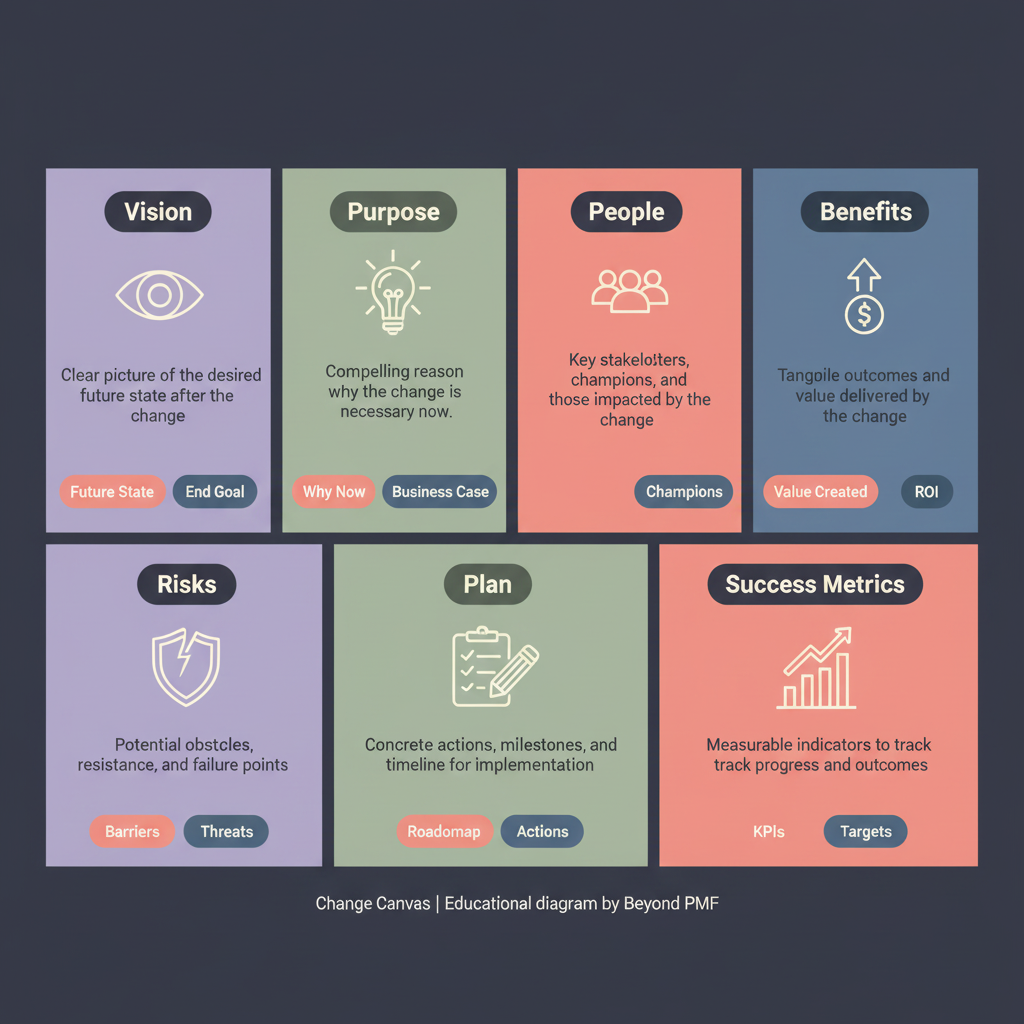
Change Canvas

The Change Canvas focuses on mapping out changes and their impacts, suggesting it aids in planning and coordinating implementation. This highlights its use in managing processes and workflows related to organizational change.

The Change Canvas framework serves as a strategic tool for organizations undergoing transformation. It helps teams visualize and plan change initiatives, ensuring alignment and understanding across all stakeholders. By breaking down the change process into manageable components, the Change Canvas aids in identifying key areas of impact, resources needed, and potential resistance, thereby streamlining the implementation of change.

Steps / Detailed Description

Identify the need for change and define the change objectives. | Map out the current state and the desired future state. | Identify stakeholders and define their roles and responsibilities. | Outline key actions, timelines, and resources required for each stage of the change. | Develop communication strategies to engage stakeholders and manage resistance. | Monitor progress and make adjustments as necessary.

Best Practices

Involve all relevant stakeholders from the beginning to ensure buy-in. | Regularly update the canvas to reflect changes and learnings. | Use the canvas as a communication tool to keep everyone informed and engaged.

Pros

Provides a clear visual representation of the change process. | Facilitates better communication and alignment among stakeholders. | Helps in identifying potential obstacles and planning accordingly.

Cons

Can be overly simplistic for complex change initiatives. | Requires buy-in from all levels of the organization to be effective. | May not be flexible enough to accommodate unexpected changes in strategy.

When to Use

When initiating any major change within an organization. | When trying to align multiple departments or teams towards a common change goal.

When Not to Use

For very small or incremental changes that do not require extensive planning. | When the organization lacks the resources to engage with the framework fully.

Related Frameworks

Lifecycle

Scope

Scope not defined

Maturity Level

Maturity level not specified

Time to Implement

2–4 Weeks
3–6 Months
1–2 Weeks
3–6 Months
1–2 Months
3–6 Months
1–2 Weeks
Less Than 1 Day
1–2 Weeks
Longer Than 6 Months
1–2 Weeks
Longer Than 6 Months
1–2 Weeks
3–6 Months
1–2 Weeks
1–2 Weeks
1–2 Weeks
1–2 Weeks
1–2 Days
1–2 Weeks
1–2 Weeks
1–2 Weeks
1–2 Weeks
1–2 Weeks
1–2 Weeks
3–6 Months
1–2 Weeks
1–2 Weeks
1–2 Weeks
3–6 Months
1–2 Weeks
1–2 Weeks
2–4 Weeks
1–2 Weeks
1–2 Days
1–2 Weeks
Longer Than 6 Months
3–6 Months
Longer Than 6 Months
1–2 Weeks
Longer Than 6 Months
3–6 Months
Less Than 1 Day
3–6 Months
1–2 Months
3–6 Months
Longer Than 6 Months
3–6 Months
Less Than 1 Day
1–2 Weeks
3–6 Months
3–6 Months
1–2 Weeks
3–6 Months
1–2 Weeks
1–2 Weeks
1–2 Days
1–2 Weeks
1–2 Months
Longer Than 6 Months
1–2 Weeks
Longer Than 6 Months
1–2 Weeks
3–6 Months
1–2 Weeks
Less Than 1 Day
1–2 Weeks
3–6 Months
1–2 Weeks
3–6 Months
1–2 Weeks
1–2 Weeks
Longer Than 6 Months
Less Than 1 Day
3–6 Months
Longer Than 6 Months
1–2 Months
1–2 Weeks
Longer Than 6 Months
1–2 Weeks
3–6 Months
1–2 Weeks
1–2 Weeks
3–6 Months
Less Than 1 Day
1–2 Weeks
1–2 Weeks
3–6 Months
3–6 Months
Less Than 1 Day
1–2 Weeks
Longer Than 6 Months
1–2 Months
1–2 Weeks
1–2 Weeks
1–2 Weeks
Longer Than 6 Months

Copyright Information

Autor:
Unknown
N/A
Publication:
Unknown