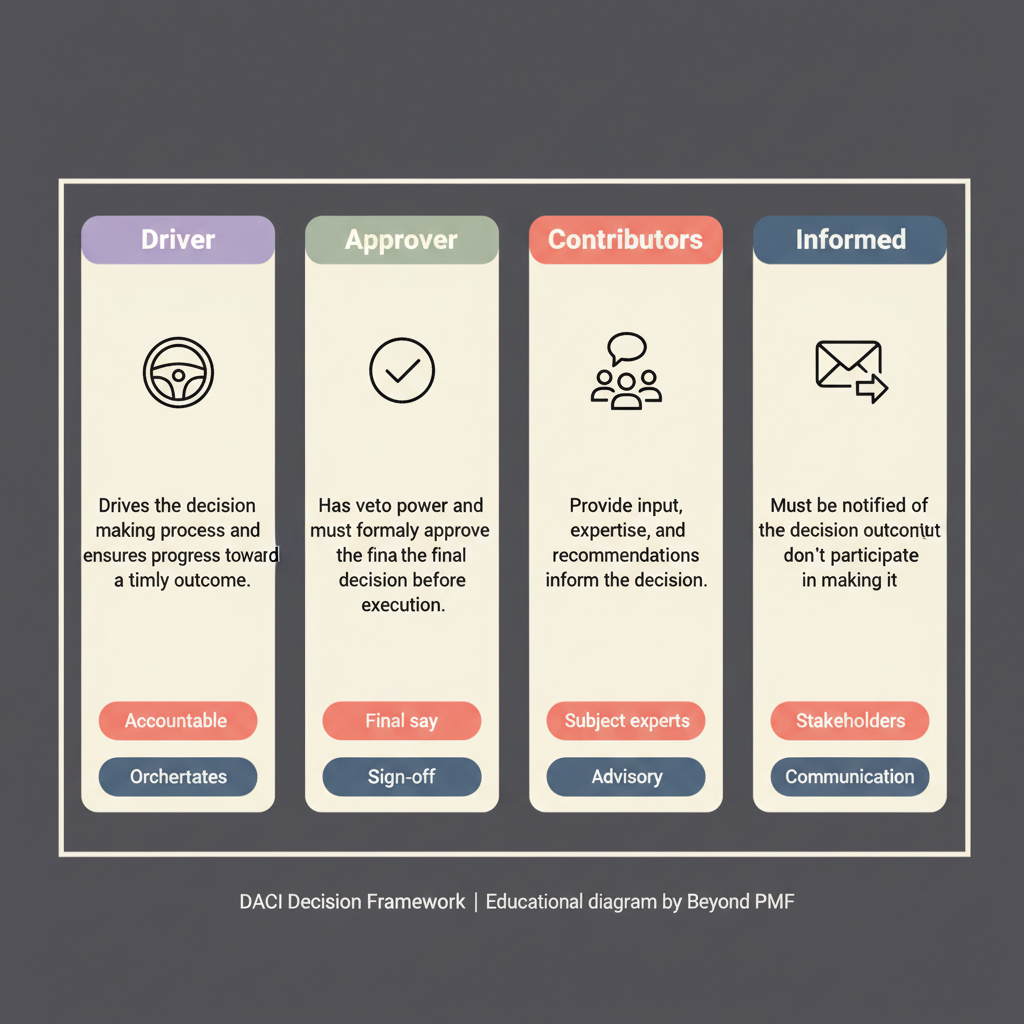
DACI Decision Framework

https://ik.imagekit.io/beyondpmf/frameworks/daci-decision-framework.png
The DACI framework addresses the friction of unclear ownership and roles in decision-making. By assigning clear responsibilities (Driver, Approver, Contributor, Informed) it helps overcome issues arising from ambiguous accountability and team structure.

The DACI Decision Framework is a decision-making model designed to enhance clarity and efficiency in team decisions. It assigns specific roles to team members, ensuring that everyone knows their responsibilities during the decision-making process. The framework is used to speed up decision-making, reduce confusion, and improve the overall quality of decisions by making clear who is responsible for what. It is particularly beneficial in complex projects or environments where decisions need to be made quickly and efficiently.

Steps / Detailed Description

Define the problem or decision to be made. | Assign the following roles: Driver, Approver, Contributors, and Informed. | Conduct necessary research and gather input from Contributors. | Driver synthesizes the input and proposes a decision. | Approver reviews the proposal and makes the final decision. | Communicate the decision to all relevant parties, especially those Informed.

Best Practices

Clearly define and communicate the roles to all team members before starting the process. | Ensure the Driver is skilled in project management and communication. | Regularly review and adjust the roles and process to fit the team and tasks.

Pros

Clarifies roles and responsibilities within the decision-making process. | Speeds up the decision-making process by reducing ambiguity. | Improves decision quality through structured input and review.

Cons

Can be overly rigid in dynamic or fast-changing environments. | May not be suitable for all types of decisions, particularly those requiring creative input. | Risk of dependency on specific individuals in assigned roles.

When to Use

When making complex business decisions involving multiple stakeholders. | In project management scenarios where clear roles and structured decision-making are needed.

When Not to Use

In highly creative processes where flexibility is more valuable than structure. | When quick, autonomous decisions are needed without group input.

Related Frameworks

Lifecycle

Scope

Scope not defined

Maturity Level

Maturity level not specified

Time to Implement

2–4 Weeks
3–6 Months
1–2 Weeks
3–6 Months
1–2 Months
3–6 Months
1–2 Weeks
Less Than 1 Day
1–2 Weeks
Longer Than 6 Months
1–2 Weeks
Longer Than 6 Months
1–2 Weeks
3–6 Months
1–2 Weeks
1–2 Weeks
1–2 Weeks
1–2 Weeks
1–2 Days
1–2 Weeks
1–2 Weeks
1–2 Weeks
1–2 Weeks
1–2 Weeks
1–2 Weeks
3–6 Months
1–2 Weeks
1–2 Weeks
1–2 Weeks
3–6 Months
1–2 Weeks
1–2 Weeks
2–4 Weeks
1–2 Weeks
1–2 Days
1–2 Weeks
Longer Than 6 Months
3–6 Months
Longer Than 6 Months
1–2 Weeks
Longer Than 6 Months
3–6 Months
Less Than 1 Day
3–6 Months
1–2 Months
3–6 Months
Longer Than 6 Months
3–6 Months
Less Than 1 Day
1–2 Weeks
3–6 Months
3–6 Months
1–2 Weeks
3–6 Months
1–2 Weeks
1–2 Weeks
1–2 Days
1–2 Weeks
1–2 Months
Longer Than 6 Months
1–2 Weeks
Longer Than 6 Months
1–2 Weeks
3–6 Months
1–2 Weeks
Less Than 1 Day
1–2 Weeks
3–6 Months
1–2 Weeks
3–6 Months
1–2 Weeks
1–2 Weeks
Longer Than 6 Months
Less Than 1 Day
3–6 Months
Longer Than 6 Months
1–2 Months
1–2 Weeks
Longer Than 6 Months
1–2 Weeks
3–6 Months
1–2 Weeks
1–2 Weeks
3–6 Months
Less Than 1 Day
1–2 Weeks
1–2 Weeks
3–6 Months
3–6 Months
Less Than 1 Day
1–2 Weeks
Longer Than 6 Months
1–2 Months
1–2 Weeks
1–2 Weeks
1–2 Weeks
Longer Than 6 Months

Copyright Information

Autor:
Public Domain
N/A
Publication:
Generic Business Tool