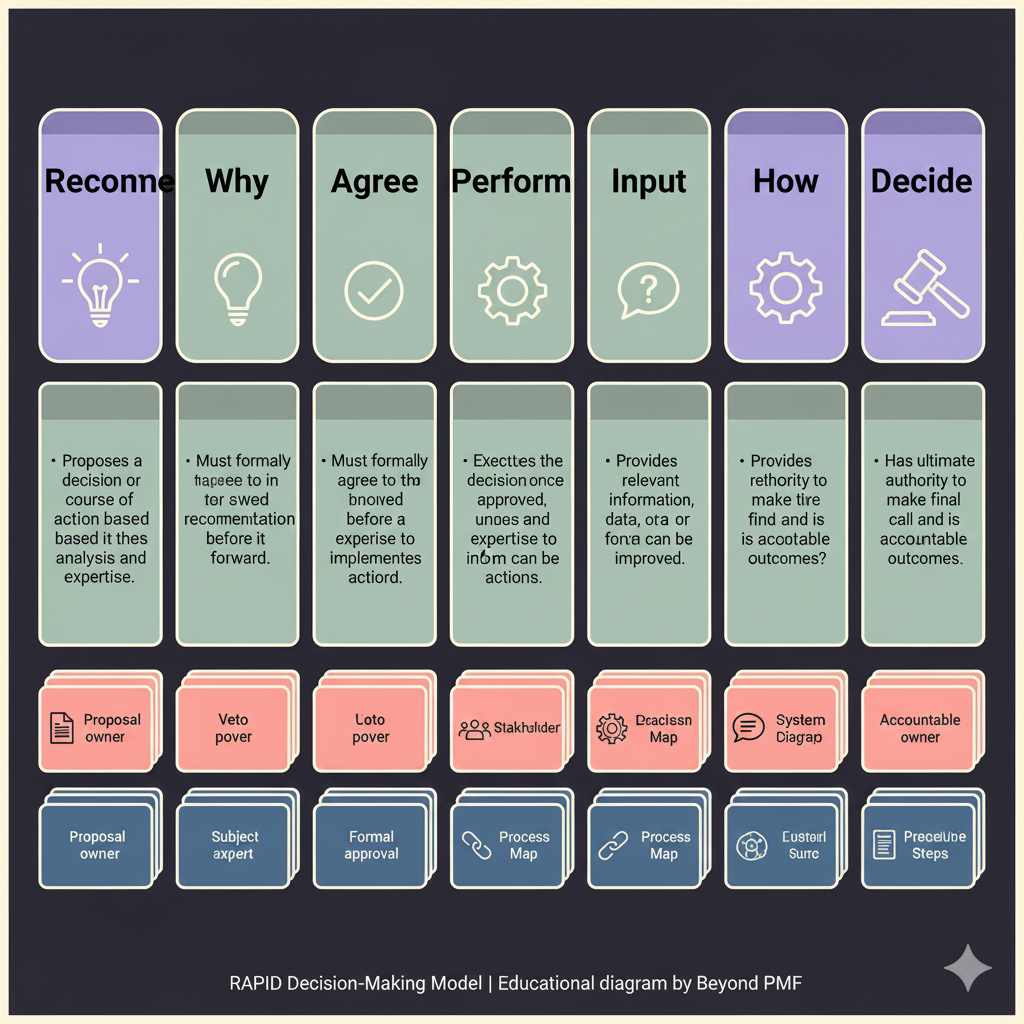
RAPID Decision-Making Model

https://ik.imagekit.io/beyondpmf/frameworks/rapid-decision-making-model.png
The RAPID model focuses on clarifying roles and streamlining the decision-making process. This directly addresses friction caused by unclear ownership, lack of accountability, and misalignment within the organizational structure.

The RAPID Decision-Making Model is a framework designed to assign clear roles and responsibilities to different stakeholders in the decision-making process. It stands for Recommend, Agree, Perform, Input, and Decide. The model helps organizations make decisions efficiently and effectively by clarifying who is accountable for what decisions. It is particularly beneficial in complex environments where multiple stakeholders are involved.

Steps / Detailed Description

Recommend: Identifies who is responsible for making recommendations on the decision at hand. | Agree: Specifies who must agree to the recommendations before moving forward. | Perform: Defines who actually performs the tasks upon decision approval. | Input: Determines who provides necessary information and who must be consulted. | Decide: Pinpoints the person with the authority to make the final decision.

Best Practices

Clearly define and communicate roles | Ensure all stakeholders understand the model | Regularly review and adjust roles as needed

Pros

Clarifies roles and responsibilities | Speeds up the decision-making process | Enhances accountability and transparency

Cons

Can be bureaucratic if not implemented flexibly | May lead to delays if roles are not clearly defined | Potential for conflict over role assignments

When to Use

In complex projects involving multiple stakeholders | When clarity in decision-making roles is needed

When Not to Use

In small teams where decision-making is straightforward | When quick, informal decision-making is required

Related Frameworks

Lifecycle

Scope

Scope not defined

Maturity Level

Maturity level not specified

Time to Implement

2–4 Weeks
3–6 Months
1–2 Weeks
3–6 Months
1–2 Months
3–6 Months
1–2 Weeks
Less Than 1 Day
1–2 Weeks
Longer Than 6 Months
1–2 Weeks
Longer Than 6 Months
1–2 Weeks
3–6 Months
1–2 Weeks
1–2 Weeks
1–2 Weeks
1–2 Weeks
1–2 Days
1–2 Weeks
1–2 Weeks
1–2 Weeks
1–2 Weeks
1–2 Weeks
1–2 Weeks
3–6 Months
1–2 Weeks
1–2 Weeks
1–2 Weeks
3–6 Months
1–2 Weeks
1–2 Weeks
2–4 Weeks
1–2 Weeks
1–2 Days
1–2 Weeks
Longer Than 6 Months
3–6 Months
Longer Than 6 Months
1–2 Weeks
Longer Than 6 Months
3–6 Months
Less Than 1 Day
3–6 Months
1–2 Months
3–6 Months
Longer Than 6 Months
3–6 Months
Less Than 1 Day
1–2 Weeks
3–6 Months
3–6 Months
1–2 Weeks
3–6 Months
1–2 Weeks
1–2 Weeks
1–2 Days
1–2 Weeks
1–2 Months
Longer Than 6 Months
1–2 Weeks
Longer Than 6 Months
1–2 Weeks
3–6 Months
1–2 Weeks
Less Than 1 Day
1–2 Weeks
3–6 Months
1–2 Weeks
3–6 Months
1–2 Weeks
1–2 Weeks
Longer Than 6 Months
Less Than 1 Day
3–6 Months
Longer Than 6 Months
1–2 Months
1–2 Weeks
Longer Than 6 Months
1–2 Weeks
3–6 Months
1–2 Weeks
1–2 Weeks
3–6 Months
Less Than 1 Day
1–2 Weeks
1–2 Weeks
3–6 Months
3–6 Months
Less Than 1 Day
1–2 Weeks
Longer Than 6 Months
1–2 Months
1–2 Weeks
1–2 Weeks
1–2 Weeks
Longer Than 6 Months

Copyright Information

Autor:
Unkown
N/A
Publication:
Unknown