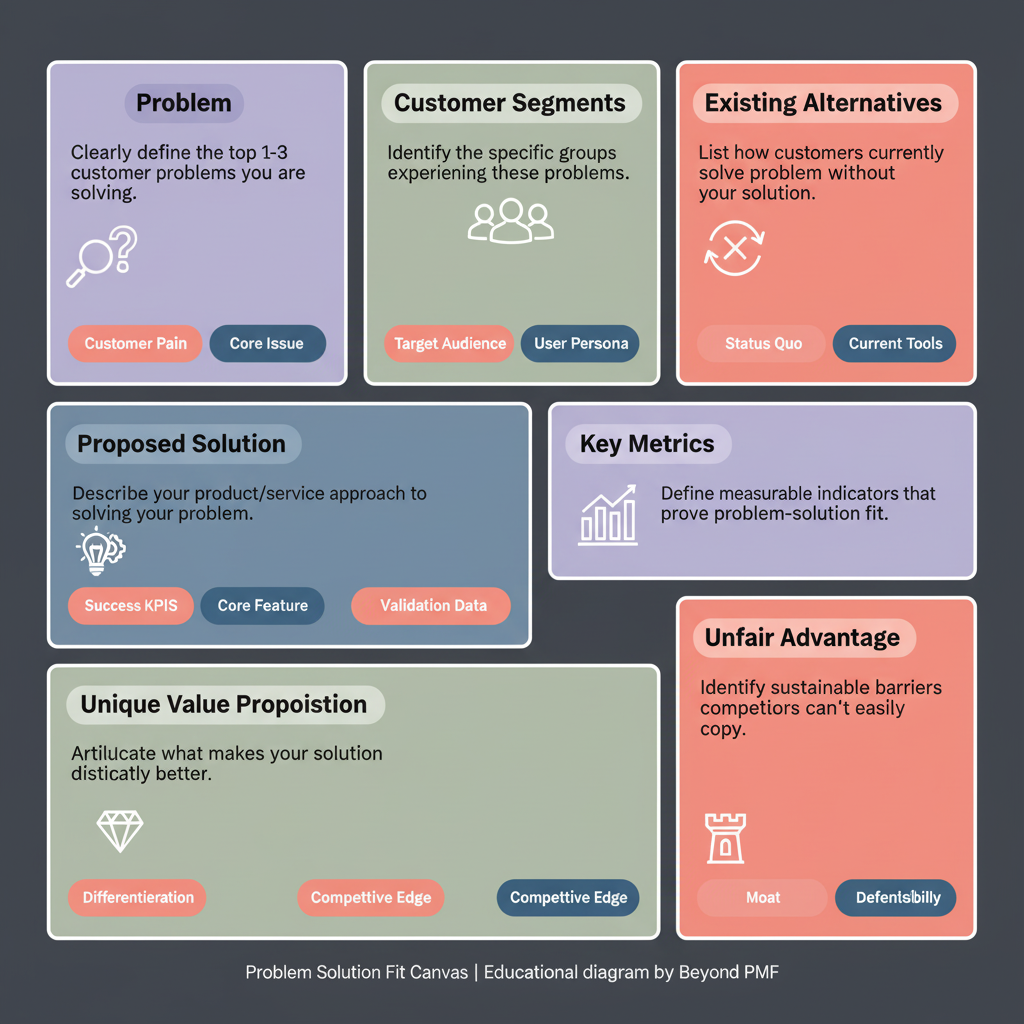
Problem Solution Fit Canvas

The Problem Solution Fit Canvas primarily addresses the strategic friction of ensuring a product or service aligns with customer needs and market opportunities. It helps businesses avoid building solutions for non-existent problems, ensuring a clear direction and market alignment.

The Problem Solution Fit Canvas is a framework designed to help businesses identify and align customer problems with effective solutions. It serves as a visual tool to map out customer needs, the proposed solutions, and the expected impact. This framework is particularly beneficial for startups and existing businesses looking to innovate or improve their product offerings, ensuring that the solutions developed are directly addressing the real issues faced by their customers.

Steps / Detailed Description

Identify the customer segment: Define who your customers are and segment them based on specific characteristics. | Outline customer problems: List down the problems your identified customer segments are facing. | Propose solutions: Brainstorm and document potential solutions that can address these problems. | Validate problem-solution fit: Test the proposed solutions with actual customers to see if they effectively solve the problems. | Iterate based on feedback: Refine the solutions based on customer feedback and testing results.

Best Practices

Engage directly with customers for accurate problem identification | Use iterative testing to refine solutions | Keep the canvas dynamic and update it as you gather more insights

Pros

Ensures alignment between customer needs and solutions | Facilitates targeted innovation | Increases the likelihood of product-market fit

Cons

Can be time-consuming | Requires accurate customer insights | May lead to biases if not properly validated

When to Use

During the initial stages of product development | When pivoting or redefining product offerings

When Not to Use

When the market and customer needs are already well understood | In later stages of product development where major pivots are risky

Related Frameworks

Scope

Scope not defined

Maturity Level

Maturity level not specified

Time to Implement

2–4 Weeks
3–6 Months
1–2 Weeks
3–6 Months
1–2 Months
3–6 Months
1–2 Weeks
Less Than 1 Day
1–2 Weeks
Longer Than 6 Months
1–2 Weeks
Longer Than 6 Months
1–2 Weeks
3–6 Months
1–2 Weeks
1–2 Weeks
1–2 Weeks
1–2 Weeks
1–2 Days
1–2 Weeks
1–2 Weeks
1–2 Weeks
1–2 Weeks
1–2 Weeks
1–2 Weeks
3–6 Months
1–2 Weeks
1–2 Weeks
1–2 Weeks
3–6 Months
1–2 Weeks
1–2 Weeks
2–4 Weeks
1–2 Weeks
1–2 Days
1–2 Weeks
Longer Than 6 Months
3–6 Months
Longer Than 6 Months
1–2 Weeks
Longer Than 6 Months
3–6 Months
Less Than 1 Day
3–6 Months
1–2 Months
3–6 Months
Longer Than 6 Months
3–6 Months
Less Than 1 Day
1–2 Weeks
3–6 Months
3–6 Months
1–2 Weeks
3–6 Months
1–2 Weeks
1–2 Weeks
1–2 Days
1–2 Weeks
1–2 Months
Longer Than 6 Months
1–2 Weeks
Longer Than 6 Months
1–2 Weeks
3–6 Months
1–2 Weeks
Less Than 1 Day
1–2 Weeks
3–6 Months
1–2 Weeks
3–6 Months
1–2 Weeks
1–2 Weeks
Longer Than 6 Months
Less Than 1 Day
3–6 Months
Longer Than 6 Months
1–2 Months
1–2 Weeks
Longer Than 6 Months
1–2 Weeks
3–6 Months
1–2 Weeks
1–2 Weeks
3–6 Months
Less Than 1 Day
1–2 Weeks
1–2 Weeks
3–6 Months
3–6 Months
Less Than 1 Day
1–2 Weeks
Longer Than 6 Months
1–2 Months
1–2 Weeks
1–2 Weeks
1–2 Weeks
Longer Than 6 Months

Copyright Information

Autor:
Unknown
N/A
Publication:
Unknown