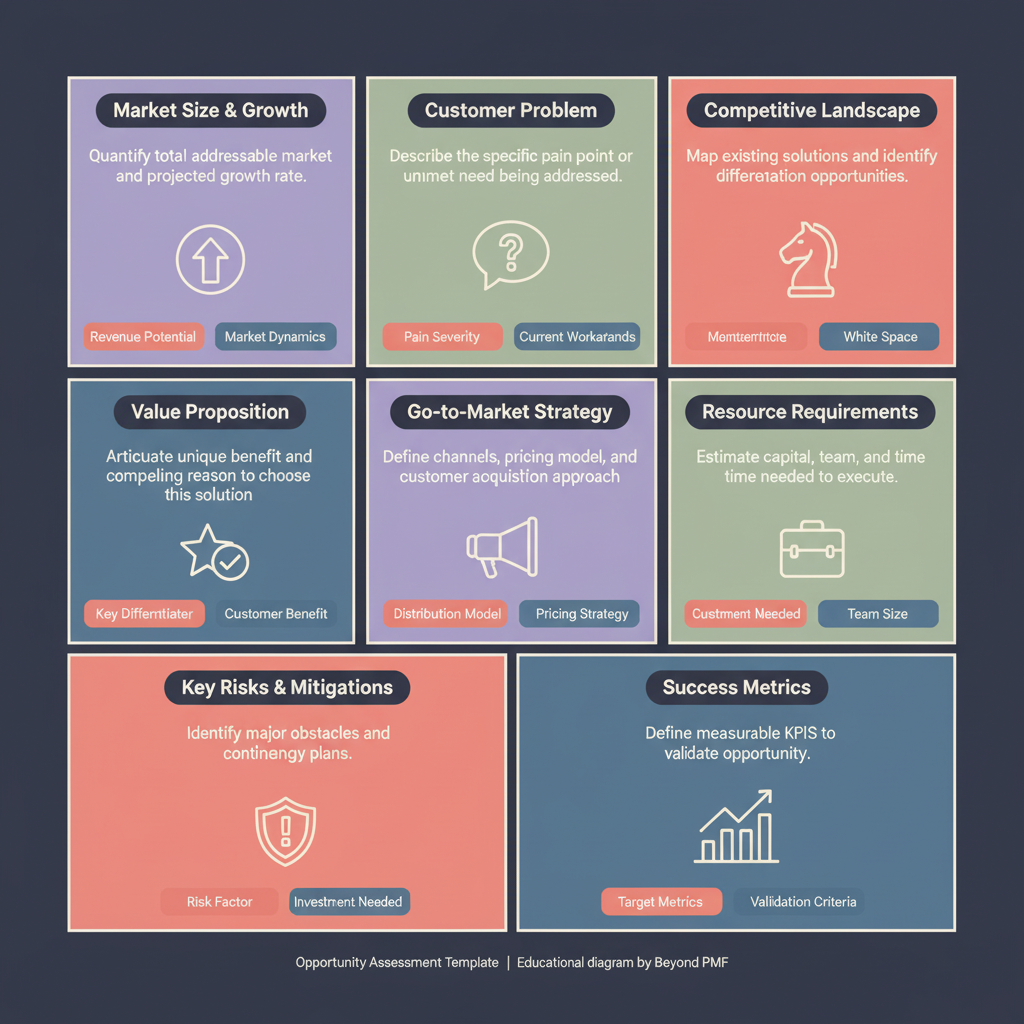
Opportunity Assessment Template

The Opportunity Assessment Template primarily addresses strategic friction by providing a structured approach to evaluate potential business opportunities. It helps organizations assess market alignment, potential business models, and overall strategic direction before committing resources.

The Opportunity Assessment Template is a strategic tool used by businesses to analyze and evaluate potential opportunities before committing resources. This framework guides decision-makers through a structured process to assess the viability, risks, and benefits of new ventures or projects. It helps in making informed decisions by providing a clear methodology to quantify and qualify potential opportunities.

Steps / Detailed Description

Identify the opportunity: Define the business opportunity and its scope. | Market analysis: Conduct a thorough analysis of the market, including size, growth, and competition. | Financial assessment: Evaluate the financial viability including potential revenue, costs, and profitability. | Risk assessment: Identify and analyze potential risks associated with the opportunity. | Strategic fit: Assess how well the opportunity aligns with the organization's strategic goals and resources. | Decision making: Compile findings and make a recommendation based on the assessment.

Best Practices

Involve stakeholders from different departments for a holistic view | Regularly update the data used in the assessment to maintain accuracy | Use both qualitative and quantitative data for a comprehensive analysis

Pros

Provides a systematic approach to evaluating opportunities | Helps minimize risks associated with new ventures | Aligns opportunities with strategic business goals

Cons

Can be time-consuming | May require specialized knowledge or external expertise | Potentially overlooks non-quantifiable factors

When to Use

Considering entering a new market | Evaluating the potential of a new product or service

When Not to Use

When quick, intuitive decision-making is required | In highly uncertain or rapidly changing markets where data may quickly become outdated

Related Frameworks

Scope

Scope not defined

Maturity Level

Maturity level not specified

Time to Implement

2–4 Weeks
3–6 Months
1–2 Weeks
3–6 Months
1–2 Months
3–6 Months
1–2 Weeks
Less Than 1 Day
1–2 Weeks
Longer Than 6 Months
1–2 Weeks
Longer Than 6 Months
1–2 Weeks
3–6 Months
1–2 Weeks
1–2 Weeks
1–2 Weeks
1–2 Weeks
1–2 Days
1–2 Weeks
1–2 Weeks
1–2 Weeks
1–2 Weeks
1–2 Weeks
1–2 Weeks
3–6 Months
1–2 Weeks
1–2 Weeks
1–2 Weeks
3–6 Months
1–2 Weeks
1–2 Weeks
2–4 Weeks
1–2 Weeks
1–2 Days
1–2 Weeks
Longer Than 6 Months
3–6 Months
Longer Than 6 Months
1–2 Weeks
Longer Than 6 Months
3–6 Months
Less Than 1 Day
3–6 Months
1–2 Months
3–6 Months
Longer Than 6 Months
3–6 Months
Less Than 1 Day
1–2 Weeks
3–6 Months
3–6 Months
1–2 Weeks
3–6 Months
1–2 Weeks
1–2 Weeks
1–2 Days
1–2 Weeks
1–2 Months
Longer Than 6 Months
1–2 Weeks
Longer Than 6 Months
1–2 Weeks
3–6 Months
1–2 Weeks
Less Than 1 Day
1–2 Weeks
3–6 Months
1–2 Weeks
3–6 Months
1–2 Weeks
1–2 Weeks
Longer Than 6 Months
Less Than 1 Day
3–6 Months
Longer Than 6 Months
1–2 Months
1–2 Weeks
Longer Than 6 Months
1–2 Weeks
3–6 Months
1–2 Weeks
1–2 Weeks
3–6 Months
Less Than 1 Day
1–2 Weeks
1–2 Weeks
3–6 Months
3–6 Months
Less Than 1 Day
1–2 Weeks
Longer Than 6 Months
1–2 Months
1–2 Weeks
1–2 Weeks
1–2 Weeks
Longer Than 6 Months

Copyright Information

Autor:
Public Domain
N/A
Publication:
Generic Business Tool