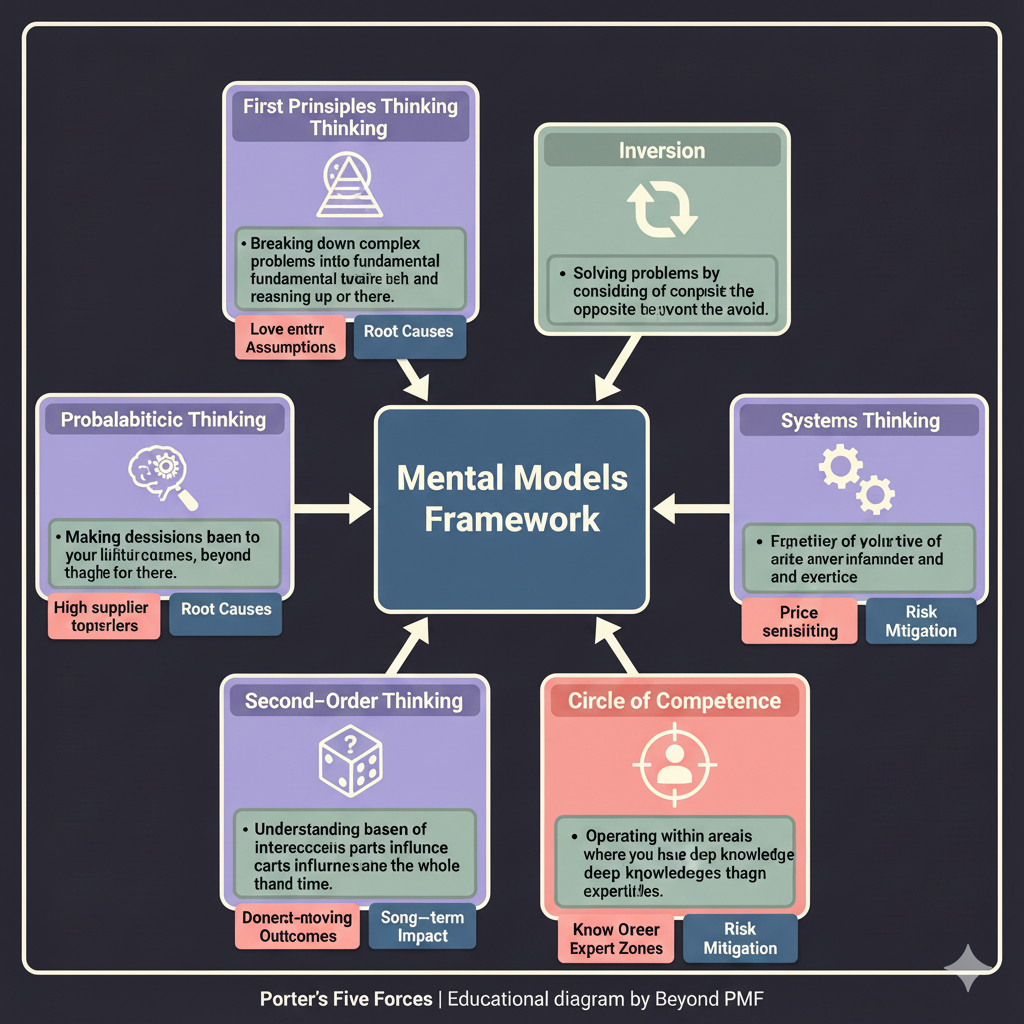
The Mental Models Framework involves understanding and applying simplified representations of the world to improve decision-making and problem-solving. It is used to enhance clarity and efficiency in thinking, allowing users to predict outcomes more accurately and plan future actions effectively. The framework is beneficial for its ability to facilitate deeper understanding, foster innovation, and improve strategic planning across various contexts.
Identify the problem or decision context. | Gather existing mental models relevant to the context. | Analyze and challenge these models to identify biases or gaps. | Synthesize new, refined mental models based on insights. | Apply the new models to make decisions or solve problems. | Continuously update and refine models as new information arises.
Regularly review and challenge your mental models | Combine multiple mental models to avoid narrow perspectives | Stay informed about new information and perspectives
Improves decision-making accuracy | Enhances problem-solving capabilities | Facilitates faster understanding of complex situations
Risk of oversimplification | Dependence on the user's prior knowledge and biases | Potential for outdated models if not regularly updated
Strategic planning and decision-making | Complex problem-solving
Highly quantitative or data-driven decisions requiring precise calculations | Situations where detailed, specific information is crucial