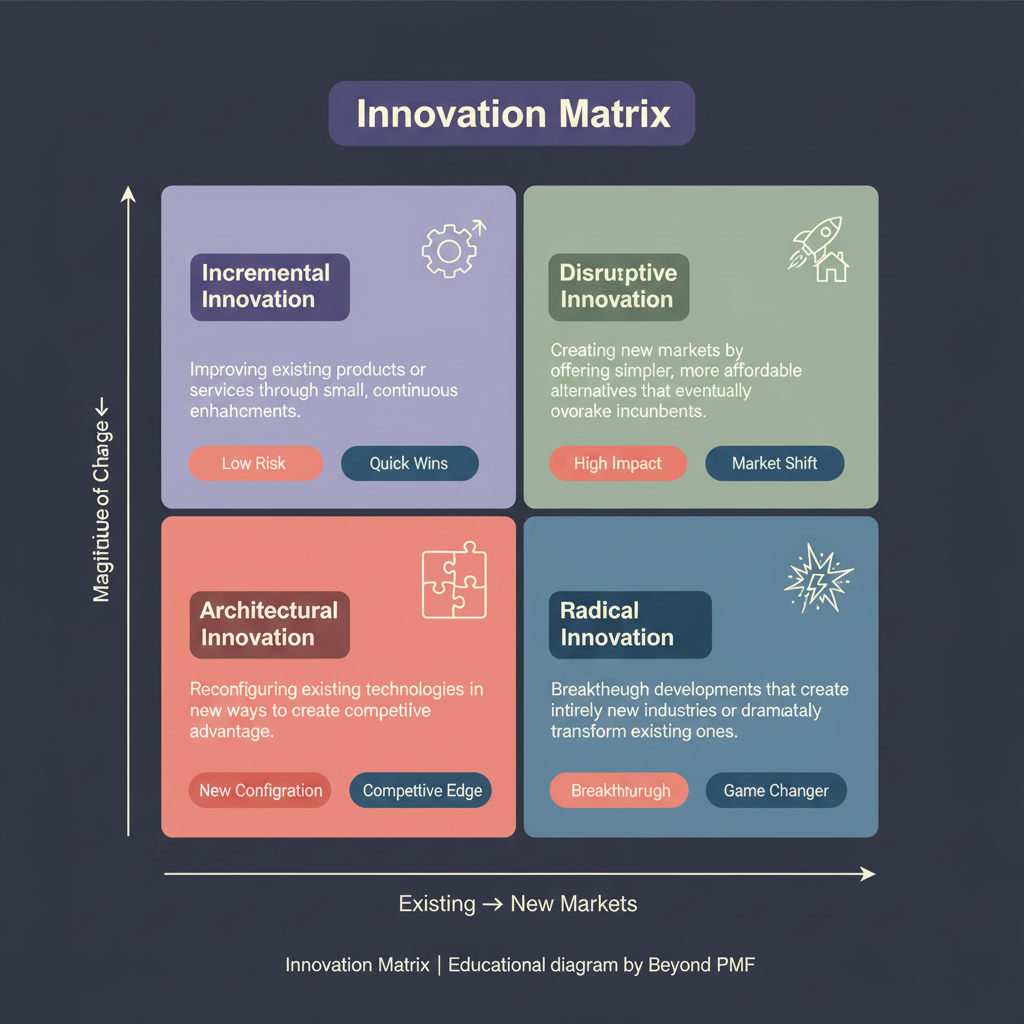
Innovation Matrix

https://ik.imagekit.io/beyondpmf/frameworks/innovation-matrix.png
The Innovation Matrix helps prioritize innovation efforts. It addresses strategic friction by providing a framework to align innovation initiatives with their novelty and implementation complexity, thus assisting in making choices about strategic focus and resource allocation.

The Innovation Matrix is a strategic framework that helps organizations map out their innovation efforts. It categorizes innovations into different types based on their level of novelty and the complexity of their implementation. This framework assists in prioritizing projects and allocating resources effectively, ensuring that innovation aligns with overall business goals. It is widely used for its ability to simplify decision-making processes in innovation management and enhance strategic planning.

Steps / Detailed Description

Identify and list all current and potential innovation projects. | Categorize each innovation based on its level of novelty (incremental, radical, disruptive). | Assess the implementation complexity of each innovation (simple, moderate, complex). | Plot the innovations on the matrix according to their categorized novelty and complexity. | Analyze the matrix to determine prioritization, resource allocation, and strategic planning.

Best Practices

Regularly update the matrix to reflect changes in the innovation landscape | Involve cross-functional teams in the categorization process | Use the matrix as a guide, not a strict rulebook

Pros

Provides a clear visualization of innovation efforts | Helps in prioritizing projects based on strategic importance | Facilitates better allocation of resources

Cons

May oversimplify the complexities of some innovations | Can be subjective in categorizing novelty and complexity | Requires regular updates as project scopes and environments change

When to Use

When needing to prioritize multiple innovation projects | During strategic planning sessions to align innovation with business goals

When Not to Use

For very small or static organizations with limited innovation activities | When innovation projects cannot be clearly categorized by novelty or complexity

Related Frameworks

Scope

Scope not defined

Maturity Level

Maturity level not specified

Time to Implement

2–4 Weeks
3–6 Months
1–2 Weeks
3–6 Months
1–2 Months
3–6 Months
1–2 Weeks
Less Than 1 Day
1–2 Weeks
Longer Than 6 Months
1–2 Weeks
Longer Than 6 Months
1–2 Weeks
3–6 Months
1–2 Weeks
1–2 Weeks
1–2 Weeks
1–2 Weeks
1–2 Days
1–2 Weeks
1–2 Weeks
1–2 Weeks
1–2 Weeks
1–2 Weeks
1–2 Weeks
3–6 Months
1–2 Weeks
1–2 Weeks
1–2 Weeks
3–6 Months
1–2 Weeks
1–2 Weeks
2–4 Weeks
1–2 Weeks
1–2 Days
1–2 Weeks
Longer Than 6 Months
3–6 Months
Longer Than 6 Months
1–2 Weeks
Longer Than 6 Months
3–6 Months
Less Than 1 Day
3–6 Months
1–2 Months
3–6 Months
Longer Than 6 Months
3–6 Months
Less Than 1 Day
1–2 Weeks
3–6 Months
3–6 Months
1–2 Weeks
3–6 Months
1–2 Weeks
1–2 Weeks
1–2 Days
1–2 Weeks
1–2 Months
Longer Than 6 Months
1–2 Weeks
Longer Than 6 Months
1–2 Weeks
3–6 Months
1–2 Weeks
Less Than 1 Day
1–2 Weeks
3–6 Months
1–2 Weeks
3–6 Months
1–2 Weeks
1–2 Weeks
Longer Than 6 Months
Less Than 1 Day
3–6 Months
Longer Than 6 Months
1–2 Months
1–2 Weeks
Longer Than 6 Months
1–2 Weeks
3–6 Months
1–2 Weeks
1–2 Weeks
3–6 Months
Less Than 1 Day
1–2 Weeks
1–2 Weeks
3–6 Months
3–6 Months
Less Than 1 Day
1–2 Weeks
Longer Than 6 Months
1–2 Months
1–2 Weeks
1–2 Weeks
1–2 Weeks
Longer Than 6 Months

Copyright Information

Autor:
Public Domain
N/A
Publication:
Generic Business Tool