Opportunity Solution Tree

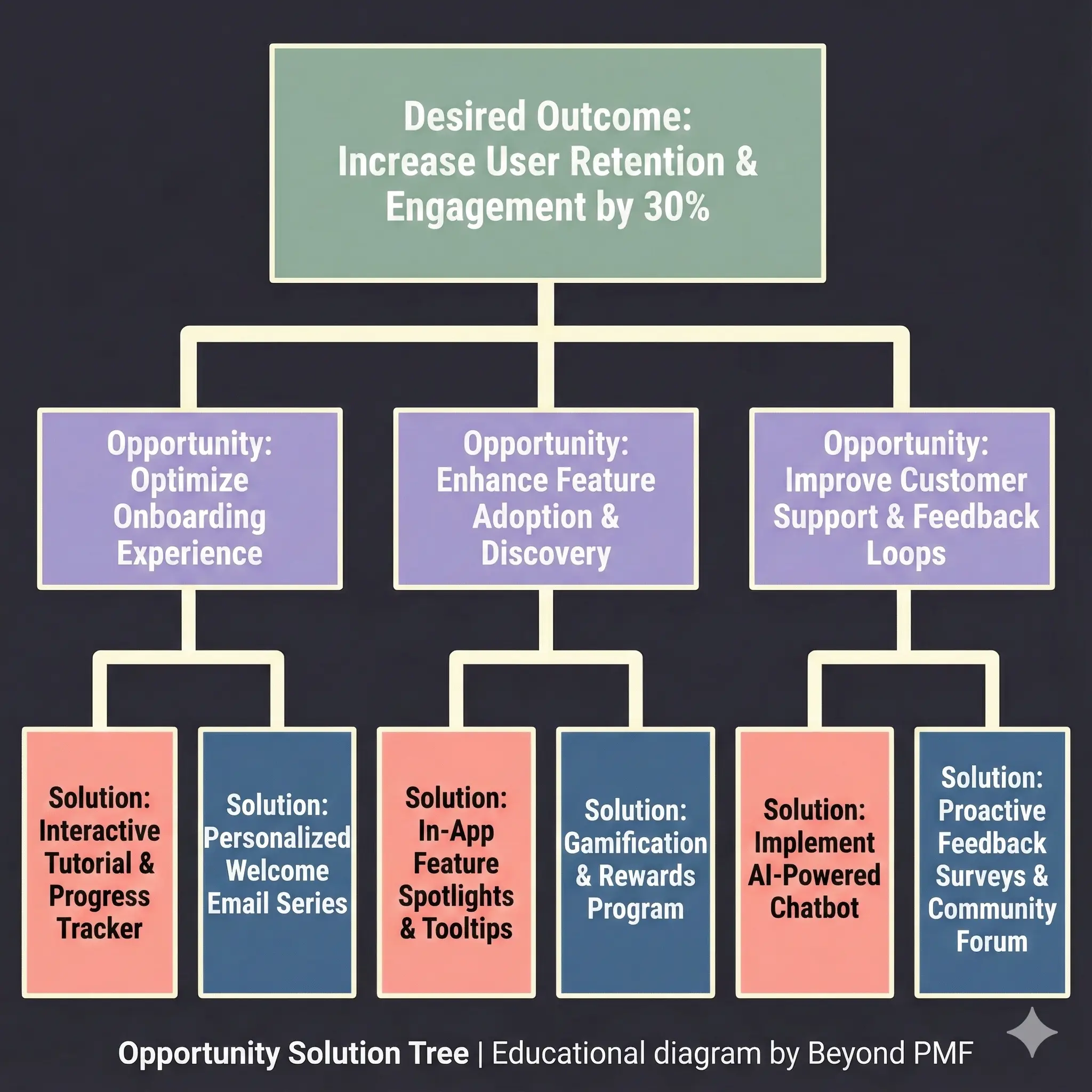
Diagram of an Opportunity Solution Tree showing a desired outcomeβ€”β€˜Increase user retention and engagement by 30%’—at the top, branching into three opportunities: optimize onboarding, enhance feature adoption, and improve customer support. Each opportunity connects to specific solutions such as interactive tutorials, welcome email series, feature spotlights, gamification, AI chatbots, and feedback surveys.
The Opportunity Solution Tree helps teams focus on customer needs and map out solutions, which directly impacts customer experience. This framework addresses the friction associated with translating problems into effective, customer-centric solutions.

The Opportunity Solution Tree is a strategic tool used by teams to identify and explore multiple opportunities that could solve a customer problem. It starts with a clear desired outcome and branches out into opportunities and then into solutions, helping teams prioritize based on impact and feasibility. This framework encourages broad thinking, followed by a narrowing down process, ensuring that the final solutions are both innovative and closely aligned with user needs.

Steps / Detailed Description

Define the desired outcome: Clearly articulate the end goal or problem to be solved. | Identify opportunities: Brainstorm and list potential opportunities that could lead to achieving the desired outcome. | Generate solutions: For each opportunity, develop multiple potential solutions. | Prioritize paths: Evaluate and prioritize the opportunities and solutions based on criteria such as impact and feasibility.

Best Practices

Start with a clear and well-defined desired outcome | Involve diverse team members in the brainstorming process | Regularly review and refine the tree to keep it manageable and relevant

Pros

Encourages comprehensive exploration of potential solutions | Helps prioritize solutions based on impact and feasibility | Aligns team efforts towards a common, clearly defined goal

Cons

Can be time-consuming to thoroughly explore all branches | May require substantial input and collaboration from multiple stakeholders | Risk of analysis paralysis if not managed properly

When to Use

When starting a new project or initiative | When needing to solve complex problems with multiple potential solutions

When Not to Use

For simple or well-defined problems with obvious solutions | When quick decisions are needed without extensive exploration

Related Frameworks

Scope

Scope not defined

Maturity Level

Maturity level not specified

Time to Implement

2–4 Weeks
3–6 Months
1–2 Weeks
3–6 Months
1–2 Months
3–6 Months
1–2 Weeks
Less Than 1 Day
1–2 Weeks
Longer Than 6 Months
1–2 Weeks
Longer Than 6 Months
1–2 Weeks
3–6 Months
1–2 Weeks
1–2 Weeks
1–2 Weeks
1–2 Weeks
1–2 Days
1–2 Weeks
1–2 Weeks
1–2 Weeks
1–2 Weeks
1–2 Weeks
1–2 Weeks
3–6 Months
1–2 Weeks
1–2 Weeks
1–2 Weeks
3–6 Months
1–2 Weeks
1–2 Weeks
2–4 Weeks
1–2 Weeks
1–2 Days
1–2 Weeks
Longer Than 6 Months
3–6 Months
Longer Than 6 Months
1–2 Weeks
Longer Than 6 Months
3–6 Months
Less Than 1 Day
3–6 Months
1–2 Months
3–6 Months
Longer Than 6 Months
3–6 Months
Less Than 1 Day
1–2 Weeks
3–6 Months
3–6 Months
1–2 Weeks
3–6 Months
1–2 Weeks
1–2 Weeks
1–2 Days
1–2 Weeks
1–2 Months
Longer Than 6 Months
1–2 Weeks
Longer Than 6 Months
1–2 Weeks
3–6 Months
1–2 Weeks
Less Than 1 Day
1–2 Weeks
3–6 Months
1–2 Weeks
3–6 Months
1–2 Weeks
1–2 Weeks
Longer Than 6 Months
Less Than 1 Day
3–6 Months
Longer Than 6 Months
1–2 Months
1–2 Weeks
Longer Than 6 Months
1–2 Weeks
3–6 Months
1–2 Weeks
1–2 Weeks
3–6 Months
Less Than 1 Day
1–2 Weeks
1–2 Weeks
3–6 Months
3–6 Months
Less Than 1 Day
1–2 Weeks
Longer Than 6 Months
1–2 Months
1–2 Weeks
1–2 Weeks
1–2 Weeks
Longer Than 6 Months

Copyright Information

Autor:
Teresa Torres
2016
Publication:
Product Talk