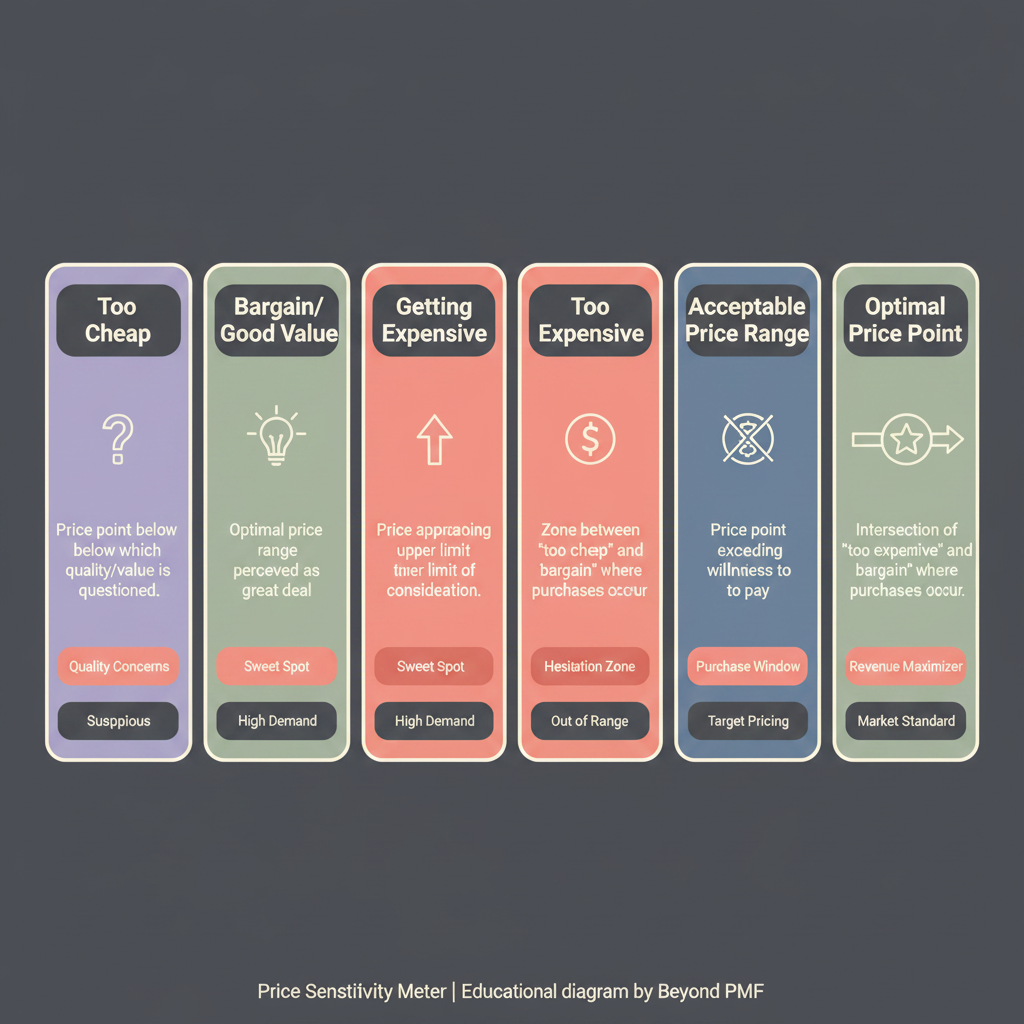
Price Sensitivity Meter

https://ik.imagekit.io/beyondpmf/frameworks/price-sensitivity-meter.png
The Price Sensitivity Meter (PSM) primarily addresses the strategic friction of market alignment and business model fit by helping businesses determine the optimal price point for their offerings. This framework informs pricing strategy, a critical component of a company's overall business model and market positioning.

The Price Sensitivity Meter, developed by Van Westendorp, is a technique used in market research to identify a range of prices that consumers perceive as acceptable for a particular product or service. This framework helps businesses understand how price variations can impact customer demand and identifies the price points where the product is considered too cheap or too expensive. The insights gained are crucial for setting prices that maximize both sales volume and profit margins.

Steps / Detailed Description

Define the target market and survey demographic. | Ask respondents four key questions about pricing perceptions. | Plot the data to find the optimal price range and points of marginal cheapness and expensiveness. | Analyze the results to determine the acceptable price range and potential resistance points.

Best Practices

Ensure a diverse and representative sample of the target market. | Combine PSM with other market research tools for comprehensive insights. | Regularly update the research to reflect current market conditions.

Pros

Provides a clear range of acceptable pricing from the consumer perspective. | Helps in understanding the price elasticity of demand for a product. | Can be used for both new and existing products.

Cons

Relies heavily on the accuracy and honesty of survey responses. | May not account for competitive market dynamics. | Focuses mainly on price, ignoring other factors like brand value and product quality.

When to Use

Determining price points for a new product launch. | Reevaluating pricing strategies for existing products.

When Not to Use

When the product has little to no competition. | In markets where external factors (like regulations) fix prices.

Related Frameworks

Scope

Scope not defined

Maturity Level

Maturity level not specified

Time to Implement

2–4 Weeks
3–6 Months
1–2 Weeks
3–6 Months
1–2 Months
3–6 Months
1–2 Weeks
Less Than 1 Day
1–2 Weeks
Longer Than 6 Months
1–2 Weeks
Longer Than 6 Months
1–2 Weeks
3–6 Months
1–2 Weeks
1–2 Weeks
1–2 Weeks
1–2 Weeks
1–2 Days
1–2 Weeks
1–2 Weeks
1–2 Weeks
1–2 Weeks
1–2 Weeks
1–2 Weeks
3–6 Months
1–2 Weeks
1–2 Weeks
1–2 Weeks
3–6 Months
1–2 Weeks
1–2 Weeks
2–4 Weeks
1–2 Weeks
1–2 Days
1–2 Weeks
Longer Than 6 Months
3–6 Months
Longer Than 6 Months
1–2 Weeks
Longer Than 6 Months
3–6 Months
Less Than 1 Day
3–6 Months
1–2 Months
3–6 Months
Longer Than 6 Months
3–6 Months
Less Than 1 Day
1–2 Weeks
3–6 Months
3–6 Months
1–2 Weeks
3–6 Months
1–2 Weeks
1–2 Weeks
1–2 Days
1–2 Weeks
1–2 Months
Longer Than 6 Months
1–2 Weeks
Longer Than 6 Months
1–2 Weeks
3–6 Months
1–2 Weeks
Less Than 1 Day
1–2 Weeks
3–6 Months
1–2 Weeks
3–6 Months
1–2 Weeks
1–2 Weeks
Longer Than 6 Months
Less Than 1 Day
3–6 Months
Longer Than 6 Months
1–2 Months
1–2 Weeks
Longer Than 6 Months
1–2 Weeks
3–6 Months
1–2 Weeks
1–2 Weeks
3–6 Months
Less Than 1 Day
1–2 Weeks
1–2 Weeks
3–6 Months
3–6 Months
Less Than 1 Day
1–2 Weeks
Longer Than 6 Months
1–2 Months
1–2 Weeks
1–2 Weeks
1–2 Weeks
Longer Than 6 Months

Copyright Information

Autor:
Van Westendorp
1976
Publication:
Unknown