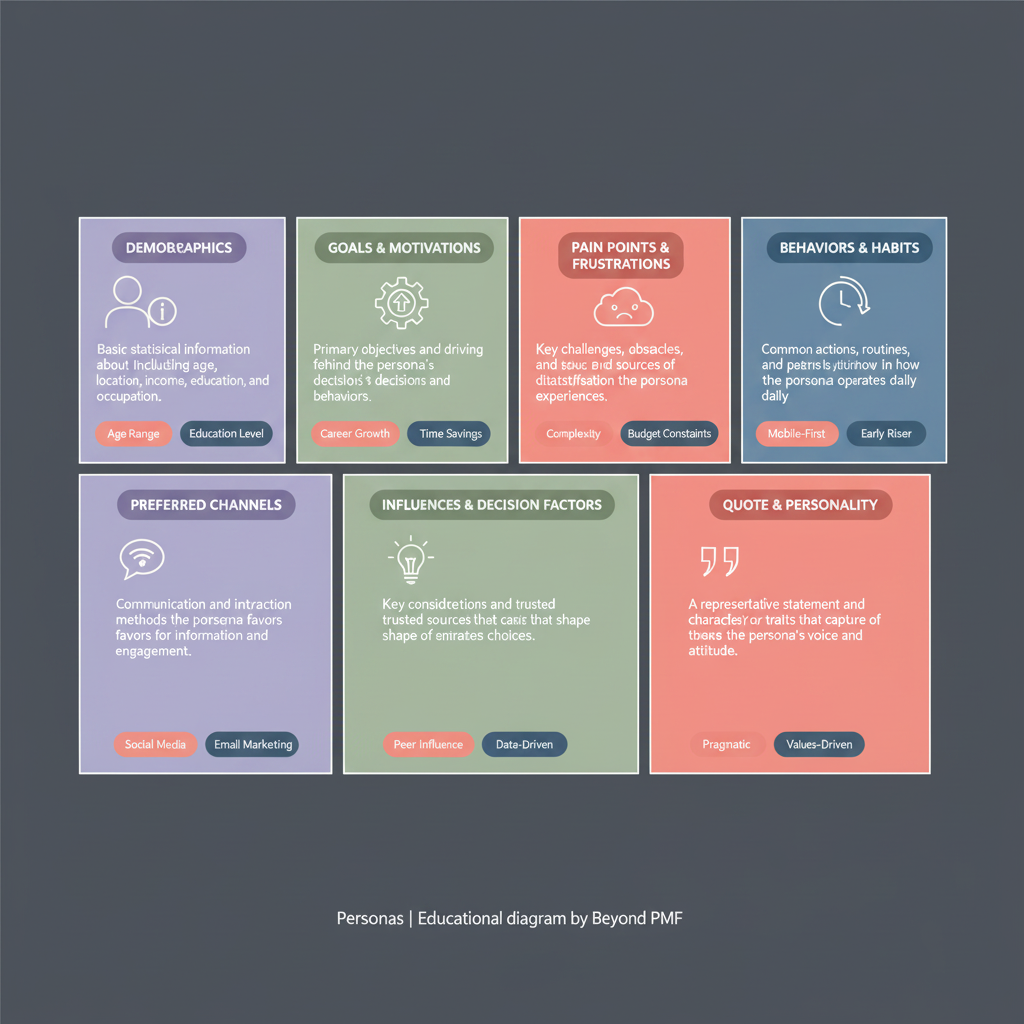
Personas

https://ik.imagekit.io/beyondpmf/frameworks/personas.png
Personas directly address customer understanding and ultimately improve the customer experience by providing a framework for teams to empathize with and design for specific user types. This focus on user needs makes it primarily an Execution-focused tool.

Personas are archetypal characters created to represent the different user types who might use a service, product, site, or brand in a similar way. Developing personas helps to understand users' needs, experiences, behaviors, and goals. Creating personas can guide decisions about product features, navigation, interactions, and even visual design of digital products.

Steps / Detailed Description

Gather user data through research such as surveys, interviews, and observations. | Identify behavioral patterns and group similar behaviors to form the basis of each persona. | Create detailed persona profiles including demographics, motivations, goals, and pain points. | Refine personas by incorporating feedback from real users and stakeholders. | Utilize personas throughout the product development process to guide design and marketing strategies.

Best Practices

Base personas on real user data rather than assumptions | Regularly update personas to reflect changes in user behavior and market conditions | Use personas in conjunction with other user-centered design techniques

Pros

Improves understanding of user needs and behaviors | Facilitates targeted and effective design strategies | Enhances communication and alignment within development teams

Cons

Can be based on assumptions if not enough real user data is used | May lead to exclusion of non-represented user groups | Requires time and resources to create and maintain

When to Use

In the early stages of product development | When redesigning or updating an existing product

When Not to Use

When there is insufficient data to create accurate personas | For projects with extremely tight timelines where deep user research isn't feasible

Related Frameworks

Scope

Scope not defined

Maturity Level

Maturity level not specified

Time to Implement

2–4 Weeks
3–6 Months
1–2 Weeks
3–6 Months
1–2 Months
3–6 Months
1–2 Weeks
Less Than 1 Day
1–2 Weeks
Longer Than 6 Months
1–2 Weeks
Longer Than 6 Months
1–2 Weeks
3–6 Months
1–2 Weeks
1–2 Weeks
1–2 Weeks
1–2 Weeks
1–2 Days
1–2 Weeks
1–2 Weeks
1–2 Weeks
1–2 Weeks
1–2 Weeks
1–2 Weeks
3–6 Months
1–2 Weeks
1–2 Weeks
1–2 Weeks
3–6 Months
1–2 Weeks
1–2 Weeks
2–4 Weeks
1–2 Weeks
1–2 Days
1–2 Weeks
Longer Than 6 Months
3–6 Months
Longer Than 6 Months
1–2 Weeks
Longer Than 6 Months
3–6 Months
Less Than 1 Day
3–6 Months
1–2 Months
3–6 Months
Longer Than 6 Months
3–6 Months
Less Than 1 Day
1–2 Weeks
3–6 Months
3–6 Months
1–2 Weeks
3–6 Months
1–2 Weeks
1–2 Weeks
1–2 Days
1–2 Weeks
1–2 Months
Longer Than 6 Months
1–2 Weeks
Longer Than 6 Months
1–2 Weeks
3–6 Months
1–2 Weeks
Less Than 1 Day
1–2 Weeks
3–6 Months
1–2 Weeks
3–6 Months
1–2 Weeks
1–2 Weeks
Longer Than 6 Months
Less Than 1 Day
3–6 Months
Longer Than 6 Months
1–2 Months
1–2 Weeks
Longer Than 6 Months
1–2 Weeks
3–6 Months
1–2 Weeks
1–2 Weeks
3–6 Months
Less Than 1 Day
1–2 Weeks
1–2 Weeks
3–6 Months
3–6 Months
Less Than 1 Day
1–2 Weeks
Longer Than 6 Months
1–2 Months
1–2 Weeks
1–2 Weeks
1–2 Weeks
Longer Than 6 Months

Copyright Information

Autor:
Public Domain
N/A
Publication:
Generic Business Tool