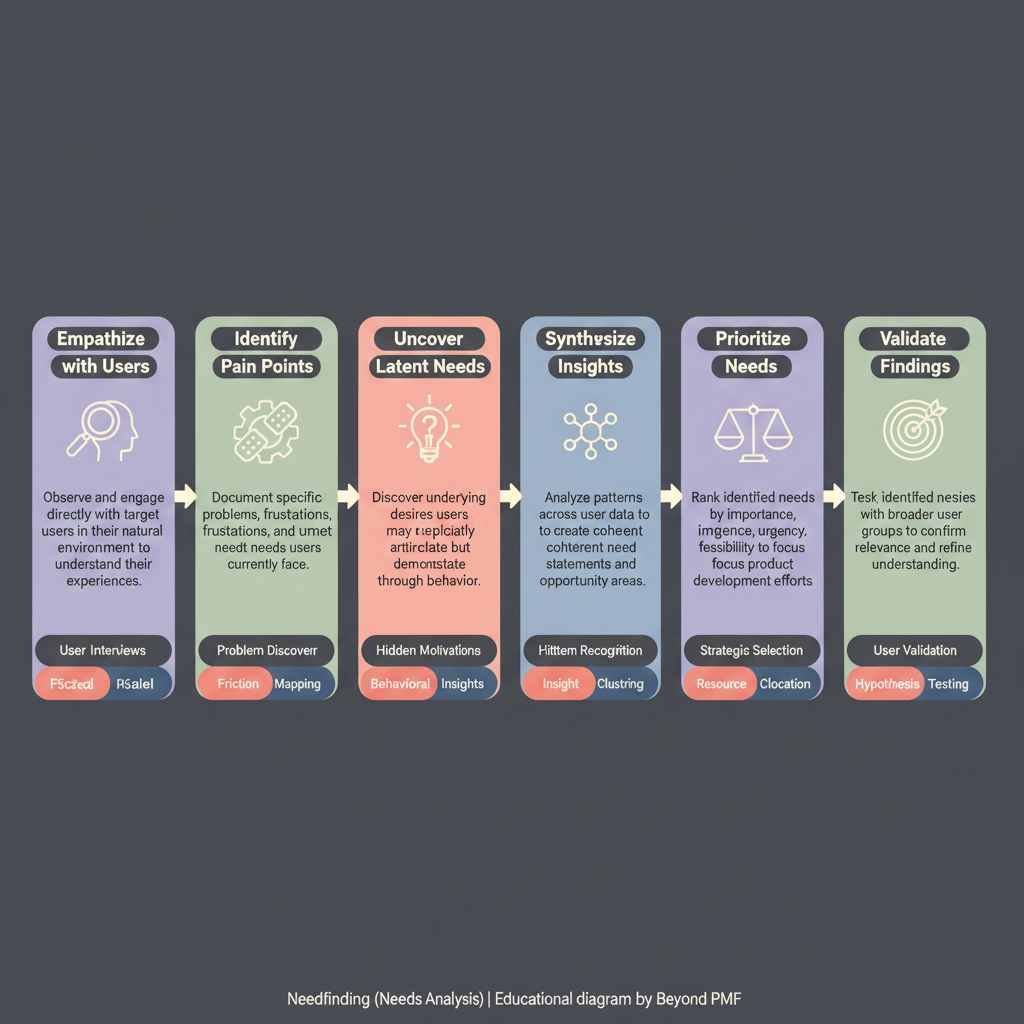
Needfinding (Needs Analysis)

https://ik.imagekit.io/beyondpmf/frameworks/needfinding-needs-analysis.png
Needfinding primarily addresses the friction of delivering products or services that meet customer needs. By deeply understanding user requirements, it aims to prevent issues related to customer experience and ensure the product aligns with user expectations, thereby improving the chances of successful implementation.

Needfinding, also known as Needs Analysis, is a critical framework used in the early stages of product development, service design, or process improvement. It involves systematic investigation to identify the needs, desires, and requirements of potential users or customers. By employing various research methods, this framework helps organizations align their offerings more closely with market demands, thereby increasing the likelihood of success. The process not only uncovers explicit needs but also helps in identifying latent needs that users themselves may not be aware of.

Steps / Detailed Description

Identify target user groups or stakeholders. | Choose appropriate data collection methods (surveys, interviews, observations, etc.). | Gather data from the chosen methods. | Analyze the data to extract meaningful insights about needs. | Prioritize needs based on feasibility and impact. | Translate needs into actionable project requirements.

Best Practices

Utilize a mix of qualitative and quantitative research methods. | Engage directly with end-users for authentic insights. | Regularly update findings to adapt to changing user needs.

Pros

Helps create products that truly meet user demands. | Uncovers hidden or latent needs. | Increases the efficiency of development by focusing on user requirements.

Cons

Can be time-consuming and resource-intensive. | Relies heavily on the accuracy of data collection methods. | May not always predict future needs as markets evolve.

When to Use

At the beginning of a new product development process. | When reevaluating or updating an existing product or service.

When Not to Use

When there is already clear, validated understanding of user needs. | In fast-paced environments where immediate decisions are necessary.

Related Frameworks

Scope

Scope not defined

Maturity Level

Maturity level not specified

Time to Implement

2–4 Weeks
3–6 Months
1–2 Weeks
3–6 Months
1–2 Months
3–6 Months
1–2 Weeks
Less Than 1 Day
1–2 Weeks
Longer Than 6 Months
1–2 Weeks
Longer Than 6 Months
1–2 Weeks
3–6 Months
1–2 Weeks
1–2 Weeks
1–2 Weeks
1–2 Weeks
1–2 Days
1–2 Weeks
1–2 Weeks
1–2 Weeks
1–2 Weeks
1–2 Weeks
1–2 Weeks
3–6 Months
1–2 Weeks
1–2 Weeks
1–2 Weeks
3–6 Months
1–2 Weeks
1–2 Weeks
2–4 Weeks
1–2 Weeks
1–2 Days
1–2 Weeks
Longer Than 6 Months
3–6 Months
Longer Than 6 Months
1–2 Weeks
Longer Than 6 Months
3–6 Months
Less Than 1 Day
3–6 Months
1–2 Months
3–6 Months
Longer Than 6 Months
3–6 Months
Less Than 1 Day
1–2 Weeks
3–6 Months
3–6 Months
1–2 Weeks
3–6 Months
1–2 Weeks
1–2 Weeks
1–2 Days
1–2 Weeks
1–2 Months
Longer Than 6 Months
1–2 Weeks
Longer Than 6 Months
1–2 Weeks
3–6 Months
1–2 Weeks
Less Than 1 Day
1–2 Weeks
3–6 Months
1–2 Weeks
3–6 Months
1–2 Weeks
1–2 Weeks
Longer Than 6 Months
Less Than 1 Day
3–6 Months
Longer Than 6 Months
1–2 Months
1–2 Weeks
Longer Than 6 Months
1–2 Weeks
3–6 Months
1–2 Weeks
1–2 Weeks
3–6 Months
Less Than 1 Day
1–2 Weeks
1–2 Weeks
3–6 Months
3–6 Months
Less Than 1 Day
1–2 Weeks
Longer Than 6 Months
1–2 Months
1–2 Weeks
1–2 Weeks
1–2 Weeks
Longer Than 6 Months

Copyright Information

Autor:
Public Domain
N/A
Publication:
Generic Business Tool