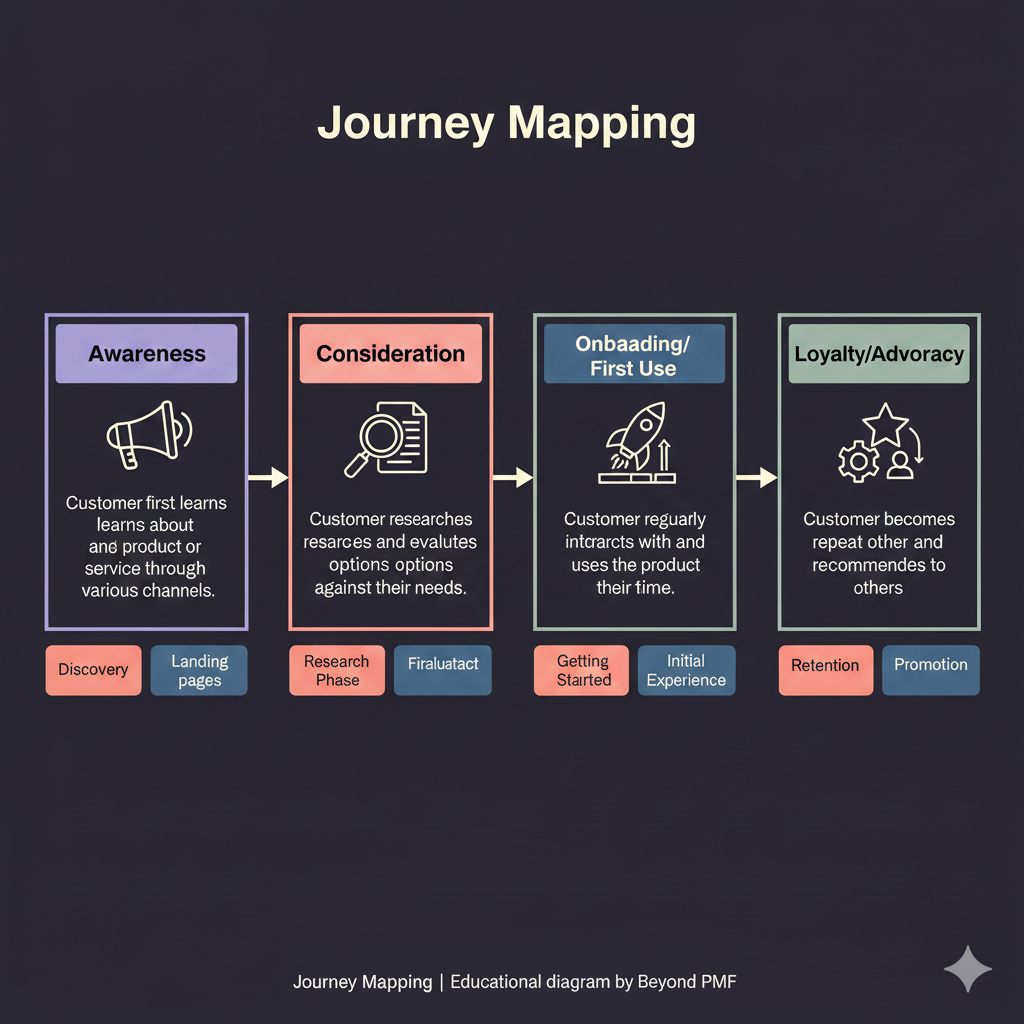
Journey Mapping is a strategic approach to understanding the flow of experiences a customer, user, or employee has with a service or product. It helps organizations visualize the path from initial contact through various touchpoints to the final outcome, identifying key interactions and the user's feelings, motivations, and questions at each stage. This framework is used to gain insights into customer needs, pinpoint areas for improvement, and enhance the overall user experience.
Define the scope and objectives of the journey map. | Gather and compile qualitative and quantitative data. | Identify key customer personas to focus the journey map on. | Map out the stages and touchpoints of the journey. | Highlight pain points, opportunities, and moments of truth. | Validate and refine the map with real user feedback. | Implement improvements based on insights gained.
Involve stakeholders from different departments. | Regularly update the journey maps as services and customer behaviors change. | Use real data and feedback to inform the journey map.
Provides a holistic view of the customer experience. | Identifies gaps and opportunities in the service or product offering. | Facilitates cross-functional collaboration and understanding.
Can be time-consuming and resource-intensive. | May rely heavily on assumptions if not enough data is available. | Risk of oversimplification, missing out on nuanced interactions.
When entering a new market or launching a new product. | When trying to improve customer satisfaction and retention.
When there is insufficient data to create an accurate map. | For quick, tactical decisions that require immediate action.