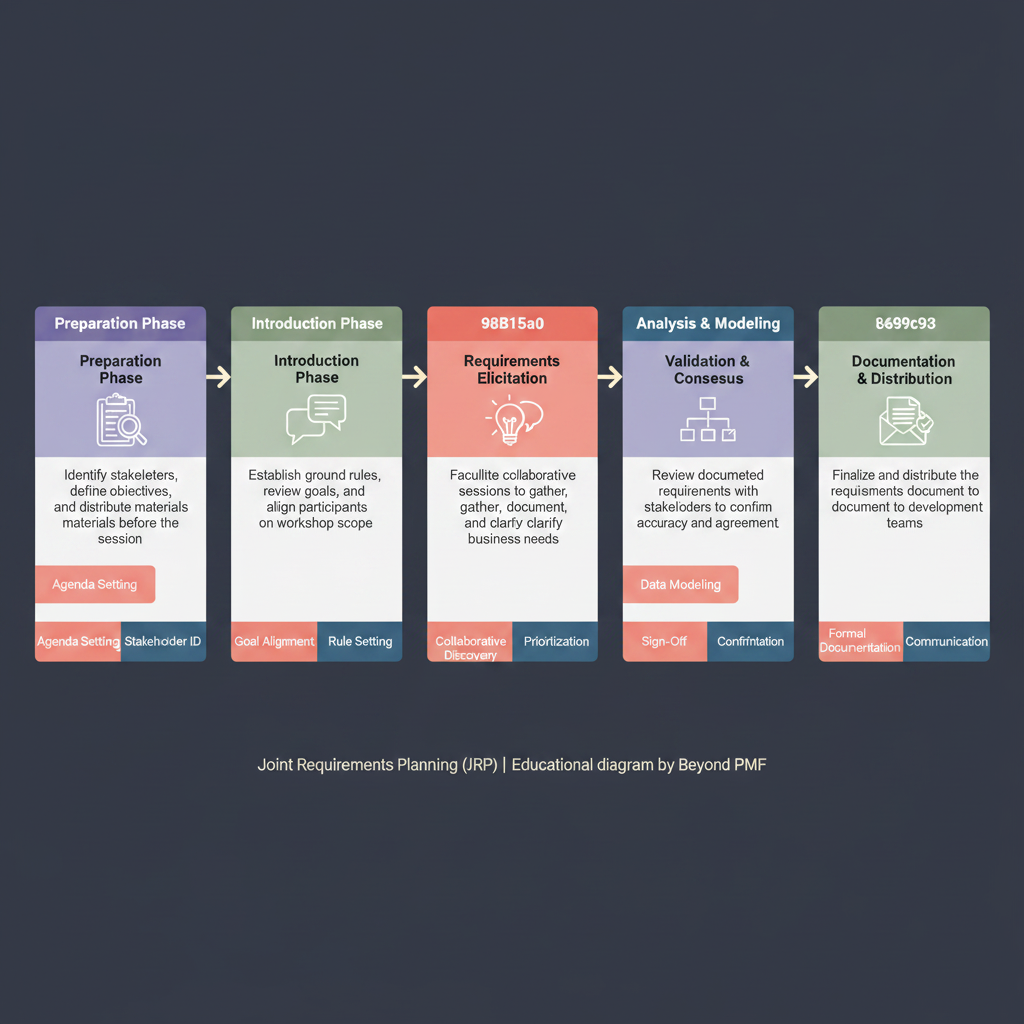
Joint Requirements Planning (JRP)

https://ik.imagekit.io/beyondpmf/frameworks/joint-requirements-planning-jrp.png
Joint Requirements Planning (JRP) primarily addresses operational friction by focusing on the process of gathering, documenting, and agreeing upon system requirements. This aims to streamline workflows and improve coordination among stakeholders.

Joint Requirements Planning (JRP) is a collaborative framework used primarily in software development and project management to gather and synchronize system requirements among all stakeholders. By involving all relevant parties early in the project, JRP aims to capture diverse perspectives and needs, which helps in defining a comprehensive set of system requirements. This collaborative approach not only enhances communication but also significantly reduces the risk of requirements oversight, ensuring that the final product aligns well with user needs and expectations.

Steps / Detailed Description

Identify all stakeholders and establish a JRP team. | Conduct initial JRP sessions to gather preliminary requirements. | Facilitate workshops and brainstorming sessions to refine requirements. | Use techniques like modeling and prototyping to validate requirements. | Document the agreed-upon requirements in a formal requirements specification. | Review and revise the requirements as needed through follow-up sessions.

Best Practices

Ensure representation from all stakeholder groups in the JRP sessions. | Use visual aids and prototypes to clarify complex requirements. | Regularly update and revise requirements documents as the project evolves.

Pros

Improves stakeholder alignment and communication | Reduces the risk of missing or misunderstood requirements | Increases project efficiency by early identification of requirements

Cons

Can be time-consuming | Requires high levels of commitment from all stakeholders | Potential for conflict and disagreement among diverse stakeholders

When to Use

In complex projects involving multiple stakeholders | When developing systems with ambiguous or undefined requirements

When Not to Use

For small-scale projects with clear and simple requirements | When project timelines are too tight for extensive collaborative sessions

Related Frameworks

Scope

Scope not defined

Maturity Level

Maturity level not specified

Time to Implement

2–4 Weeks
3–6 Months
1–2 Weeks
3–6 Months
1–2 Months
3–6 Months
1–2 Weeks
Less Than 1 Day
1–2 Weeks
Longer Than 6 Months
1–2 Weeks
Longer Than 6 Months
1–2 Weeks
3–6 Months
1–2 Weeks
1–2 Weeks
1–2 Weeks
1–2 Weeks
1–2 Days
1–2 Weeks
1–2 Weeks
1–2 Weeks
1–2 Weeks
1–2 Weeks
1–2 Weeks
3–6 Months
1–2 Weeks
1–2 Weeks
1–2 Weeks
3–6 Months
1–2 Weeks
1–2 Weeks
2–4 Weeks
1–2 Weeks
1–2 Days
1–2 Weeks
Longer Than 6 Months
3–6 Months
Longer Than 6 Months
1–2 Weeks
Longer Than 6 Months
3–6 Months
Less Than 1 Day
3–6 Months
1–2 Months
3–6 Months
Longer Than 6 Months
3–6 Months
Less Than 1 Day
1–2 Weeks
3–6 Months
3–6 Months
1–2 Weeks
3–6 Months
1–2 Weeks
1–2 Weeks
1–2 Days
1–2 Weeks
1–2 Months
Longer Than 6 Months
1–2 Weeks
Longer Than 6 Months
1–2 Weeks
3–6 Months
1–2 Weeks
Less Than 1 Day
1–2 Weeks
3–6 Months
1–2 Weeks
3–6 Months
1–2 Weeks
1–2 Weeks
Longer Than 6 Months
Less Than 1 Day
3–6 Months
Longer Than 6 Months
1–2 Months
1–2 Weeks
Longer Than 6 Months
1–2 Weeks
3–6 Months
1–2 Weeks
1–2 Weeks
3–6 Months
Less Than 1 Day
1–2 Weeks
1–2 Weeks
3–6 Months
3–6 Months
Less Than 1 Day
1–2 Weeks
Longer Than 6 Months
1–2 Months
1–2 Weeks
1–2 Weeks
1–2 Weeks
Longer Than 6 Months

Copyright Information

Autor:
Unknown
N/A
Publication:
Unknown