Jobs-to-be-Done Timeline

https://ik.imagekit.io/beyondpmf/frameworks/jobs-to-be-done-timeline.png
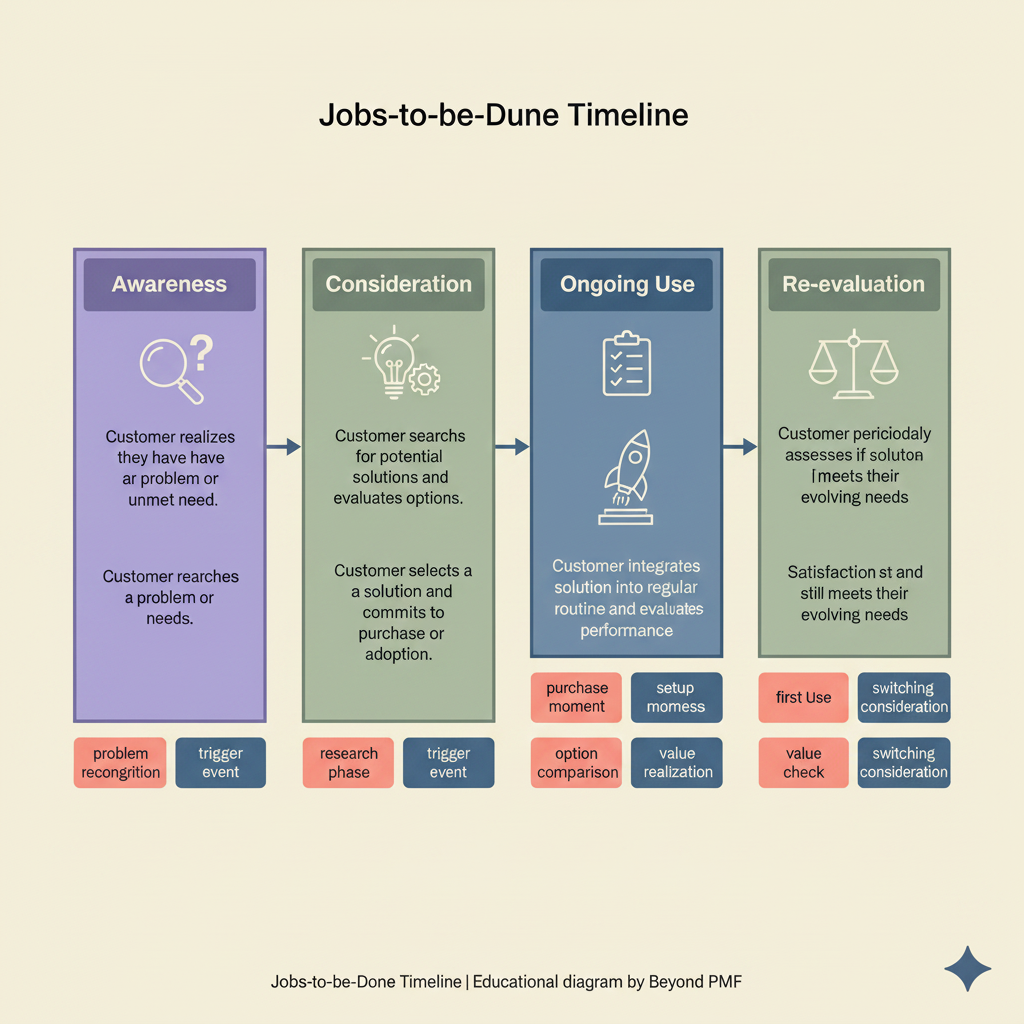
The Jobs-to-be-Done Timeline helps businesses understand customer motivations, which directly impacts market alignment, product strategy, and business model decisions by focusing on the 'why' behind customer actions and needs over time.

The Jobs-to-be-Done Timeline is a framework that maps out the customer journey from first thought to final purchase and use, focusing on the specific jobs customers are trying to get done at each stage. It is used to gain deeper insights into customer needs and decision-making processes, which can inform product development, marketing, and sales strategies. The timeline approach helps businesses align their offerings more closely with customer requirements and timelines, enhancing customer satisfaction and loyalty.

Steps / Detailed Description

Identify the 'first thought' customers have that leads them to consider a solution. | Map out the 'passive looking' phase where customers gather information. | Define the 'active looking' phase where customers intensively seek solutions. | Detail the 'deciding' phase where customers choose a product or service. | Analyze the 'ongoing use' and potential 'repurchase' phases.

Best Practices

Conduct thorough customer interviews and surveys to gather data. | Regularly update the timeline with new insights and market trends. | Use visual tools to map and present the timeline for easier understanding and analysis.

Pros

Provides a clear, chronological understanding of customer behavior. | Helps tailor products and marketing to specific customer needs. | Enhances the ability to predict and influence customer decisions.

Cons

Can be time-consuming to gather accurate customer data. | May require continuous updating as customer behaviors change. | Relies heavily on accurate customer insights, which can be difficult to obtain.

When to Use

When developing new products or services. | When trying to improve or innovate on existing offerings.

When Not to Use

When there is insufficient data on customer behavior. | In highly volatile markets where customer preferences change rapidly.

Related Frameworks

Scope

Scope not defined

Maturity Level

Maturity level not specified

Time to Implement

2–4 Weeks
3–6 Months
1–2 Weeks
3–6 Months
1–2 Months
3–6 Months
1–2 Weeks
Less Than 1 Day
1–2 Weeks
Longer Than 6 Months
1–2 Weeks
Longer Than 6 Months
1–2 Weeks
3–6 Months
1–2 Weeks
1–2 Weeks
1–2 Weeks
1–2 Weeks
1–2 Days
1–2 Weeks
1–2 Weeks
1–2 Weeks
1–2 Weeks
1–2 Weeks
1–2 Weeks
3–6 Months
1–2 Weeks
1–2 Weeks
1–2 Weeks
3–6 Months
1–2 Weeks
1–2 Weeks
2–4 Weeks
1–2 Weeks
1–2 Days
1–2 Weeks
Longer Than 6 Months
3–6 Months
Longer Than 6 Months
1–2 Weeks
Longer Than 6 Months
3–6 Months
Less Than 1 Day
3–6 Months
1–2 Months
3–6 Months
Longer Than 6 Months
3–6 Months
Less Than 1 Day
1–2 Weeks
3–6 Months
3–6 Months
1–2 Weeks
3–6 Months
1–2 Weeks
1–2 Weeks
1–2 Days
1–2 Weeks
1–2 Months
Longer Than 6 Months
1–2 Weeks
Longer Than 6 Months
1–2 Weeks
3–6 Months
1–2 Weeks
Less Than 1 Day
1–2 Weeks
3–6 Months
1–2 Weeks
3–6 Months
1–2 Weeks
1–2 Weeks
Longer Than 6 Months
Less Than 1 Day
3–6 Months
Longer Than 6 Months
1–2 Months
1–2 Weeks
Longer Than 6 Months
1–2 Weeks
3–6 Months
1–2 Weeks
1–2 Weeks
3–6 Months
Less Than 1 Day
1–2 Weeks
1–2 Weeks
3–6 Months
3–6 Months
Less Than 1 Day
1–2 Weeks
Longer Than 6 Months
1–2 Months
1–2 Weeks
1–2 Weeks
1–2 Weeks
Longer Than 6 Months

Copyright Information

Autor:
Unknown
N/A
Publication:
Unknown