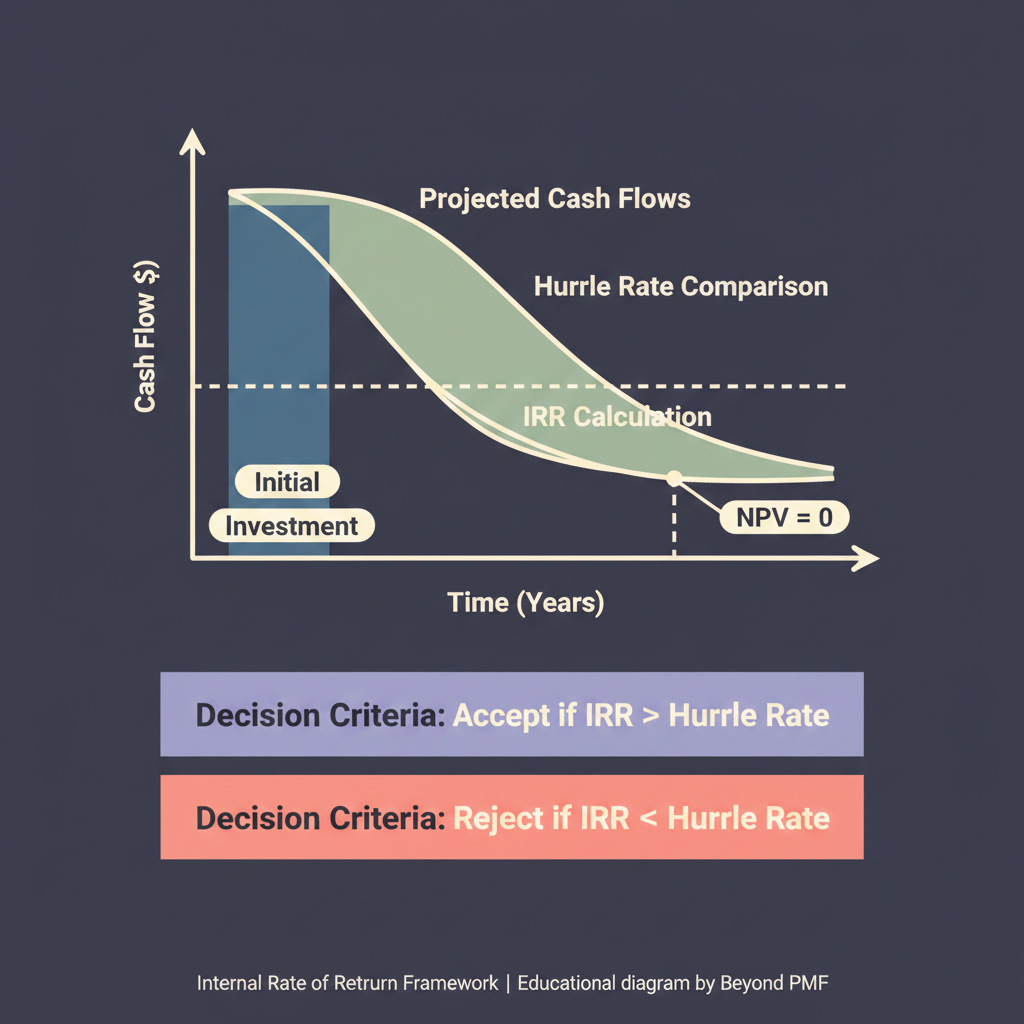
Internal Rate of Return Framework

https://ik.imagekit.io/beyondpmf/frameworks/internal-rate-of-return-framework.png
The IRR framework addresses the strategic friction of making informed investment decisions. It helps evaluate the financial viability of potential projects and aligns resource allocation with overall strategic goals by quantifying profitability.

The Internal Rate of Return (IRR) framework is a critical financial metric used by businesses and investors to evaluate the profitability of investments or projects. It calculates the rate of return at which the net present value of costs (cash outflows) equals the net present value of the benefits (cash inflows). IRR is widely used because it provides a simple metric that can help compare the desirability of various investments.

Steps / Detailed Description

Identify all expected cash inflows and outflows associated with the investment. | Determine the lifespan or the period over which the cash flows will occur. | Use the IRR formula or financial calculator to find the rate that equates the present value of inflows with outflows. | Compare the calculated IRR to the required rate of return to decide on the investment's feasibility.

Best Practices

Combine IRR with other financial metrics like NPV for a comprehensive analysis. | Ensure accurate and conservative estimation of cash flows. | Reevaluate IRR calculations if project parameters change.

Pros

Provides a clear percentage return for easy comparison with other investments. | Helps in assessing the break-even point of investments. | Useful for ranking multiple investment opportunities.

Cons

Can be misleading if used alone due to its ignorance of scale of investment. | Sensitive to the estimation of cash flows and their timing. | Does not account for the cost of capital changes over time.

When to Use

Evaluating the profitability of new projects or investments. | Comparing the financial viability between multiple investment options.

When Not to Use

When the project involves unconventional cash flows. | If the investment duration is very long and the economic environment is unstable.

Related Frameworks

Lifecycle

Scope

Scope not defined

Maturity Level

Maturity level not specified

Time to Implement

2–4 Weeks
3–6 Months
1–2 Weeks
3–6 Months
1–2 Months
3–6 Months
1–2 Weeks
Less Than 1 Day
1–2 Weeks
Longer Than 6 Months
1–2 Weeks
Longer Than 6 Months
1–2 Weeks
3–6 Months
1–2 Weeks
1–2 Weeks
1–2 Weeks
1–2 Weeks
1–2 Days
1–2 Weeks
1–2 Weeks
1–2 Weeks
1–2 Weeks
1–2 Weeks
1–2 Weeks
3–6 Months
1–2 Weeks
1–2 Weeks
1–2 Weeks
3–6 Months
1–2 Weeks
1–2 Weeks
2–4 Weeks
1–2 Weeks
1–2 Days
1–2 Weeks
Longer Than 6 Months
3–6 Months
Longer Than 6 Months
1–2 Weeks
Longer Than 6 Months
3–6 Months
Less Than 1 Day
3–6 Months
1–2 Months
3–6 Months
Longer Than 6 Months
3–6 Months
Less Than 1 Day
1–2 Weeks
3–6 Months
3–6 Months
1–2 Weeks
3–6 Months
1–2 Weeks
1–2 Weeks
1–2 Days
1–2 Weeks
1–2 Months
Longer Than 6 Months
1–2 Weeks
Longer Than 6 Months
1–2 Weeks
3–6 Months
1–2 Weeks
Less Than 1 Day
1–2 Weeks
3–6 Months
1–2 Weeks
3–6 Months
1–2 Weeks
1–2 Weeks
Longer Than 6 Months
Less Than 1 Day
3–6 Months
Longer Than 6 Months
1–2 Months
1–2 Weeks
Longer Than 6 Months
1–2 Weeks
3–6 Months
1–2 Weeks
1–2 Weeks
3–6 Months
Less Than 1 Day
1–2 Weeks
1–2 Weeks
3–6 Months
3–6 Months
Less Than 1 Day
1–2 Weeks
Longer Than 6 Months
1–2 Months
1–2 Weeks
1–2 Weeks
1–2 Weeks
Longer Than 6 Months

Copyright Information

Autor:
Public Domain
N/A
Publication:
Generic Business Tool