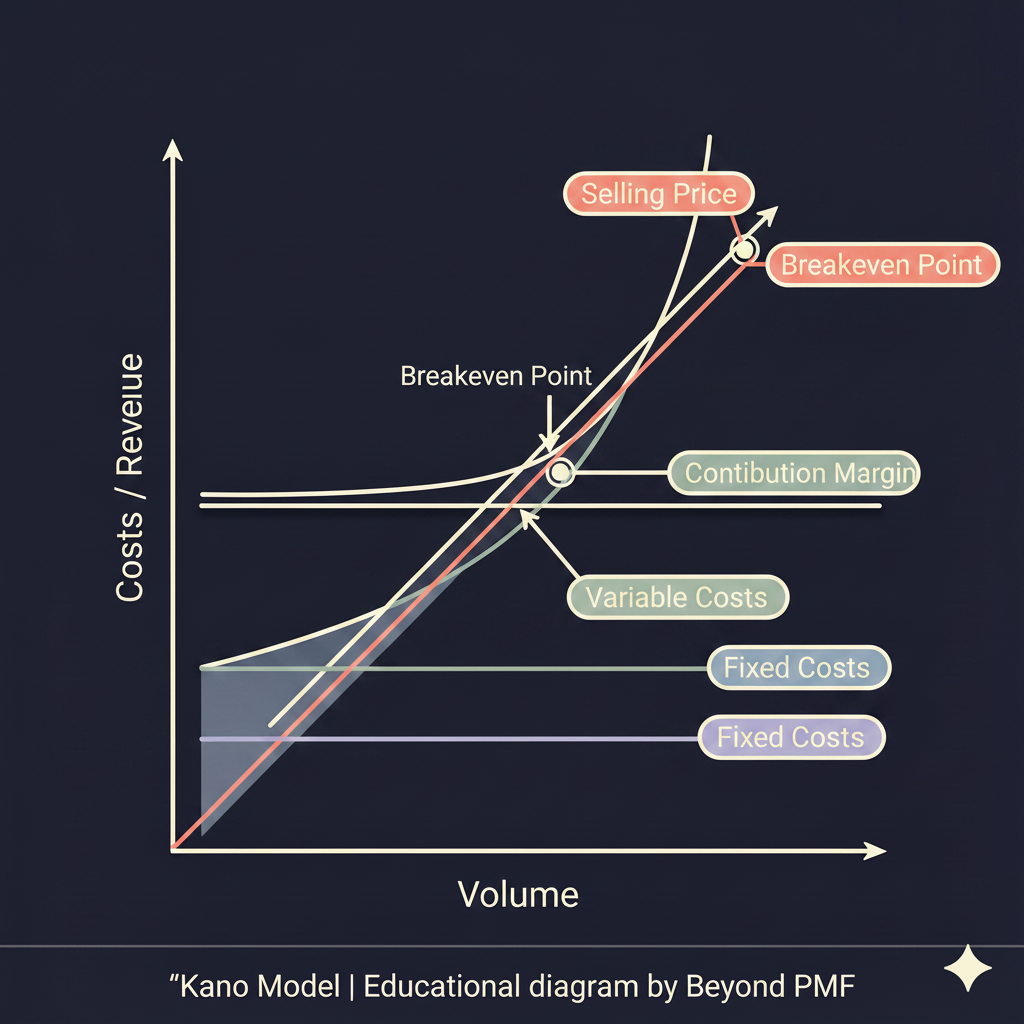
Breakeven Analysis

https://ik.imagekit.io/beyondpmf/frameworks/breakeven-analysis.png
Breakeven analysis helps address the strategic friction of understanding a business's viability and profitability by calculating the point at which revenues equal expenses. It ensures financial sustainability and aligns with the overarching business model and direction.

Breakeven Analysis is a critical financial calculation used to identify the point at which revenue equals the costs associated with making and selling a product, or providing a service. This analysis helps businesses understand the minimum sales volume needed to cover their fixed and variable costs, thereby aiding in decision-making and financial planning. It is particularly beneficial for assessing the viability of new products, setting appropriate price levels, and managing cost controls.

Steps / Detailed Description

Identify fixed costs: Costs that do not change regardless of the amount of goods or services produced. | Determine variable costs per unit: Costs that vary directly with the production volume. | Calculate the selling price per unit: The amount at which goods or services are sold to customers. | Compute the breakeven point: This is done by dividing total fixed costs by the difference between the unit selling price and the variable cost per unit.

Best Practices

Regularly update cost and price data | Consider a range of scenarios with different price levels | Integrate market trends and forecasts into analysis

Pros

Provides clarity on financial targets | Helps in pricing and cost control | Aids in decision making for investments and expenses

Cons

Does not consider changes in market conditions | Assumes all produced units are sold | Ignores the impact of economies of scale

When to Use

Launching a new product | Planning for future investments

When Not to Use

In highly volatile markets | When product demand is uncertain

Related Frameworks

Lifecycle

Scope

Scope not defined

Maturity Level

Maturity level not specified

Time to Implement

2–4 Weeks
3–6 Months
1–2 Weeks
3–6 Months
1–2 Months
3–6 Months
1–2 Weeks
Less Than 1 Day
1–2 Weeks
Longer Than 6 Months
1–2 Weeks
Longer Than 6 Months
1–2 Weeks
3–6 Months
1–2 Weeks
1–2 Weeks
1–2 Weeks
1–2 Weeks
1–2 Days
1–2 Weeks
1–2 Weeks
1–2 Weeks
1–2 Weeks
1–2 Weeks
1–2 Weeks
3–6 Months
1–2 Weeks
1–2 Weeks
1–2 Weeks
3–6 Months
1–2 Weeks
1–2 Weeks
2–4 Weeks
1–2 Weeks
1–2 Days
1–2 Weeks
Longer Than 6 Months
3–6 Months
Longer Than 6 Months
1–2 Weeks
Longer Than 6 Months
3–6 Months
Less Than 1 Day
3–6 Months
1–2 Months
3–6 Months
Longer Than 6 Months
3–6 Months
Less Than 1 Day
1–2 Weeks
3–6 Months
3–6 Months
1–2 Weeks
3–6 Months
1–2 Weeks
1–2 Weeks
1–2 Days
1–2 Weeks
1–2 Months
Longer Than 6 Months
1–2 Weeks
Longer Than 6 Months
1–2 Weeks
3–6 Months
1–2 Weeks
Less Than 1 Day
1–2 Weeks
3–6 Months
1–2 Weeks
3–6 Months
1–2 Weeks
1–2 Weeks
Longer Than 6 Months
Less Than 1 Day
3–6 Months
Longer Than 6 Months
1–2 Months
1–2 Weeks
Longer Than 6 Months
1–2 Weeks
3–6 Months
1–2 Weeks
1–2 Weeks
3–6 Months
Less Than 1 Day
1–2 Weeks
1–2 Weeks
3–6 Months
3–6 Months
Less Than 1 Day
1–2 Weeks
Longer Than 6 Months
1–2 Months
1–2 Weeks
1–2 Weeks
1–2 Weeks
Longer Than 6 Months

Copyright Information

Autor:
Public Domain
N/A
Publication:
Generic Business Tool