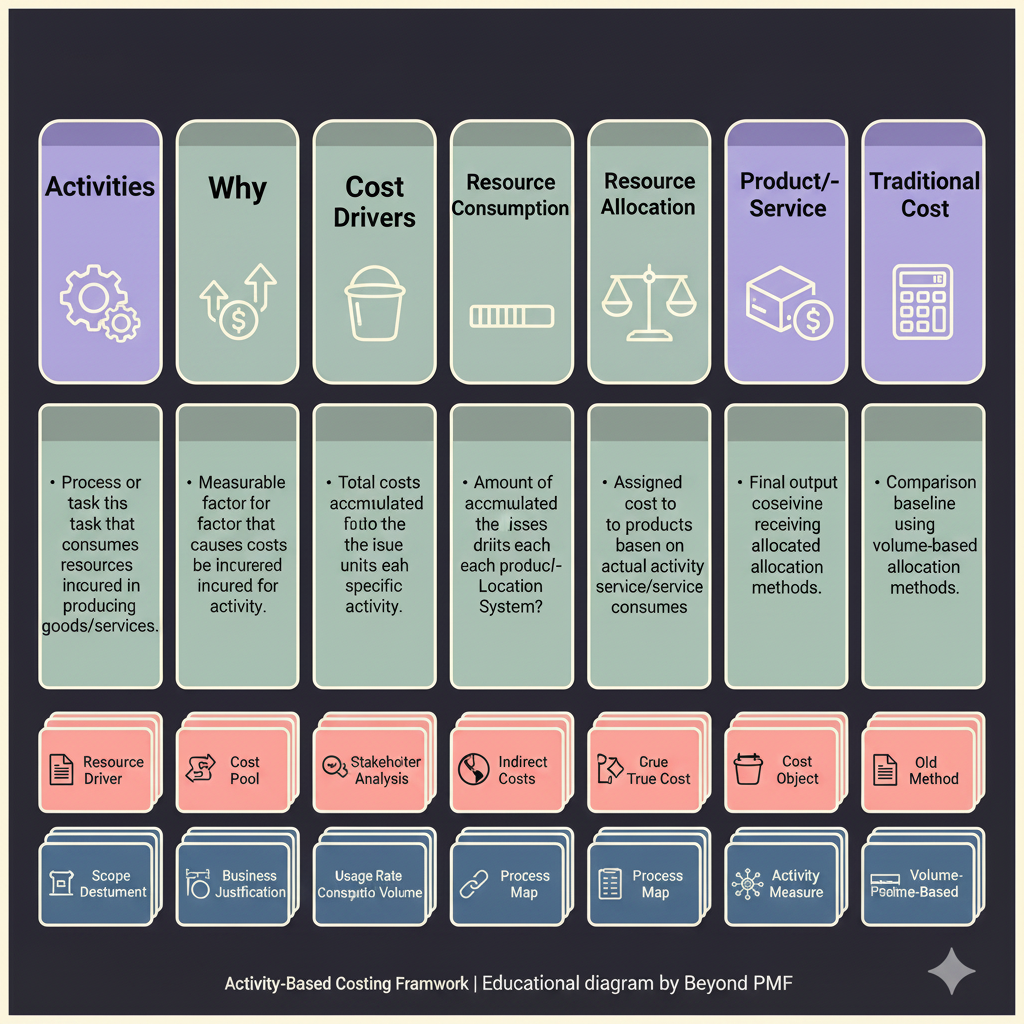
Activity-Based Costing Framework

https://ik.imagekit.io/beyondpmf/frameworks/activity-based-costing-framework.png
Activity-Based Costing primarily addresses friction within operational processes by improving the accuracy of cost allocation. This helps to streamline workflows and improve coordination related to costing.

Activity-Based Costing (ABC) is a detailed accounting framework that assigns manufacturing and non-manufacturing costs to products in a more logical manner than traditional costing methods. By focusing on activities as the fundamental cost drivers, it helps organizations identify inefficient products, departments, and activities. This framework aids in understanding the true cost of producing a product, enabling more informed pricing, budgeting, and strategic decisions. The main benefit of ABC is that it provides a more accurate picture of cost behavior and product profitability.

Steps / Detailed Description

Identify the activities that are required to produce a product or deliver a service. | Assign costs to these activities based on their consumption of resources. | Determine cost drivers associated with each activity. | Calculate the rate per cost driver. | Assign costs to products or services based on their usage of each cost driver.

Best Practices

Regularly update and review cost drivers and activity data | Ensure accurate and comprehensive data collection | Integrate ABC with other financial systems for holistic management

Pros

Provides more accurate product costing | Helps identify and eliminate inefficient processes | Facilitates better decision-making and budgeting

Cons

Can be time-consuming and costly to implement | Requires detailed and accurate data collection | May lead to complexity and confusion if not properly managed

When to Use

Complex production processes with multiple products | When overhead costs are a significant portion of total costs

When Not to Use

In small or less complex operations | Where direct costs far outweigh overhead costs

Related Frameworks

Lifecycle

Not tied to a specific lifecycle stage

Scope

Scope not defined

Maturity Level

Maturity level not specified

Time to Implement

2–4 Weeks
3–6 Months
1–2 Weeks
3–6 Months
1–2 Months
3–6 Months
1–2 Weeks
Less Than 1 Day
1–2 Weeks
Longer Than 6 Months
1–2 Weeks
Longer Than 6 Months
1–2 Weeks
3–6 Months
1–2 Weeks
1–2 Weeks
1–2 Weeks
1–2 Weeks
1–2 Days
1–2 Weeks
1–2 Weeks
1–2 Weeks
1–2 Weeks
1–2 Weeks
1–2 Weeks
3–6 Months
1–2 Weeks
1–2 Weeks
1–2 Weeks
3–6 Months
1–2 Weeks
1–2 Weeks
2–4 Weeks
1–2 Weeks
1–2 Days
1–2 Weeks
Longer Than 6 Months
3–6 Months
Longer Than 6 Months
1–2 Weeks
Longer Than 6 Months
3–6 Months
Less Than 1 Day
3–6 Months
1–2 Months
3–6 Months
Longer Than 6 Months
3–6 Months
Less Than 1 Day
1–2 Weeks
3–6 Months
3–6 Months
1–2 Weeks
3–6 Months
1–2 Weeks
1–2 Weeks
1–2 Days
1–2 Weeks
1–2 Months
Longer Than 6 Months
1–2 Weeks
Longer Than 6 Months
1–2 Weeks
3–6 Months
1–2 Weeks
Less Than 1 Day
1–2 Weeks
3–6 Months
1–2 Weeks
3–6 Months
1–2 Weeks
1–2 Weeks
Longer Than 6 Months
Less Than 1 Day
3–6 Months
Longer Than 6 Months
1–2 Months
1–2 Weeks
Longer Than 6 Months
1–2 Weeks
3–6 Months
1–2 Weeks
1–2 Weeks
3–6 Months
Less Than 1 Day
1–2 Weeks
1–2 Weeks
3–6 Months
3–6 Months
Less Than 1 Day
1–2 Weeks
Longer Than 6 Months
1–2 Months
1–2 Weeks
1–2 Weeks
1–2 Weeks
Longer Than 6 Months

Copyright Information

Autor:
Public Domain
N/A
Publication:
Generic Business Tool