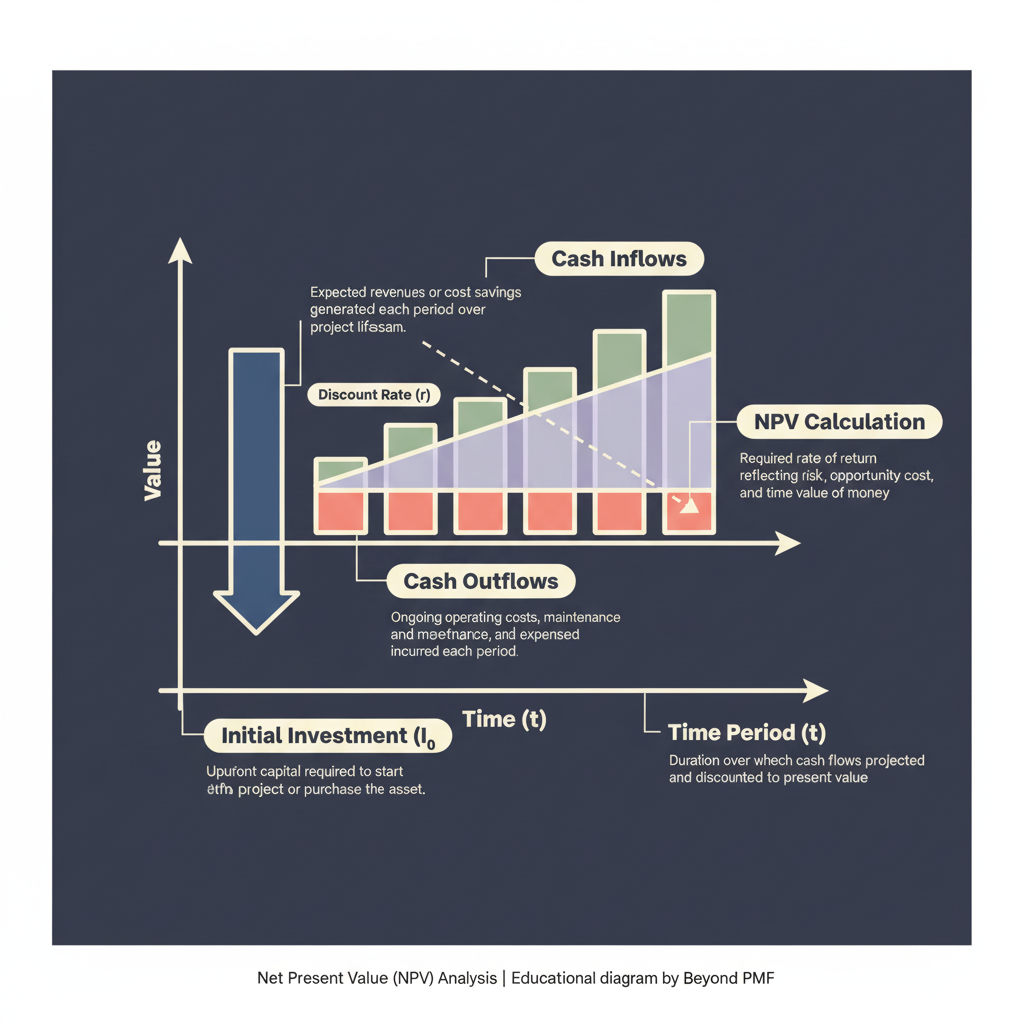
Net Present Value (NPV) Analysis is a fundamental tool in financial management and capital budgeting. It helps in determining the profitability of a project by discounting the expected cash flows to their present value and subtracting the initial investment. This framework is crucial for making informed investment decisions, as it considers the time value of money, providing a clear indicator of the financial benefit or loss from a project.
Estimate future cash inflows and outflows associated with the investment. | Determine the appropriate discount rate, often based on the cost of capital or required rate of return. | Discount the future cash flows to their present values using the discount rate. | Sum the discounted cash flows to get the total present value of inflows and outflows. | Subtract the initial investment cost from the total present value of inflows to calculate the NPV.
Use conservative estimates for cash flows to avoid overoptimism. | Regularly review and update the discount rate to reflect current market conditions. | Consider conducting sensitivity analysis to understand the impact of variable changes.
Provides a clear monetary value to assess profitability. | Considers the time value of money, making it a comprehensive evaluation tool. | Helps compare the viability of different projects or investments.
Relies heavily on the accuracy of estimated cash flows. | Sensitive to changes in the discount rate. | May not fully capture non-financial benefits or costs.
Evaluating long-term investment projects. | Comparing different investment opportunities.
Projects where non-financial benefits are the primary concern. | When future cash flows are highly unpredictable.