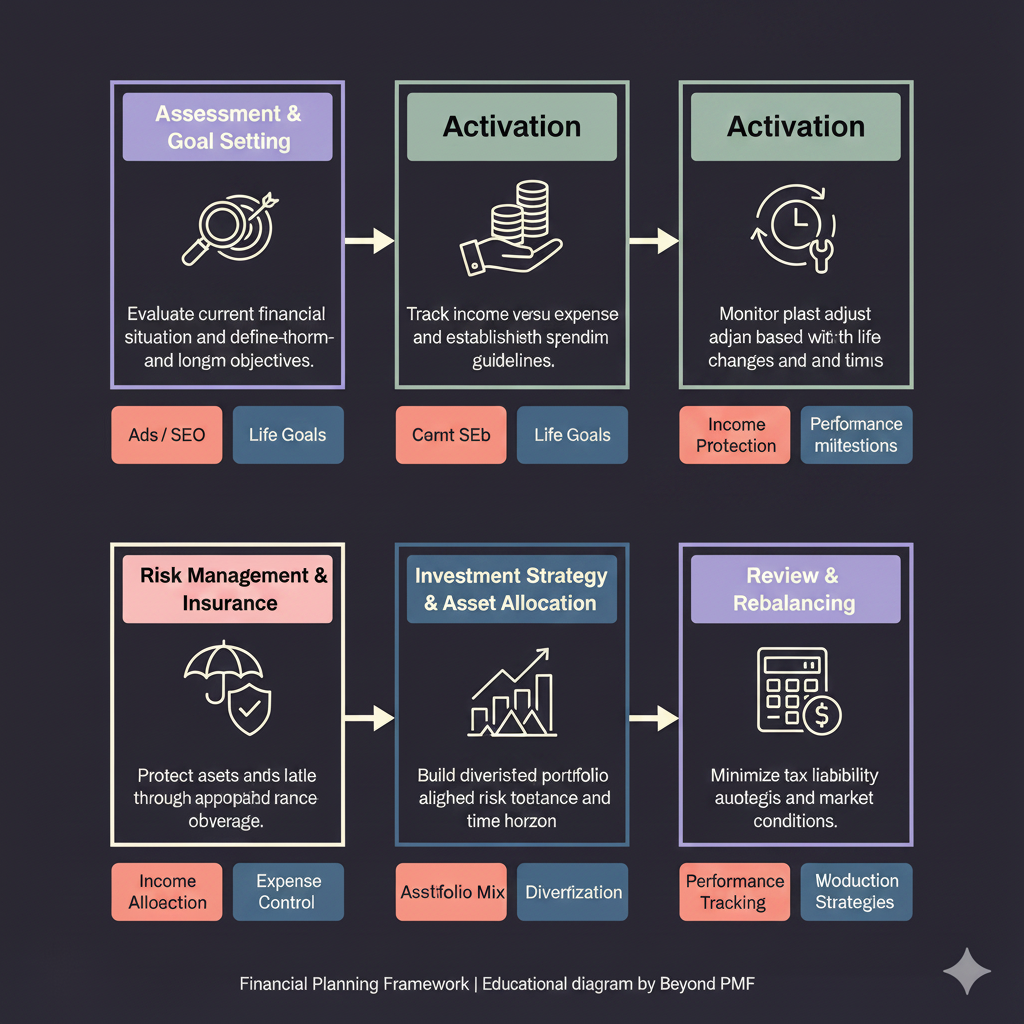
Financial Planning Framework

https://ik.imagekit.io/beyondpmf/frameworks/financial-planning-framework.png
The Financial Planning Framework addresses operational friction by providing a structured approach to managing financial resources. It helps streamline processes, improve coordination of financial activities, and establish governance around financial goals.

The Financial Planning Framework is a comprehensive tool used by individuals and organizations to align financial resources with their long-term goals. It involves assessing current financial status, forecasting future needs, and creating strategies to achieve financial objectives. This framework helps in optimizing budget allocation, minimizing financial risks, and ensuring sustainable growth.

Steps / Detailed Description

Assessment of current financial situation: Review and analyze current assets, liabilities, income, and expenses. | Goal setting: Define short-term and long-term financial goals. | Risk evaluation: Identify potential financial risks and uncertainties. | Strategy formulation: Develop strategies to manage finances, including savings, investments, and debt management. | Implementation: Execute the financial strategies and plans. | Monitoring and adjustment: Regularly review financial performance and make necessary adjustments to stay on track.

Best Practices

Regularly update financial plans to reflect changing circumstances | Involve financial experts when necessary | Set realistic and measurable financial goals

Pros

Provides a clear roadmap for achieving financial goals | Helps in identifying and mitigating financial risks | Facilitates informed decision-making and resource allocation

Cons

Can be time-consuming and complex | Requires regular updates and adjustments | May not account for unexpected financial emergencies

When to Use

When planning for long-term financial goals | When managing significant financial resources or investments

When Not to Use

In cases of immediate financial crisis where quick decisions are needed | When the financial situation is straightforward and predictable

Related Frameworks

Lifecycle

Not tied to a specific lifecycle stage

Scope

Scope not defined

Maturity Level

Maturity level not specified

Time to Implement

2–4 Weeks
3–6 Months
1–2 Weeks
3–6 Months
1–2 Months
3–6 Months
1–2 Weeks
Less Than 1 Day
1–2 Weeks
Longer Than 6 Months
1–2 Weeks
Longer Than 6 Months
1–2 Weeks
3–6 Months
1–2 Weeks
1–2 Weeks
1–2 Weeks
1–2 Weeks
1–2 Days
1–2 Weeks
1–2 Weeks
1–2 Weeks
1–2 Weeks
1–2 Weeks
1–2 Weeks
3–6 Months
1–2 Weeks
1–2 Weeks
1–2 Weeks
3–6 Months
1–2 Weeks
1–2 Weeks
2–4 Weeks
1–2 Weeks
1–2 Days
1–2 Weeks
Longer Than 6 Months
3–6 Months
Longer Than 6 Months
1–2 Weeks
Longer Than 6 Months
3–6 Months
Less Than 1 Day
3–6 Months
1–2 Months
3–6 Months
Longer Than 6 Months
3–6 Months
Less Than 1 Day
1–2 Weeks
3–6 Months
3–6 Months
1–2 Weeks
3–6 Months
1–2 Weeks
1–2 Weeks
1–2 Days
1–2 Weeks
1–2 Months
Longer Than 6 Months
1–2 Weeks
Longer Than 6 Months
1–2 Weeks
3–6 Months
1–2 Weeks
Less Than 1 Day
1–2 Weeks
3–6 Months
1–2 Weeks
3–6 Months
1–2 Weeks
1–2 Weeks
Longer Than 6 Months
Less Than 1 Day
3–6 Months
Longer Than 6 Months
1–2 Months
1–2 Weeks
Longer Than 6 Months
1–2 Weeks
3–6 Months
1–2 Weeks
1–2 Weeks
3–6 Months
Less Than 1 Day
1–2 Weeks
1–2 Weeks
3–6 Months
3–6 Months
Less Than 1 Day
1–2 Weeks
Longer Than 6 Months
1–2 Months
1–2 Weeks
1–2 Weeks
1–2 Weeks
Longer Than 6 Months

Copyright Information

Autor:
Public Domain
N/A
Publication:
Generic Business Tool