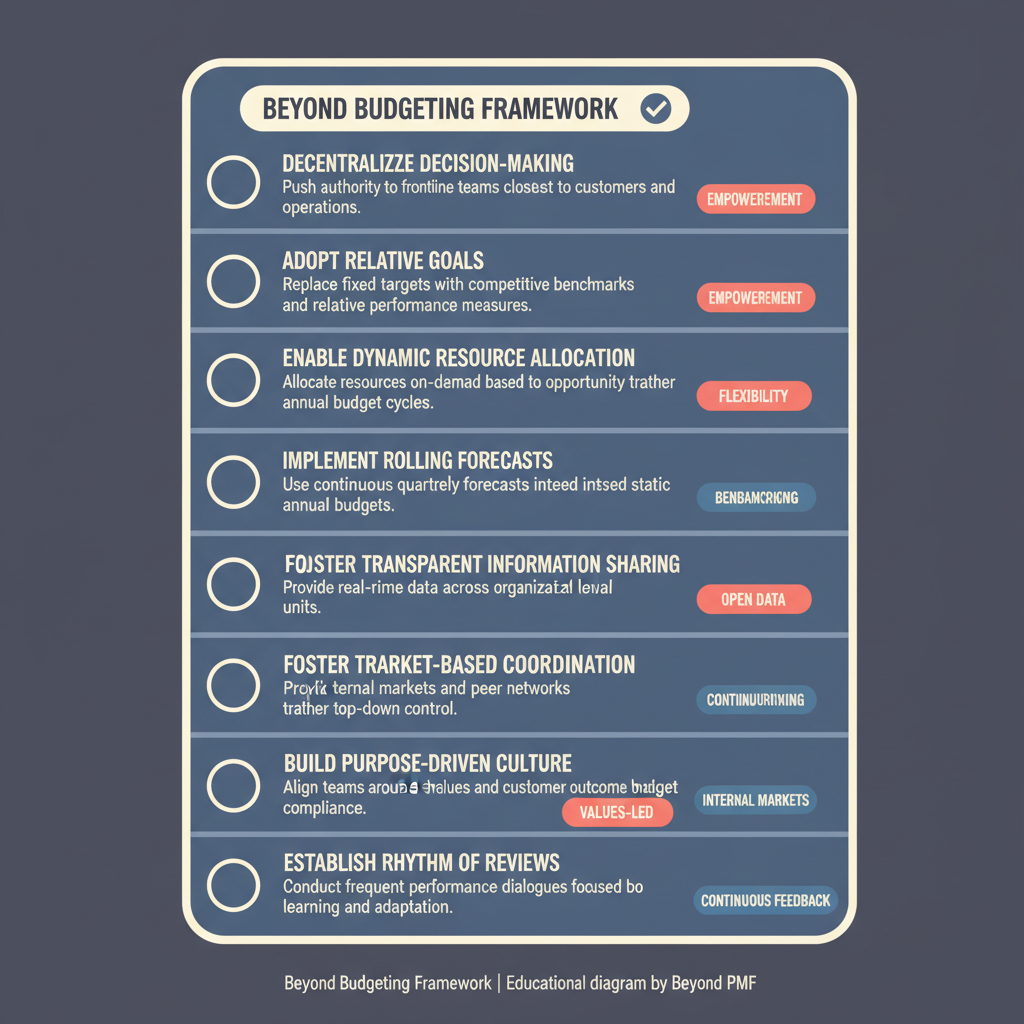
Beyond Budgeting Framework

https://ik.imagekit.io/beyondpmf/frameworks/beyond-budgeting-framework.png
Beyond Budgeting replaces traditional budgeting, which often creates rigid and slow processes. This framework addresses friction in workflows, coordination, and governance related to performance management.

The Beyond Budgeting Framework is designed to help organizations overcome the limitations of traditional budgeting. It emphasizes a more adaptive and decentralized approach to management, focusing on fluid resource allocation and relative performance evaluation. This framework is used to increase responsiveness to market changes, foster innovation, and enhance organizational agility. Its benefits include improved speed of decision-making, increased employee empowerment, and stronger alignment with strategic goals.

Steps / Detailed Description

Understand the limitations of traditional budgeting within your organization. | Gain executive support for moving beyond traditional budgeting. | Define new performance metrics that focus on relative improvement and value creation. | Develop a more flexible and adaptive financial planning process. | Implement decentralized decision-making to enhance responsiveness. | Establish a culture of accountability and continuous improvement.

Best Practices

Start with a pilot project to demonstrate the benefits and refine the approach. | Ensure clear communication and training throughout the organization. | Regularly review and adapt the performance metrics and financial processes.

Pros

Increases organizational agility | Enhances responsiveness to market changes | Empowers employees and decentralizes decision-making

Cons

Can be challenging to implement without strong leadership commitment | Requires significant cultural change which can be resisted | Lack of fixed budgets may lead to short-term focus in some areas

When to Use

In dynamic industries where market conditions change rapidly | When traditional budgeting processes hinder flexibility and speed

When Not to Use

In highly regulated industries where detailed financial planning is required | When organizational culture strongly favors traditional budgeting methods

Related Frameworks

Lifecycle

Not tied to a specific lifecycle stage

Scope

Scope not defined

Maturity Level

Maturity level not specified

Time to Implement

2–4 Weeks
3–6 Months
1–2 Weeks
3–6 Months
1–2 Months
3–6 Months
1–2 Weeks
Less Than 1 Day
1–2 Weeks
Longer Than 6 Months
1–2 Weeks
Longer Than 6 Months
1–2 Weeks
3–6 Months
1–2 Weeks
1–2 Weeks
1–2 Weeks
1–2 Weeks
1–2 Days
1–2 Weeks
1–2 Weeks
1–2 Weeks
1–2 Weeks
1–2 Weeks
1–2 Weeks
3–6 Months
1–2 Weeks
1–2 Weeks
1–2 Weeks
3–6 Months
1–2 Weeks
1–2 Weeks
2–4 Weeks
1–2 Weeks
1–2 Days
1–2 Weeks
Longer Than 6 Months
3–6 Months
Longer Than 6 Months
1–2 Weeks
Longer Than 6 Months
3–6 Months
Less Than 1 Day
3–6 Months
1–2 Months
3–6 Months
Longer Than 6 Months
3–6 Months
Less Than 1 Day
1–2 Weeks
3–6 Months
3–6 Months
1–2 Weeks
3–6 Months
1–2 Weeks
1–2 Weeks
1–2 Days
1–2 Weeks
1–2 Months
Longer Than 6 Months
1–2 Weeks
Longer Than 6 Months
1–2 Weeks
3–6 Months
1–2 Weeks
Less Than 1 Day
1–2 Weeks
3–6 Months
1–2 Weeks
3–6 Months
1–2 Weeks
1–2 Weeks
Longer Than 6 Months
Less Than 1 Day
3–6 Months
Longer Than 6 Months
1–2 Months
1–2 Weeks
Longer Than 6 Months
1–2 Weeks
3–6 Months
1–2 Weeks
1–2 Weeks
3–6 Months
Less Than 1 Day
1–2 Weeks
1–2 Weeks
3–6 Months
3–6 Months
Less Than 1 Day
1–2 Weeks
Longer Than 6 Months
1–2 Months
1–2 Weeks
1–2 Weeks
1–2 Weeks
Longer Than 6 Months

Copyright Information

Autor:
Robin Fraser and Jeremy Hope
1998
Publication:
Beyond Budgeting Institute