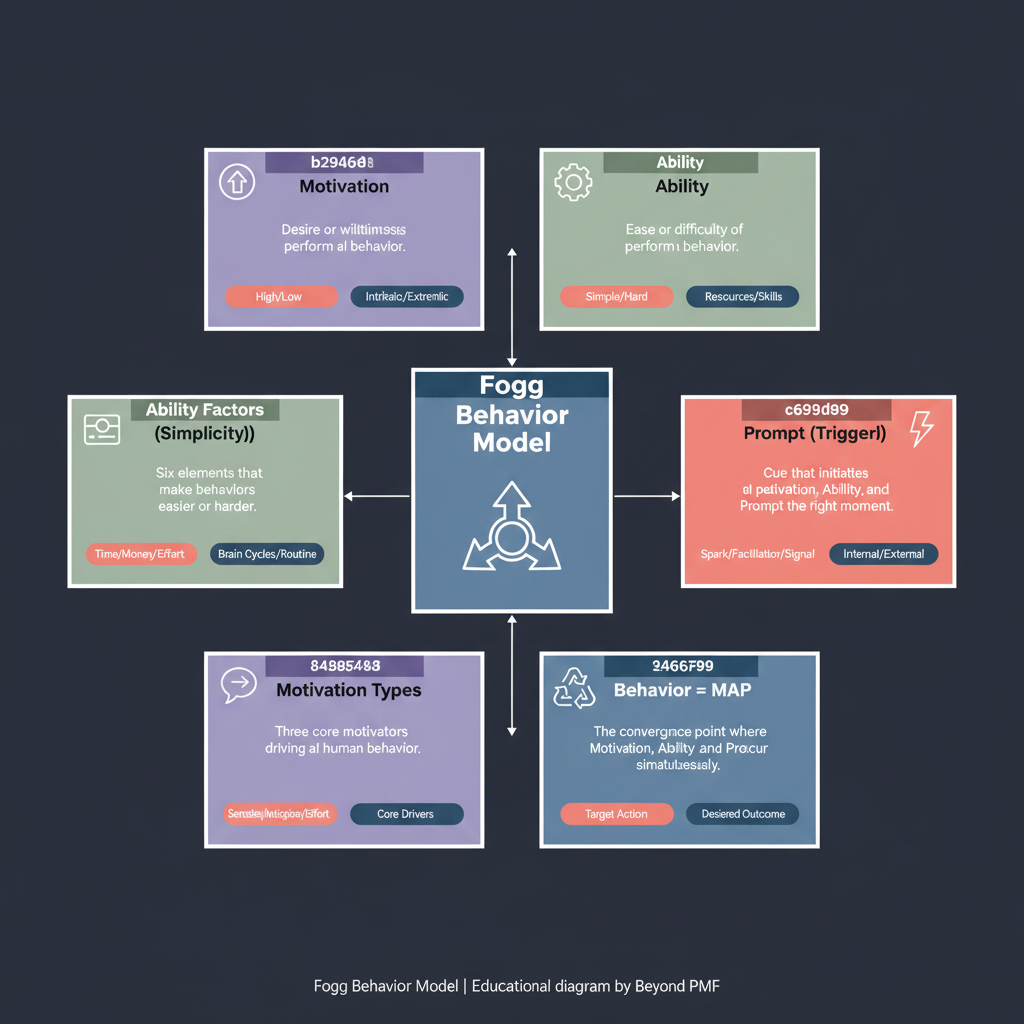
Developed by Dr. BJ Fogg, the Fogg Behavior Model is a psychological theory used to analyze and influence human behavior. It posits that behavior is the result of three elements: motivation, ability, and a prompt. All three must converge at the same moment for a behavior to occur. This model is particularly beneficial in designing products, services, and experiences that effectively change behaviors in predictable ways.
Identify the desired behavior. | Determine the user's motivations and the factors that will increase or decrease these motivations. | Assess the user's ability to perform the behavior, considering simplicity and convenience. | Design and implement prompts that will trigger the behavior at the right moment.
Regularly test and iterate on different prompts | Tailor strategies to specific user segments based on their ability and motivation levels | Ensure prompts are timely and contextually relevant
Simplifies understanding of behavior change | Highly applicable to product design and user experience | Focuses on practical elements that can be directly influenced
May oversimplify complex behaviors | Relies heavily on accurate identification of motivations | Effectiveness of prompts can vary widely between individuals
Designing user interfaces to increase user engagement | Developing health programs aiming for behavior change
Complex issues where behavior is not easily influenced by simple prompts | Situations where motivation and ability are extremely low and difficult to enhance