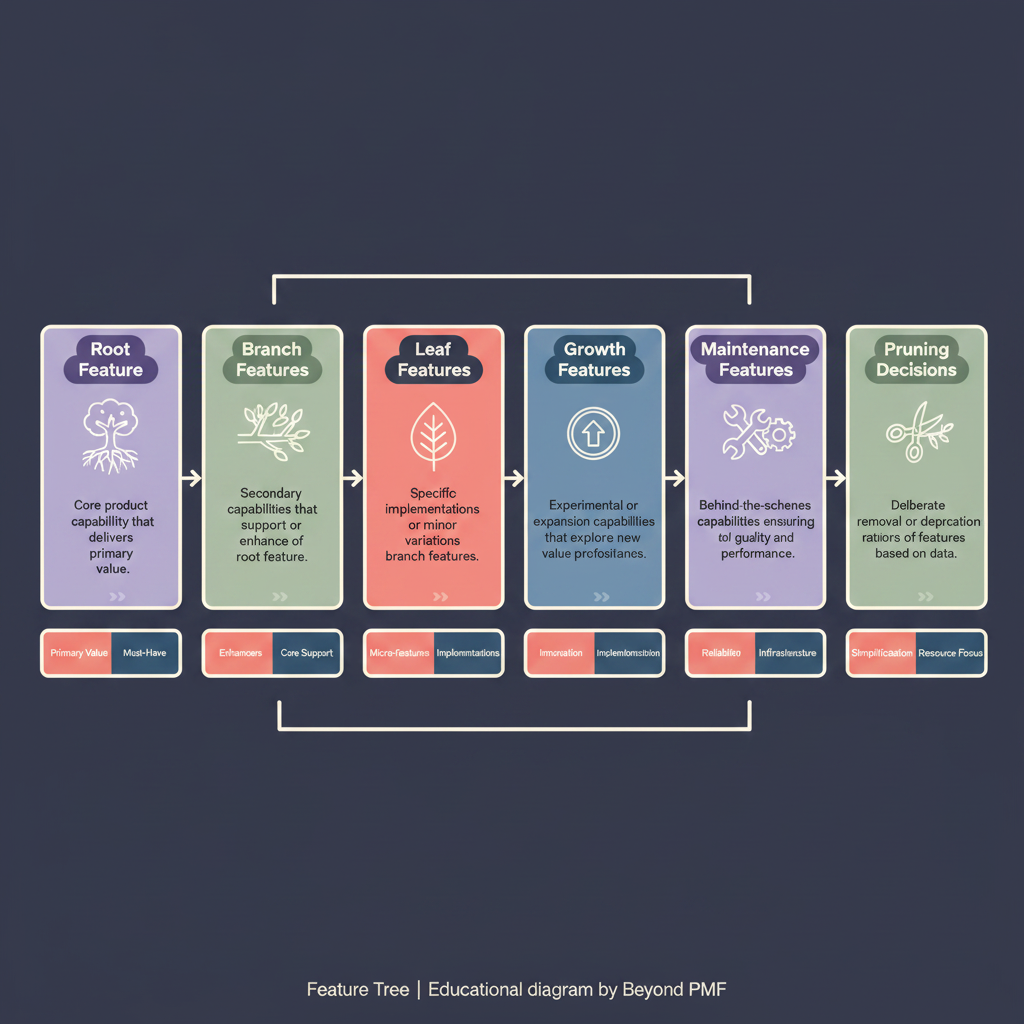
The Feature Tree framework is a hierarchical visualization that helps product managers and development teams categorize, prioritize, and manage product features effectively. It resembles a tree structure where the main trunk represents the core product, and each branch represents different categories of features. This framework assists in ensuring that all product features are aligned with the business goals and user needs, facilitating better planning and communication across teams.
Identify the core product features and represent them as the trunk of the tree. | Categorize additional features into major groups that form the primary branches. | Break down each major feature group into smaller, detailed features, forming the smaller branches and leaves. | Prioritize features based on strategic importance and dependencies, marking them accordingly on the tree. | Use the tree for discussions and decision-making in product development meetings.
Regularly update the feature tree to reflect changes and additions | Use color coding or tagging to denote priority and status of features | Involve all stakeholders in the creation and updating of the feature tree
Provides a clear visualization of all product features | Helps in prioritizing features based on their strategic value | Facilitates better communication and understanding among team members
Can become complex and unwieldy with large numbers of features | May require frequent updates as product development progresses | Focuses more on structure than on the interdependencies between features
In the early stages of product development for initial feature planning | When revising or adding new features to an existing product
For products with very few features, where a simpler list or table may suffice | When rapid changes in the product features occur, making frequent updates cumbersome