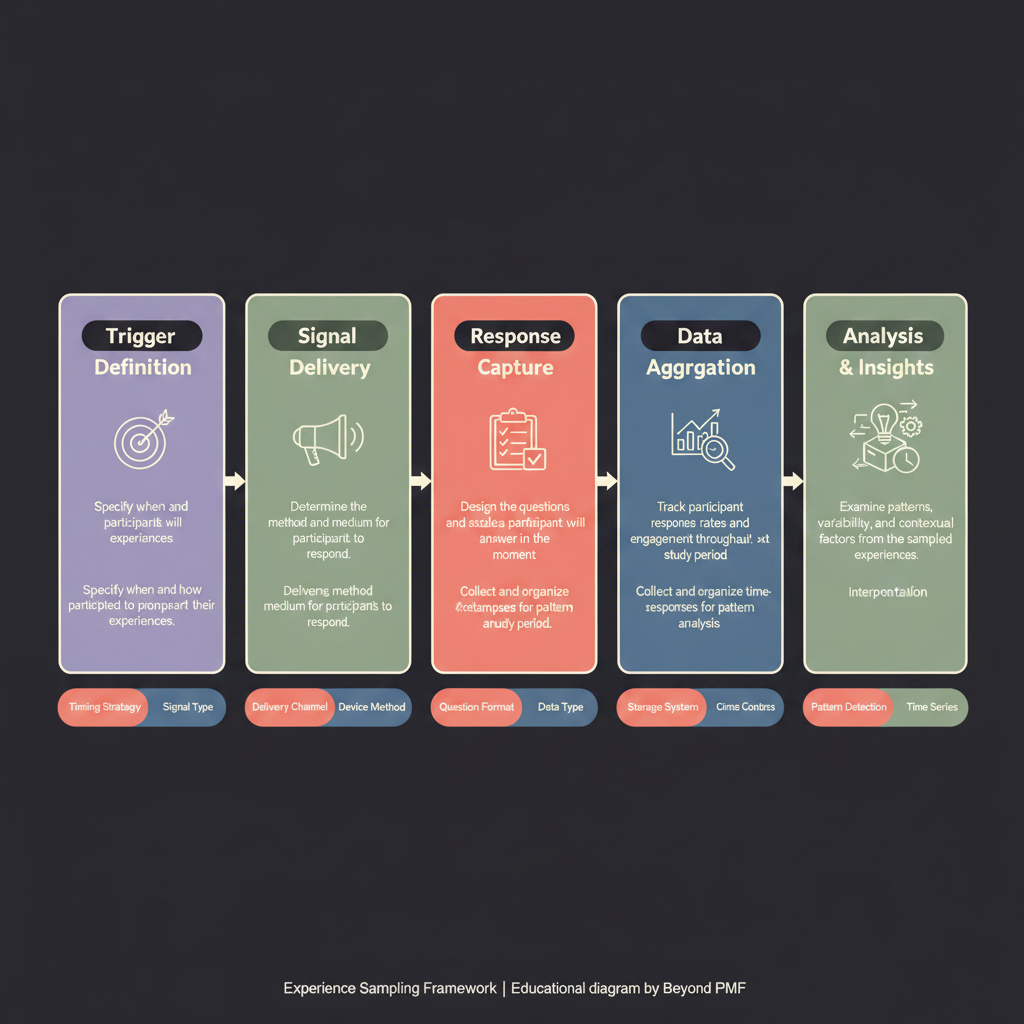
The Experience Sampling Framework (ESF) is a quantitative method that involves asking participants to report their thoughts, feelings, and behaviors at random intervals over a period of time. This approach allows researchers to capture data in the moment, reducing recall bias and providing a more accurate representation of participants' experiences. ESF is widely used in psychology, market research, and user experience studies to understand how people interact with their environments and how their experiences change over time.
Define the research objectives and questions. | Select a representative sample of participants. | Determine the sampling method (signal, event, or interval based). | Develop the questionnaire or assessment tool. | Implement the sampling protocol using mobile devices or paper diaries. | Collect the data at predetermined or random times. | Analyze the data to identify patterns and insights.
Ensure clear and concise instructions are provided to participants. | Use technology to simplify the data collection process. | Maintain regular communication with participants to encourage compliance.
High ecological validity due to real-time data collection | Reduces recall bias by capturing experiences as they occur | Flexible and adaptable to various research settings
Can be intrusive and disrupt daily activities | Relies on participant compliance and accuracy | Potentially high dropout rates due to the demanding nature of the method
Studying the daily experiences and behaviors of individuals | Researching the impact of specific events on mood and behavior
When the research requires non-intrusive methods | If the target population has limited access to required technology