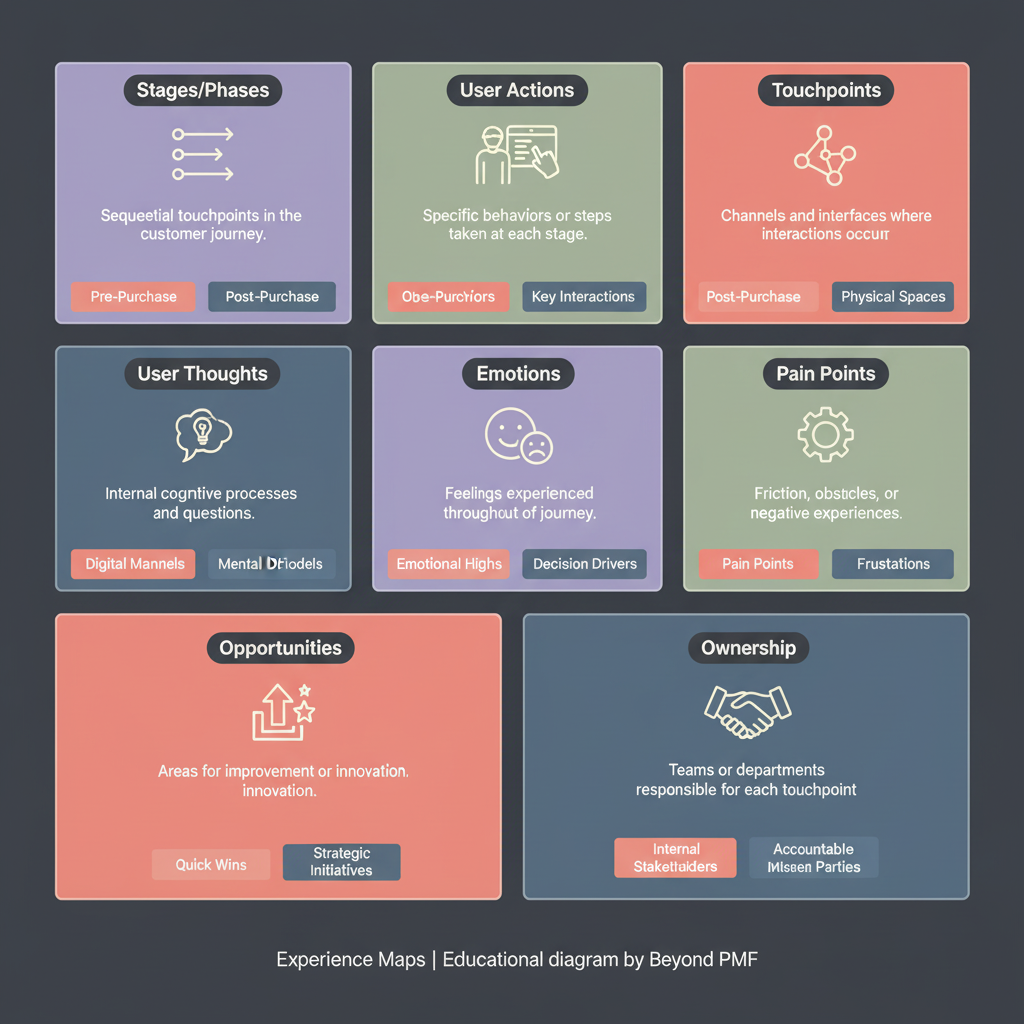
Experience Maps

Experience Maps primarily address customer UX issues by visualizing the customer journey and highlighting interactions and emotions. This helps identify and improve areas of friction in the user experience during delivery and implementation.

Experience Maps are comprehensive diagrams that chart the entire journey a user undergoes with a product or service, from initial awareness to post-use evaluation. This framework is used to gain deep insights into customer experiences, motivations, needs, and pain points. By visualizing the user's journey, organizations can identify opportunities for improvement and innovation, ensuring a more user-centered approach in their service delivery.

Steps / Detailed Description

Define the scope and objectives of the map. | Gather and analyze qualitative and quantitative user data. | Identify key user personas and their goals. | Map the user journey across various touchpoints. | Highlight critical moments, emotions, and pain points. | Validate and refine the map with real user feedback.

Best Practices

Involve stakeholders from different departments. | Regularly update the map with new insights. | Use clear, visual elements to enhance understanding.

Pros

Provides a holistic view of the customer journey. | Identifies gaps and opportunities in user experience. | Facilitates cross-functional collaboration and understanding.

Cons

Can be time-consuming to create and maintain. | Requires substantial user data to be accurate. | May become overly complex if not focused.

When to Use

When redesigning or launching new services/products. | When trying to understand user behavior and decision-making.

When Not to Use

For simple, short-term tactical decisions. | When there is insufficient data about user interactions.

Related Frameworks

Scope

Scope not defined

Maturity Level

Maturity level not specified

Time to Implement

2–4 Weeks
3–6 Months
1–2 Weeks
3–6 Months
1–2 Months
3–6 Months
1–2 Weeks
Less Than 1 Day
1–2 Weeks
Longer Than 6 Months
1–2 Weeks
Longer Than 6 Months
1–2 Weeks
3–6 Months
1–2 Weeks
1–2 Weeks
1–2 Weeks
1–2 Weeks
1–2 Days
1–2 Weeks
1–2 Weeks
1–2 Weeks
1–2 Weeks
1–2 Weeks
1–2 Weeks
3–6 Months
1–2 Weeks
1–2 Weeks
1–2 Weeks
3–6 Months
1–2 Weeks
1–2 Weeks
2–4 Weeks
1–2 Weeks
1–2 Days
1–2 Weeks
Longer Than 6 Months
3–6 Months
Longer Than 6 Months
1–2 Weeks
Longer Than 6 Months
3–6 Months
Less Than 1 Day
3–6 Months
1–2 Months
3–6 Months
Longer Than 6 Months
3–6 Months
Less Than 1 Day
1–2 Weeks
3–6 Months
3–6 Months
1–2 Weeks
3–6 Months
1–2 Weeks
1–2 Weeks
1–2 Days
1–2 Weeks
1–2 Months
Longer Than 6 Months
1–2 Weeks
Longer Than 6 Months
1–2 Weeks
3–6 Months
1–2 Weeks
Less Than 1 Day
1–2 Weeks
3–6 Months
1–2 Weeks
3–6 Months
1–2 Weeks
1–2 Weeks
Longer Than 6 Months
Less Than 1 Day
3–6 Months
Longer Than 6 Months
1–2 Months
1–2 Weeks
Longer Than 6 Months
1–2 Weeks
3–6 Months
1–2 Weeks
1–2 Weeks
3–6 Months
Less Than 1 Day
1–2 Weeks
1–2 Weeks
3–6 Months
3–6 Months
Less Than 1 Day
1–2 Weeks
Longer Than 6 Months
1–2 Months
1–2 Weeks
1–2 Weeks
1–2 Weeks
Longer Than 6 Months

Copyright Information

Autor:
Public Domain
N/A
Publication:
Generic Business Tool