Customer Development Model

https://ik.imagekit.io/beyondpmf/frameworks/customer-development-model.png
The Customer Development Model primarily addresses the strategic friction of market alignment and validating the business model. It helps identify the right market for a product and build features that meet customer needs, which is a core part of defining and validating business strategy. It guides the company on the correct direction, product positioning, and understanding of the business.

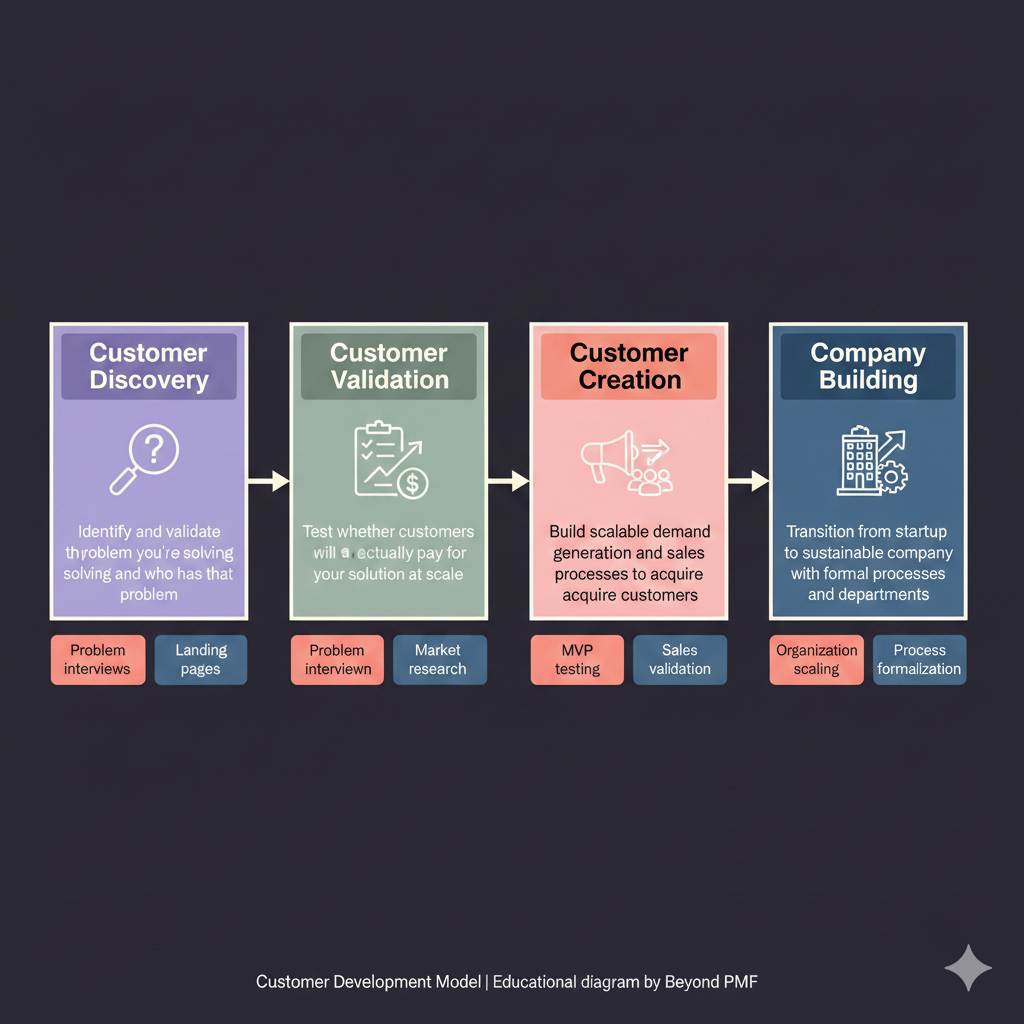
The Customer Development Model, developed by Steve Blank, is a key component of the Lean Startup methodology. It emphasizes understanding customer problems and needs before developing a full-scale product. This iterative, four-step framework guides businesses through the process of customer discovery, validation, creation, and company building. It is designed to help startups avoid building products that customers do not want and thus reduces the market risks and increases the likelihood of startup success.

Steps / Detailed Description

Customer Discovery: Identify and understand potential customers' problems and needs. | Customer Validation: Test the product concept with early adopters to ensure market demand. | Customer Creation: Develop and execute a marketing plan to drive customer demand and sales. | Company Building: Transition from a startup to a functional company with scalable operations.

Best Practices

Engage with real potential customers early and often | Be prepared to pivot based on customer feedback | Validate assumptions with minimal viable products (MVPs) rather than full features

Pros

Reduces the risk of product-market mismatch | Increases efficiency by focusing on customer feedback early in development | Facilitates a lean approach to product development

Cons

Time-consuming in the early stages | Requires substantial customer interaction which may be challenging | Can lead to pivoting away from original vision based on customer feedback

When to Use

When launching a new product | When entering a new market

When Not to Use

In a well-established market with well-defined customer preferences | When the product development is strictly technology-driven with little input from end-users

Related Frameworks

Scope

Scope not defined

Maturity Level

Maturity level not specified

Time to Implement

2–4 Weeks
3–6 Months
1–2 Weeks
3–6 Months
1–2 Months
3–6 Months
1–2 Weeks
Less Than 1 Day
1–2 Weeks
Longer Than 6 Months
1–2 Weeks
Longer Than 6 Months
1–2 Weeks
3–6 Months
1–2 Weeks
1–2 Weeks
1–2 Weeks
1–2 Weeks
1–2 Days
1–2 Weeks
1–2 Weeks
1–2 Weeks
1–2 Weeks
1–2 Weeks
1–2 Weeks
3–6 Months
1–2 Weeks
1–2 Weeks
1–2 Weeks
3–6 Months
1–2 Weeks
1–2 Weeks
2–4 Weeks
1–2 Weeks
1–2 Days
1–2 Weeks
Longer Than 6 Months
3–6 Months
Longer Than 6 Months
1–2 Weeks
Longer Than 6 Months
3–6 Months
Less Than 1 Day
3–6 Months
1–2 Months
3–6 Months
Longer Than 6 Months
3–6 Months
Less Than 1 Day
1–2 Weeks
3–6 Months
3–6 Months
1–2 Weeks
3–6 Months
1–2 Weeks
1–2 Weeks
1–2 Days
1–2 Weeks
1–2 Months
Longer Than 6 Months
1–2 Weeks
Longer Than 6 Months
1–2 Weeks
3–6 Months
1–2 Weeks
Less Than 1 Day
1–2 Weeks
3–6 Months
1–2 Weeks
3–6 Months
1–2 Weeks
1–2 Weeks
Longer Than 6 Months
Less Than 1 Day
3–6 Months
Longer Than 6 Months
1–2 Months
1–2 Weeks
Longer Than 6 Months
1–2 Weeks
3–6 Months
1–2 Weeks
1–2 Weeks
3–6 Months
Less Than 1 Day
1–2 Weeks
1–2 Weeks
3–6 Months
3–6 Months
Less Than 1 Day
1–2 Weeks
Longer Than 6 Months
1–2 Months
1–2 Weeks
1–2 Weeks
1–2 Weeks
Longer Than 6 Months

Copyright Information

Autor:
Steve Blank
2005
Publication:
The Four Steps to the Epiphany