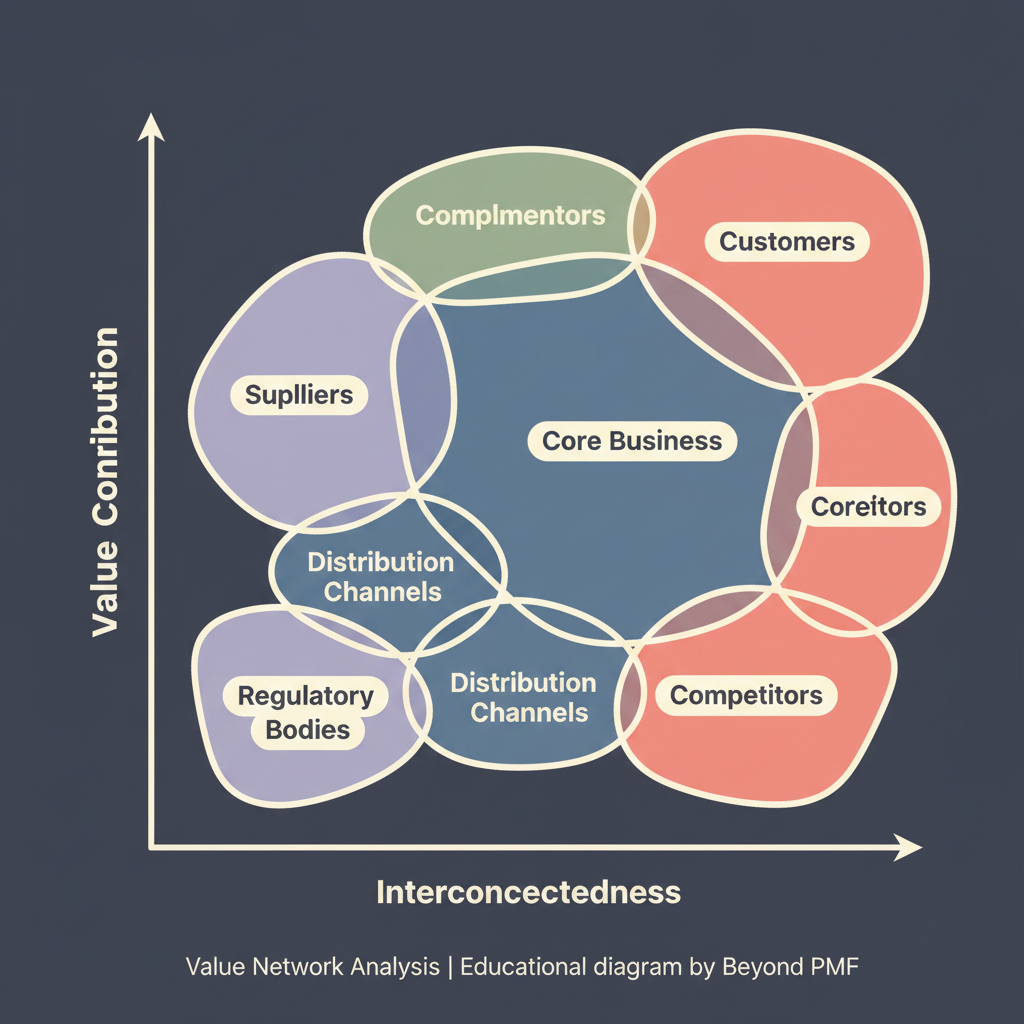
Value Network Analysis

https://ik.imagekit.io/beyondpmf/frameworks/value-network-analysis.png
Value Network Analysis helps visualize and analyze relationships between entities, thus addressing issues related to org design and cross-functional alignment. It helps clarify how value flows and where bottlenecks or inefficiencies in relationships might exist. This directly addresses structural friction in the organization.

Value Network Analysis is a comprehensive framework that helps organizations identify and optimize the interactions and exchanges between people, roles, and entities within a network. It is used to assess the tangible and intangible assets that flow through these connections, such as information, money, and services, to enhance efficiency and innovation. The framework is beneficial for improving collaboration, enhancing strategic decision-making, and increasing organizational agility by providing a clear map of value flows and dependencies.

Steps / Detailed Description

Identify all relevant entities (people, roles, organizations) within the network. | Map out the interactions and transactions between these entities. | Analyze the value of each interaction and transaction. | Identify areas of inefficiency or underutilized resources. | Develop strategies to enhance value creation and streamline processes.

Best Practices

Regularly update the value network maps to reflect changes in the organization | Involve stakeholders from different parts of the network for comprehensive input | Use advanced analytical tools to process and visualize data effectively

Pros

Enhances understanding of complex interdependencies within a network | Facilitates better strategic decision-making by mapping value flows | Improves identification of opportunities for innovation and collaboration

Cons

Can be time-consuming to gather and analyze all necessary data | Requires a deep understanding of all network interactions to be effective | May not capture the dynamic nature of some interactions over time

When to Use

When needing to improve organizational efficiency and collaboration | During strategic planning to understand and optimize value creation

When Not to Use

In very small organizations where network relationships are already clear | When quick, tactical decisions are needed without the time for in-depth analysis

Related Frameworks

Lifecycle

Not tied to a specific lifecycle stage

Scope

Scope not defined

Maturity Level

Maturity level not specified

Time to Implement

2–4 Weeks
3–6 Months
1–2 Weeks
3–6 Months
1–2 Months
3–6 Months
1–2 Weeks
Less Than 1 Day
1–2 Weeks
Longer Than 6 Months
1–2 Weeks
Longer Than 6 Months
1–2 Weeks
3–6 Months
1–2 Weeks
1–2 Weeks
1–2 Weeks
1–2 Weeks
1–2 Days
1–2 Weeks
1–2 Weeks
1–2 Weeks
1–2 Weeks
1–2 Weeks
1–2 Weeks
3–6 Months
1–2 Weeks
1–2 Weeks
1–2 Weeks
3–6 Months
1–2 Weeks
1–2 Weeks
2–4 Weeks
1–2 Weeks
1–2 Days
1–2 Weeks
Longer Than 6 Months
3–6 Months
Longer Than 6 Months
1–2 Weeks
Longer Than 6 Months
3–6 Months
Less Than 1 Day
3–6 Months
1–2 Months
3–6 Months
Longer Than 6 Months
3–6 Months
Less Than 1 Day
1–2 Weeks
3–6 Months
3–6 Months
1–2 Weeks
3–6 Months
1–2 Weeks
1–2 Weeks
1–2 Days
1–2 Weeks
1–2 Months
Longer Than 6 Months
1–2 Weeks
Longer Than 6 Months
1–2 Weeks
3–6 Months
1–2 Weeks
Less Than 1 Day
1–2 Weeks
3–6 Months
1–2 Weeks
3–6 Months
1–2 Weeks
1–2 Weeks
Longer Than 6 Months
Less Than 1 Day
3–6 Months
Longer Than 6 Months
1–2 Months
1–2 Weeks
Longer Than 6 Months
1–2 Weeks
3–6 Months
1–2 Weeks
1–2 Weeks
3–6 Months
Less Than 1 Day
1–2 Weeks
1–2 Weeks
3–6 Months
3–6 Months
Less Than 1 Day
1–2 Weeks
Longer Than 6 Months
1–2 Months
1–2 Weeks
1–2 Weeks
1–2 Weeks
Longer Than 6 Months

Copyright Information

Autor:
Unknown
N/A
Publication:
Generic Business Tool