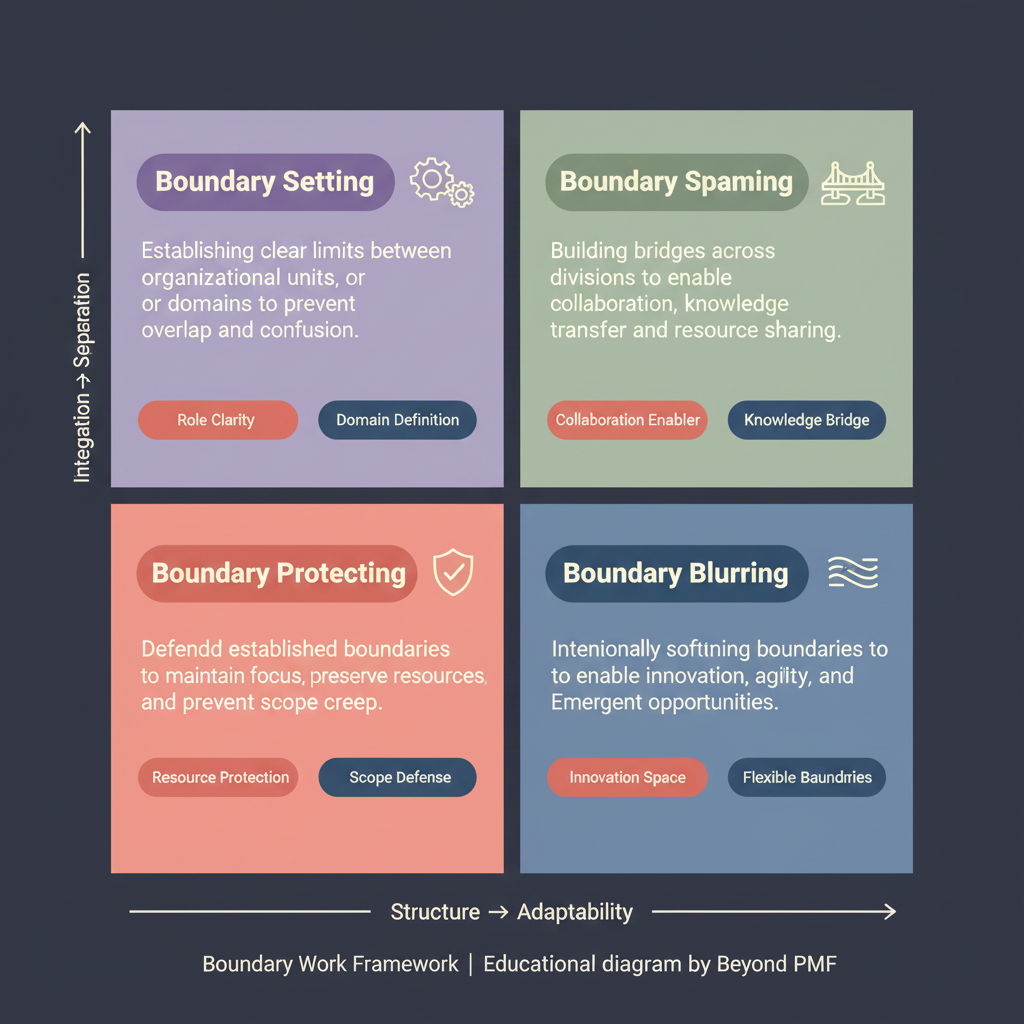
Boundary Work Framework

https://ik.imagekit.io/beyondpmf/frameworks/boundary-work-framework.png
The Boundary Work Framework primarily addresses structural friction by focusing on how different organizational units or disciplines interact. It aims to improve alignment, clarify roles, and optimize the overall org design by explicitly managing the interfaces between teams.

The Boundary Work Framework is designed to help organizations effectively manage the interfaces between different functional areas, departments, or external partners. It focuses on establishing clear roles, responsibilities, and communication channels to enhance collaboration and minimize conflicts. This framework is particularly beneficial in complex projects or environments where interdisciplinary cooperation is crucial for success.

Steps / Detailed Description

Identify the boundaries: Determine where the boundaries lie between different groups or areas. | Define roles and responsibilities: Clearly outline what each party is responsible for at these boundaries. | Establish communication protocols: Set up effective communication channels and rules to facilitate smooth interactions. | Implement boundary-spanning activities: Engage in activities that foster collaboration and understanding across boundaries. | Monitor and adjust: Regularly review the effectiveness of boundary management and make necessary adjustments.

Best Practices

Regularly update boundary definitions as the organization evolves | Encourage open communication and feedback across boundaries | Provide training and support for boundary-spanning roles

Pros

Enhances collaboration across different units | Reduces conflicts and misunderstandings | Improves overall organizational efficiency

Cons

Can be time-consuming to implement | Requires continuous monitoring and adjustment | May be resisted by organizational cultures that value independence

When to Use

In multi-departmental projects | When collaborating with external partners

When Not to Use

In small or less complex projects | When quick decision-making is required without cross-departmental input

Related Frameworks

Lifecycle

Not tied to a specific lifecycle stage

Scope

Scope not defined

Maturity Level

Maturity level not specified

Time to Implement

2–4 Weeks
3–6 Months
1–2 Weeks
3–6 Months
1–2 Months
3–6 Months
1–2 Weeks
Less Than 1 Day
1–2 Weeks
Longer Than 6 Months
1–2 Weeks
Longer Than 6 Months
1–2 Weeks
3–6 Months
1–2 Weeks
1–2 Weeks
1–2 Weeks
1–2 Weeks
1–2 Days
1–2 Weeks
1–2 Weeks
1–2 Weeks
1–2 Weeks
1–2 Weeks
1–2 Weeks
3–6 Months
1–2 Weeks
1–2 Weeks
1–2 Weeks
3–6 Months
1–2 Weeks
1–2 Weeks
2–4 Weeks
1–2 Weeks
1–2 Days
1–2 Weeks
Longer Than 6 Months
3–6 Months
Longer Than 6 Months
1–2 Weeks
Longer Than 6 Months
3–6 Months
Less Than 1 Day
3–6 Months
1–2 Months
3–6 Months
Longer Than 6 Months
3–6 Months
Less Than 1 Day
1–2 Weeks
3–6 Months
3–6 Months
1–2 Weeks
3–6 Months
1–2 Weeks
1–2 Weeks
1–2 Days
1–2 Weeks
1–2 Months
Longer Than 6 Months
1–2 Weeks
Longer Than 6 Months
1–2 Weeks
3–6 Months
1–2 Weeks
Less Than 1 Day
1–2 Weeks
3–6 Months
1–2 Weeks
3–6 Months
1–2 Weeks
1–2 Weeks
Longer Than 6 Months
Less Than 1 Day
3–6 Months
Longer Than 6 Months
1–2 Months
1–2 Weeks
Longer Than 6 Months
1–2 Weeks
3–6 Months
1–2 Weeks
1–2 Weeks
3–6 Months
Less Than 1 Day
1–2 Weeks
1–2 Weeks
3–6 Months
3–6 Months
Less Than 1 Day
1–2 Weeks
Longer Than 6 Months
1–2 Months
1–2 Weeks
1–2 Weeks
1–2 Weeks
Longer Than 6 Months

Copyright Information

Autor:
Unknown
N/A
Publication:
Unknown