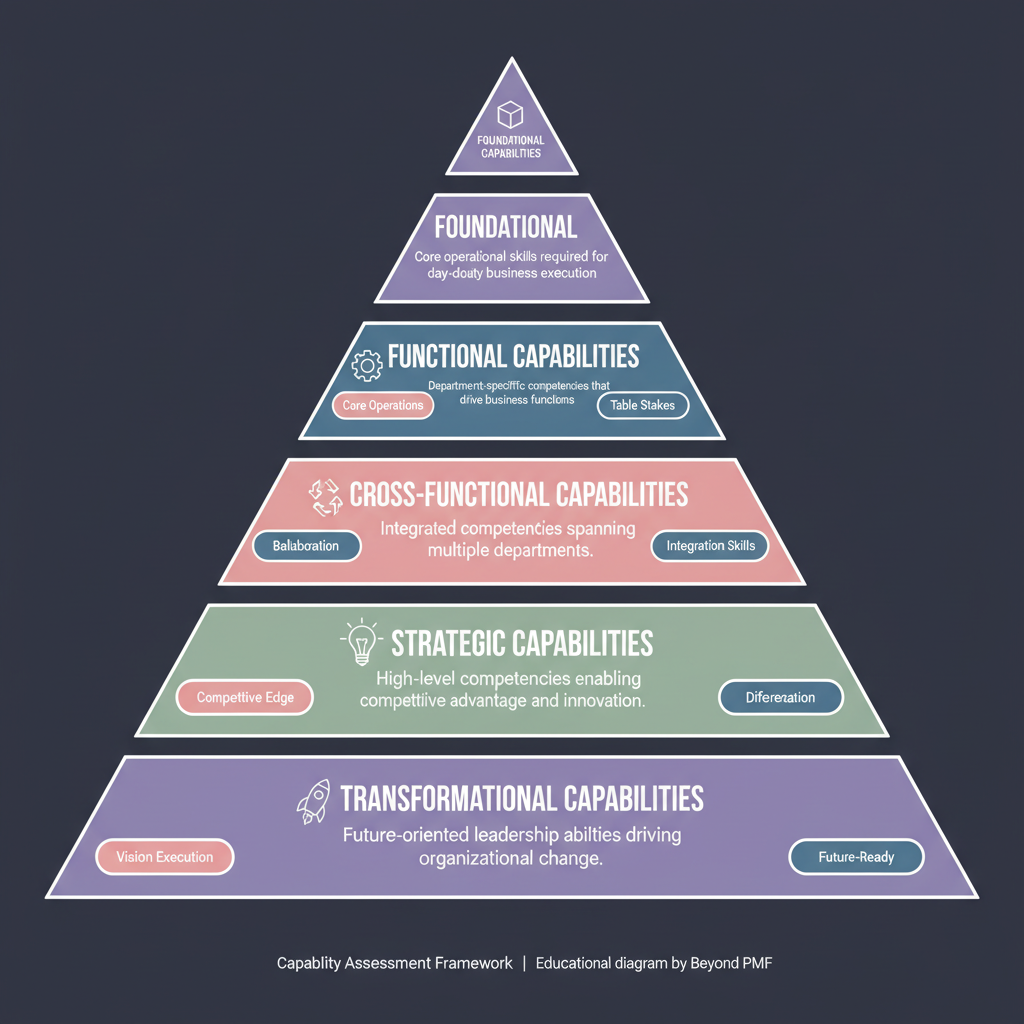
Capability Assessment Framework

https://ik.imagekit.io/beyondpmf/frameworks/capability-assessment-framework.png
The Capability Assessment Framework helps organizations evaluate and improve their abilities, which directly impacts the efficiency and effectiveness of their operational processes. By identifying capability gaps, the framework helps to streamline workflows and improve coordination across different functions.

The Capability Assessment Framework is designed to help organizations assess their current capabilities against a set of criteria to identify areas of strength and improvement. It is used to systematically evaluate processes, people, and technology within an organization. The framework aids in decision-making by providing insights into operational effectiveness and strategic alignment, thereby enhancing overall performance and competitiveness.

Steps / Detailed Description

Define the scope and objectives of the assessment. | Identify the capabilities to be assessed. | Develop assessment criteria and metrics. | Collect data through surveys, interviews, and observations. | Analyze the data to determine capability gaps. | Develop recommendations for improvement based on the analysis. | Implement improvement strategies. | Monitor progress and re-assess periodically.

Best Practices

Ensure clear communication of the purpose and benefits of the assessment. | Involve stakeholders from different levels of the organization. | Regularly update the assessment criteria to reflect changes in business environment.

Pros

Provides a clear understanding of current capabilities. | Helps in identifying areas for improvement. | Facilitates strategic planning and resource allocation.

Cons

Can be time-consuming and resource-intensive. | May require specialized skills to conduct effectively. | Risk of resistance from staff if not managed properly.

When to Use

When undergoing strategic planning. | When seeking to improve operational efficiency.

When Not to Use

When there is limited time and resources. | In highly volatile or uncertain industry conditions.

Related Frameworks

Lifecycle

Not tied to a specific lifecycle stage

Scope

Scope not defined

Maturity Level

Maturity level not specified

Time to Implement

2–4 Weeks
3–6 Months
1–2 Weeks
3–6 Months
1–2 Months
3–6 Months
1–2 Weeks
Less Than 1 Day
1–2 Weeks
Longer Than 6 Months
1–2 Weeks
Longer Than 6 Months
1–2 Weeks
3–6 Months
1–2 Weeks
1–2 Weeks
1–2 Weeks
1–2 Weeks
1–2 Days
1–2 Weeks
1–2 Weeks
1–2 Weeks
1–2 Weeks
1–2 Weeks
1–2 Weeks
3–6 Months
1–2 Weeks
1–2 Weeks
1–2 Weeks
3–6 Months
1–2 Weeks
1–2 Weeks
2–4 Weeks
1–2 Weeks
1–2 Days
1–2 Weeks
Longer Than 6 Months
3–6 Months
Longer Than 6 Months
1–2 Weeks
Longer Than 6 Months
3–6 Months
Less Than 1 Day
3–6 Months
1–2 Months
3–6 Months
Longer Than 6 Months
3–6 Months
Less Than 1 Day
1–2 Weeks
3–6 Months
3–6 Months
1–2 Weeks
3–6 Months
1–2 Weeks
1–2 Weeks
1–2 Days
1–2 Weeks
1–2 Months
Longer Than 6 Months
1–2 Weeks
Longer Than 6 Months
1–2 Weeks
3–6 Months
1–2 Weeks
Less Than 1 Day
1–2 Weeks
3–6 Months
1–2 Weeks
3–6 Months
1–2 Weeks
1–2 Weeks
Longer Than 6 Months
Less Than 1 Day
3–6 Months
Longer Than 6 Months
1–2 Months
1–2 Weeks
Longer Than 6 Months
1–2 Weeks
3–6 Months
1–2 Weeks
1–2 Weeks
3–6 Months
Less Than 1 Day
1–2 Weeks
1–2 Weeks
3–6 Months
3–6 Months
Less Than 1 Day
1–2 Weeks
Longer Than 6 Months
1–2 Months
1–2 Weeks
1–2 Weeks
1–2 Weeks
Longer Than 6 Months

Copyright Information

Autor:
Public Domain
N/A
Publication:
Generic Business Tool