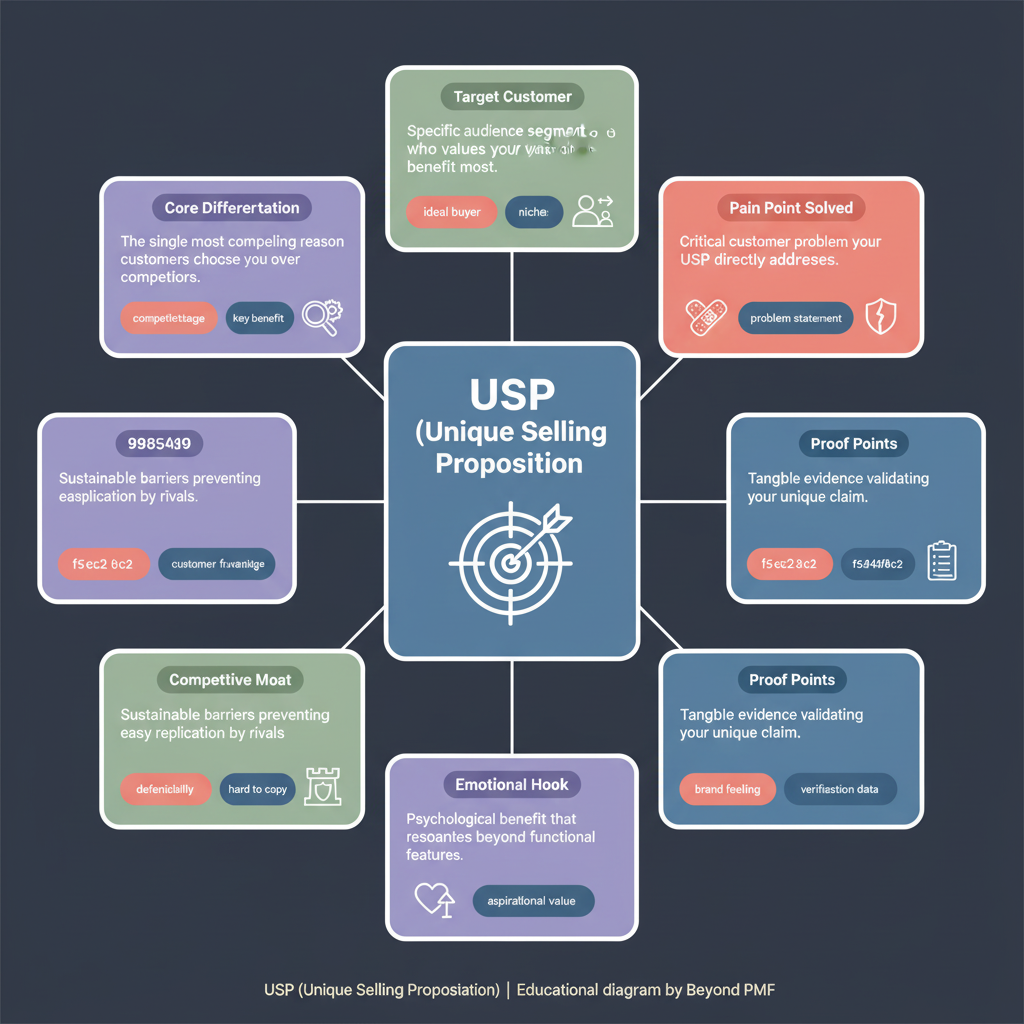
USP (Unique Selling Proposition)

https://ik.imagekit.io/beyondpmf/frameworks/usp-unique-selling-proposition.png
The USP framework primarily addresses the strategic friction of unclear market positioning and lack of differentiation. It helps businesses define a clear value proposition, thus creating a competitive advantage and a cohesive business strategy.

The Unique Selling Proposition (USP) is a marketing concept that identifies the distinct benefits or features of a product or service that set it apart from competitors. It is used to highlight the unique value offered to customers, thereby creating a competitive advantage. The USP should be compelling enough to attract customers and encourage them to choose one brand over others. It is crucial for effective branding, marketing campaigns, and overall business strategy.

Steps / Detailed Description

Identify the features or attributes of the product or service. | Research the needs and desires of the target audience. | Analyze competitors to understand what they offer and their weaknesses. | Define what makes your product or service unique in addressing customer needs better than competitors. | Craft a clear and concise USP statement that encapsulates this uniqueness. | Integrate the USP into all marketing and communication strategies.

Best Practices

Ensure the USP is genuinely unique and not easily replicated. | Keep the USP simple, memorable, and relevant to the target audience. | Regularly review and adjust the USP based on market changes and customer feedback.

Pros

Helps differentiate a product or service in a crowded market. | Enhances brand recall and customer loyalty. | Facilitates focused and effective marketing strategies.

Cons

Risk of oversimplification, missing out on other product features. | May lead to customer disappointment if expectations are not met. | Requires constant updating to maintain relevance in dynamic markets.

When to Use

Launching a new product or service. | Rebranding or repositioning an existing product.

When Not to Use

When the product features are similar and not distinguishable from competitors. | In highly regulated markets where differentiation is limited.

Related Frameworks

Lifecycle

Scope

Scope not defined

Maturity Level

Maturity level not specified

Time to Implement

2–4 Weeks
3–6 Months
1–2 Weeks
3–6 Months
1–2 Months
3–6 Months
1–2 Weeks
Less Than 1 Day
1–2 Weeks
Longer Than 6 Months
1–2 Weeks
Longer Than 6 Months
1–2 Weeks
3–6 Months
1–2 Weeks
1–2 Weeks
1–2 Weeks
1–2 Weeks
1–2 Days
1–2 Weeks
1–2 Weeks
1–2 Weeks
1–2 Weeks
1–2 Weeks
1–2 Weeks
3–6 Months
1–2 Weeks
1–2 Weeks
1–2 Weeks
3–6 Months
1–2 Weeks
1–2 Weeks
2–4 Weeks
1–2 Weeks
1–2 Days
1–2 Weeks
Longer Than 6 Months
3–6 Months
Longer Than 6 Months
1–2 Weeks
Longer Than 6 Months
3–6 Months
Less Than 1 Day
3–6 Months
1–2 Months
3–6 Months
Longer Than 6 Months
3–6 Months
Less Than 1 Day
1–2 Weeks
3–6 Months
3–6 Months
1–2 Weeks
3–6 Months
1–2 Weeks
1–2 Weeks
1–2 Days
1–2 Weeks
1–2 Months
Longer Than 6 Months
1–2 Weeks
Longer Than 6 Months
1–2 Weeks
3–6 Months
1–2 Weeks
Less Than 1 Day
1–2 Weeks
3–6 Months
1–2 Weeks
3–6 Months
1–2 Weeks
1–2 Weeks
Longer Than 6 Months
Less Than 1 Day
3–6 Months
Longer Than 6 Months
1–2 Months
1–2 Weeks
Longer Than 6 Months
1–2 Weeks
3–6 Months
1–2 Weeks
1–2 Weeks
3–6 Months
Less Than 1 Day
1–2 Weeks
1–2 Weeks
3–6 Months
3–6 Months
Less Than 1 Day
1–2 Weeks
Longer Than 6 Months
1–2 Months
1–2 Weeks
1–2 Weeks
1–2 Weeks
Longer Than 6 Months

Copyright Information

Autor:
Rosser Reeves
1940s
Publication:
Ted Bates Advertising Agency