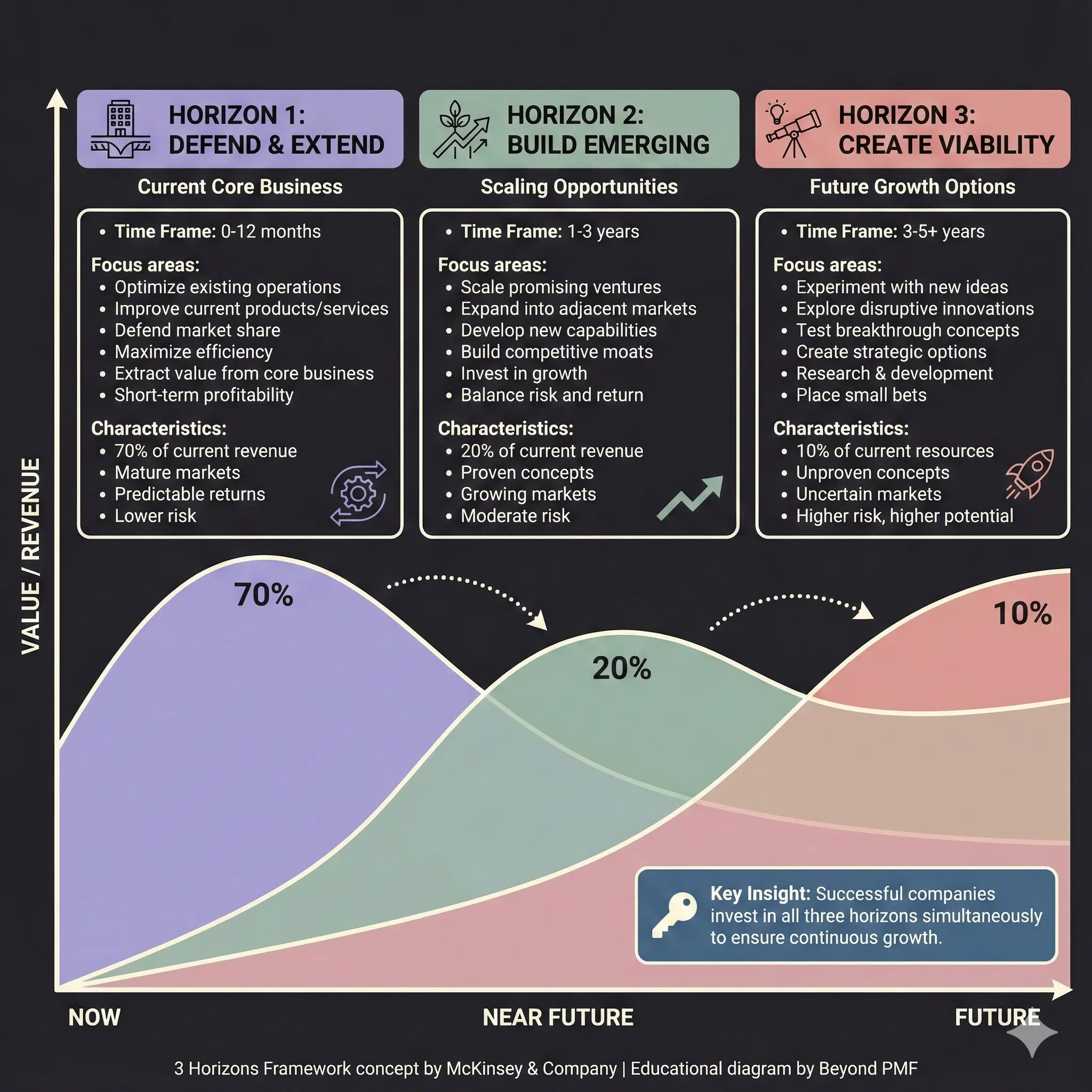
3 Horizons Framework

Diagram of the McKinsey 3 Horizons Framework showing three time-based growth horizons: Horizon 1 β€˜Defend & Extend’ for core business, Horizon 2 β€˜Build Emerging’ for scaling opportunities, and Horizon 3 β€˜Create Viability’ for future growth. Includes focus areas, characteristics, and overlapping curves labeled 70%, 20%, and 10% to illustrate shifting value over time.”
The 3 Horizons Framework primarily addresses the strategic friction of balancing short-term operational needs with long-term growth and future planning. It helps organizations clarify their strategic direction by considering both current activities and future opportunities, addressing potential conflicts in priorities.

The 3 Horizons Framework is a strategic tool used by businesses to ensure continuous growth by managing different levels of business initiatives. Horizon 1 focuses on improving current operations, Horizon 2 on emerging opportunities, and Horizon 3 on creating future options. This framework aids in prioritizing investments and resources, ensuring that companies are not only maintaining their current market position but also investing in future growth.

Steps / Detailed Description

Identify and categorize current business activities into three horizons based on their time frame and potential for growth. | Develop strategies for each horizon: optimizing existing products and services for Horizon 1, developing new opportunities for Horizon 2, and creating visionary ideas for Horizon 3. | Allocate resources and adjust investments across all horizons to balance short-term performance with long-term growth. | Regularly review and revise the strategies and resource allocations as market conditions and company capabilities evolve.

Best Practices

Clearly define what constitutes each horizon within your organization | Ensure top management involvement and support for long-term initiatives | Regularly review and adjust the horizons as per the changing business environment

Pros

Encourages long-term thinking while maintaining short-term performance | Helps in allocating resources efficiently across different stages of growth | Facilitates innovation by systematically exploring future opportunities

Cons

Can be complex to implement without clear definitions and goals | Risk of neglecting Horizon 3 due to pressure for immediate results | Requires significant management commitment and understanding

When to Use

When planning long-term business growth strategies | In times of significant market or technological changes

When Not to Use

If the organization is in crisis mode and needs immediate survival strategies | When there is insufficient leadership commitment to support long-term initiatives

Related Frameworks

Lifecycle

Scope

Scope not defined

Maturity Level

Maturity level not specified

Time to Implement

2–4 Weeks
3–6 Months
1–2 Weeks
3–6 Months
1–2 Months
3–6 Months
1–2 Weeks
Less Than 1 Day
1–2 Weeks
Longer Than 6 Months
1–2 Weeks
Longer Than 6 Months
1–2 Weeks
3–6 Months
1–2 Weeks
1–2 Weeks
1–2 Weeks
1–2 Weeks
1–2 Days
1–2 Weeks
1–2 Weeks
1–2 Weeks
1–2 Weeks
1–2 Weeks
1–2 Weeks
3–6 Months
1–2 Weeks
1–2 Weeks
1–2 Weeks
3–6 Months
1–2 Weeks
1–2 Weeks
2–4 Weeks
1–2 Weeks
1–2 Days
1–2 Weeks
Longer Than 6 Months
3–6 Months
Longer Than 6 Months
1–2 Weeks
Longer Than 6 Months
3–6 Months
Less Than 1 Day
3–6 Months
1–2 Months
3–6 Months
Longer Than 6 Months
3–6 Months
Less Than 1 Day
1–2 Weeks
3–6 Months
3–6 Months
1–2 Weeks
3–6 Months
1–2 Weeks
1–2 Weeks
1–2 Days
1–2 Weeks
1–2 Months
Longer Than 6 Months
1–2 Weeks
Longer Than 6 Months
1–2 Weeks
3–6 Months
1–2 Weeks
Less Than 1 Day
1–2 Weeks
3–6 Months
1–2 Weeks
3–6 Months
1–2 Weeks
1–2 Weeks
Longer Than 6 Months
Less Than 1 Day
3–6 Months
Longer Than 6 Months
1–2 Months
1–2 Weeks
Longer Than 6 Months
1–2 Weeks
3–6 Months
1–2 Weeks
1–2 Weeks
3–6 Months
Less Than 1 Day
1–2 Weeks
1–2 Weeks
3–6 Months
3–6 Months
Less Than 1 Day
1–2 Weeks
Longer Than 6 Months
1–2 Months
1–2 Weeks
1–2 Weeks
1–2 Weeks
Longer Than 6 Months

Copyright Information

Autor:
McKinsey & Company
2000
Publication:
McKinsey & Company