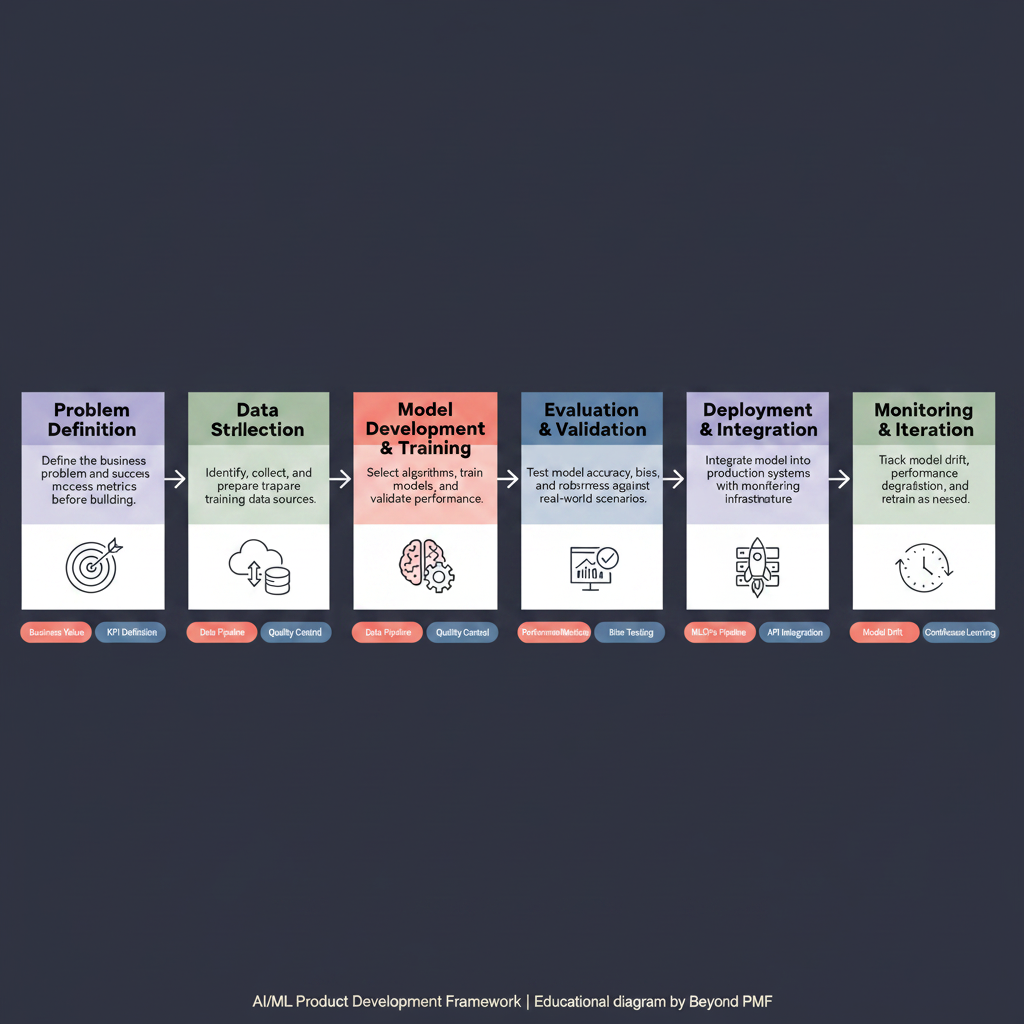
AI/ML Product Development Framework

https://ik.imagekit.io/beyondpmf/frameworks/ai-ml-product-development-framework.png
This framework focuses on the practical steps of developing and deploying AI/ML products. It primarily addresses challenges related to technical implementation, delivery speed, and the overall quality of the product, including customer-facing aspects.

The AI/ML Product Development Framework is a comprehensive guide used by organizations to streamline the development of artificial intelligence and machine learning products. It encompasses all phases of product development, from initial data collection and analysis to model training, validation, and deployment. This framework is crucial for ensuring that AI/ML solutions are not only technically viable but also align with business objectives and user needs, thereby maximizing the return on investment.

Steps / Detailed Description

Define the problem and set clear objectives. | Collect and preprocess data relevant to the problem. | Choose appropriate machine learning models and algorithms. | Train the models using the prepared datasets. | Evaluate model performance and iterate to improve accuracy. | Deploy the model in a controlled production environment. | Monitor the model's performance and update as needed.

Best Practices

Continuously update data and models to reflect new information. | Involve stakeholders early and often in the development process. | Implement robust security and privacy measures from the start.

Pros

Ensures alignment of AI/ML projects with business goals. | Facilitates systematic and repeatable development processes. | Improves product quality through structured testing and validation.

Cons

Can be time-consuming and resource-intensive. | Requires high expertise in both AI/ML and domain-specific knowledge. | Rapid technological changes can outpace the development cycle.

When to Use

Developing new AI-powered products or services. | Enhancing existing products with AI capabilities.

When Not to Use

Projects with undefined or constantly changing objectives. | When quick, temporary solutions are needed without scalability concerns.

Related Frameworks

Lifecycle

Scope

Scope not defined

Maturity Level

Maturity level not specified

Time to Implement

2–4 Weeks
3–6 Months
1–2 Weeks
3–6 Months
1–2 Months
3–6 Months
1–2 Weeks
Less Than 1 Day
1–2 Weeks
Longer Than 6 Months
1–2 Weeks
Longer Than 6 Months
1–2 Weeks
3–6 Months
1–2 Weeks
1–2 Weeks
1–2 Weeks
1–2 Weeks
1–2 Days
1–2 Weeks
1–2 Weeks
1–2 Weeks
1–2 Weeks
1–2 Weeks
1–2 Weeks
3–6 Months
1–2 Weeks
1–2 Weeks
1–2 Weeks
3–6 Months
1–2 Weeks
1–2 Weeks
2–4 Weeks
1–2 Weeks
1–2 Days
1–2 Weeks
Longer Than 6 Months
3–6 Months
Longer Than 6 Months
1–2 Weeks
Longer Than 6 Months
3–6 Months
Less Than 1 Day
3–6 Months
1–2 Months
3–6 Months
Longer Than 6 Months
3–6 Months
Less Than 1 Day
1–2 Weeks
3–6 Months
3–6 Months
1–2 Weeks
3–6 Months
1–2 Weeks
1–2 Weeks
1–2 Days
1–2 Weeks
1–2 Months
Longer Than 6 Months
1–2 Weeks
Longer Than 6 Months
1–2 Weeks
3–6 Months
1–2 Weeks
Less Than 1 Day
1–2 Weeks
3–6 Months
1–2 Weeks
3–6 Months
1–2 Weeks
1–2 Weeks
Longer Than 6 Months
Less Than 1 Day
3–6 Months
Longer Than 6 Months
1–2 Months
1–2 Weeks
Longer Than 6 Months
1–2 Weeks
3–6 Months
1–2 Weeks
1–2 Weeks
3–6 Months
Less Than 1 Day
1–2 Weeks
1–2 Weeks
3–6 Months
3–6 Months
Less Than 1 Day
1–2 Weeks
Longer Than 6 Months
1–2 Months
1–2 Weeks
1–2 Weeks
1–2 Weeks
Longer Than 6 Months

Copyright Information

Autor:
Unknown
N/A
Publication:
Unknown