8Ps Marketing Mix

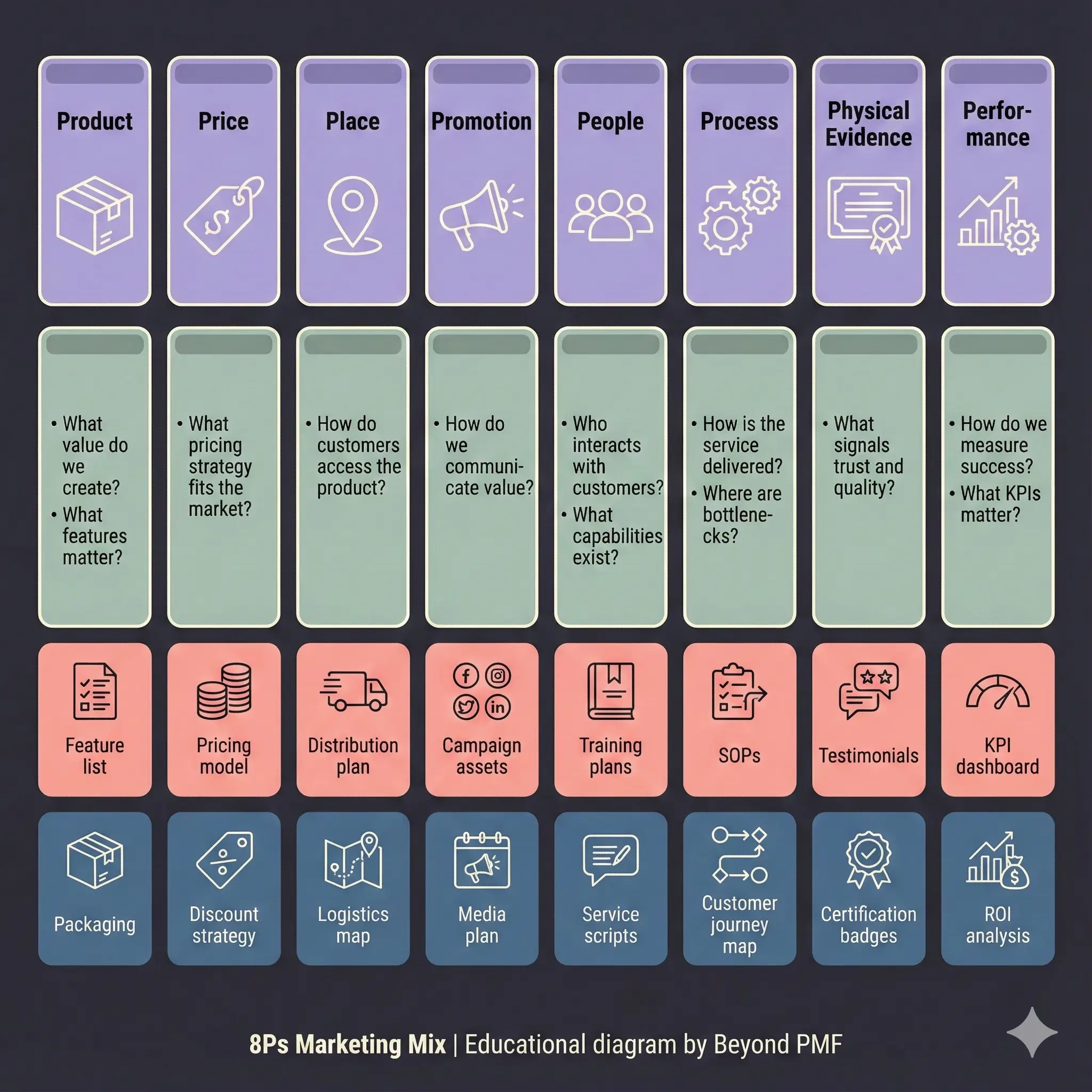
Diagram of the 8Ps Marketing Mix showing eight elements: Product, Price, Place, Promotion, People, Process, Physical Evidence, and Performance. Each column lists key questions such as value creation, pricing strategy, distribution, communication, capabilities, service delivery, quality signals, and KPIs. The bottom row provides example outputs like feature lists, pricing models, distribution plans, campaign assets, training plans, SOPs, testimonials, and KPI dashboards.
The 8Ps Marketing Mix aims to provide a more detailed marketing strategy by addressing various aspects of the market. This framework specifically deals with the overall direction of marketing efforts, market alignment, and the business model related to the marketing function.

The 8Ps Marketing Mix is a comprehensive tool used by marketers to analyze and optimize various aspects of their marketing strategies. It extends the classic 4Ps (Product, Price, Place, Promotion) by adding four more Ps: People, Process, Physical evidence, and Performance. This framework helps businesses to better understand their operations and market environment, enabling them to tailor their strategies to meet customer needs more effectively and enhance their competitive advantage.

Steps / Detailed Description

Product: Define and develop your product or service to meet customer needs. | Price: Set pricing strategies that reflect the perceived value and market demand. | Place: Choose distribution channels that ensure product availability where and when customers need it. | Promotion: Develop and implement promotional strategies to communicate with the target market. | People: Manage customer interactions and ensure staff are well-trained and customer-focused. | Process: Optimize and streamline operational processes for efficiency and customer satisfaction. | Physical Evidence: Create a tangible or visual proof of the service quality to build customer trust. | Performance: Monitor and measure the performance of the marketing strategies and make necessary adjustments.

Best Practices

Regularly review each of the 8Ps to ensure they are aligned with current market conditions | Train staff to understand and implement the marketing mix effectively | Use customer feedback to continuously improve each aspect of the mix

Pros

Provides a more holistic view of the marketing strategy | Enhances customer experience through additional focus areas | Facilitates better alignment of marketing strategies with business objectives

Cons

Can be complex and time-consuming to implement | May require more resources and coordination | Risk of diluting focus by trying to optimize across too many areas

When to Use

When developing a comprehensive marketing strategy | When entering a new market or launching a new product

When Not to Use

In very small or resource-constrained projects | When quick, tactical decisions are needed without comprehensive analysis

Related Frameworks

Lifecycle

Scope

Scope not defined

Maturity Level

Maturity level not specified

Time to Implement

2–4 Weeks
3–6 Months
1–2 Weeks
3–6 Months
1–2 Months
3–6 Months
1–2 Weeks
Less Than 1 Day
1–2 Weeks
Longer Than 6 Months
1–2 Weeks
Longer Than 6 Months
1–2 Weeks
3–6 Months
1–2 Weeks
1–2 Weeks
1–2 Weeks
1–2 Weeks
1–2 Days
1–2 Weeks
1–2 Weeks
1–2 Weeks
1–2 Weeks
1–2 Weeks
1–2 Weeks
3–6 Months
1–2 Weeks
1–2 Weeks
1–2 Weeks
3–6 Months
1–2 Weeks
1–2 Weeks
2–4 Weeks
1–2 Weeks
1–2 Days
1–2 Weeks
Longer Than 6 Months
3–6 Months
Longer Than 6 Months
1–2 Weeks
Longer Than 6 Months
3–6 Months
Less Than 1 Day
3–6 Months
1–2 Months
3–6 Months
Longer Than 6 Months
3–6 Months
Less Than 1 Day
1–2 Weeks
3–6 Months
3–6 Months
1–2 Weeks
3–6 Months
1–2 Weeks
1–2 Weeks
1–2 Days
1–2 Weeks
1–2 Months
Longer Than 6 Months
1–2 Weeks
Longer Than 6 Months
1–2 Weeks
3–6 Months
1–2 Weeks
Less Than 1 Day
1–2 Weeks
3–6 Months
1–2 Weeks
3–6 Months
1–2 Weeks
1–2 Weeks
Longer Than 6 Months
Less Than 1 Day
3–6 Months
Longer Than 6 Months
1–2 Months
1–2 Weeks
Longer Than 6 Months
1–2 Weeks
3–6 Months
1–2 Weeks
1–2 Weeks
3–6 Months
Less Than 1 Day
1–2 Weeks
1–2 Weeks
3–6 Months
3–6 Months
Less Than 1 Day
1–2 Weeks
Longer Than 6 Months
1–2 Months
1–2 Weeks
1–2 Weeks
1–2 Weeks
Longer Than 6 Months

Copyright Information

Autor:
Unknown
N/A
Publication:
Generic Business Tool