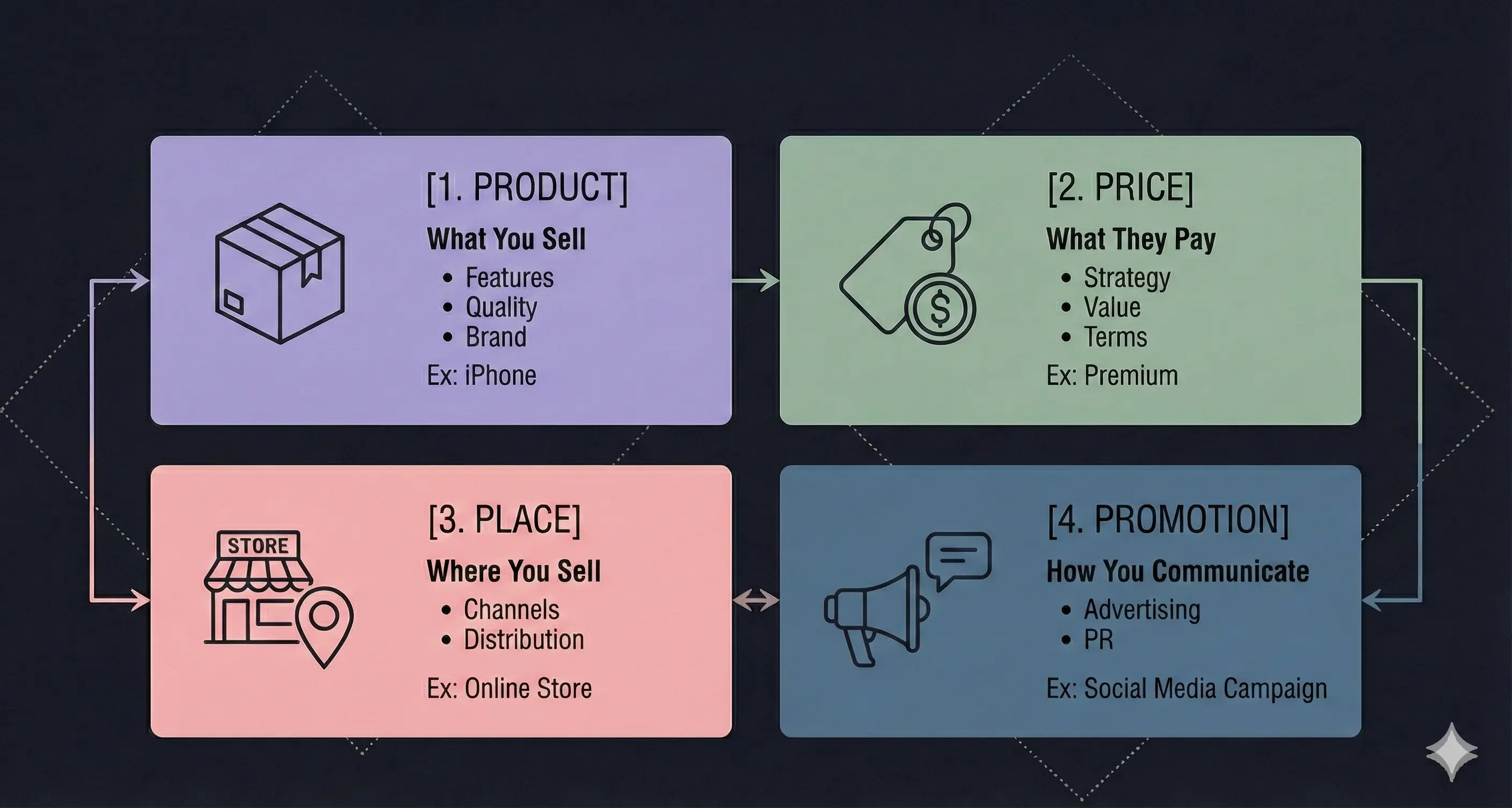
4Ps Marketing Mix

Diagram of the Marketing Mix 4Ps showing four blocks: Product (what you sell), Price (what customers pay), Place (where you sell), and Promotion (how you communicate). Each block includes example elements such as features, value, distribution channels, and advertising, with icons for a box, price tag, store, and megaphone.
The 4Ps Marketing Mix primarily addresses strategic friction by providing a structured approach to defining a product or service's market position. It helps businesses align their product, pricing, distribution (place), and promotional efforts to create a cohesive marketing strategy and achieve market fit.

The 4Ps Marketing Mix is a foundational framework in marketing that helps businesses strategize their product offerings effectively. It involves analyzing and optimizing four key aspects: Product (what to sell), Price (at what price), Place (where to sell), and Promotion (how to promote it). This framework assists in aligning marketing strategies with business objectives, ensuring that products meet market demands while maximizing profitability.

Steps / Detailed Description

Define the Product: Determine the features, benefits, and uniqueness of the product or service. | Set the Price: Establish pricing strategies that reflect the perceived value, market demand, and competitive landscape. | Choose the Place: Decide on distribution channels that will best reach the target audience and ensure product availability. | Plan the Promotion: Develop promotional strategies to create awareness, interest, and desire among potential customers.

Best Practices

Regularly update each component to adapt to market changes. | Integrate customer feedback to refine the product and promotional strategies. | Use data-driven insights to inform decisions about price and place.

Pros

Provides a clear and structured approach to product marketing. | Helps in aligning marketing strategies with overall business goals. | Facilitates decision-making by breaking down complex marketing tasks into manageable components.

Cons

May oversimplify the complexities of modern marketing environments. | Lacks emphasis on customer relationships and feedback loops. | Can be less effective in digital-first or service-oriented markets.

When to Use

Launching a new product in the market. | Revising marketing strategies for existing products.

When Not to Use

In highly dynamic markets where customer preferences change rapidly. | When direct customer engagement and personalization are more critical than traditional marketing methods.

Related Frameworks

Lifecycle

Scope

Scope not defined

Maturity Level

Maturity level not specified

Time to Implement

2–4 Weeks
3–6 Months
1–2 Weeks
3–6 Months
1–2 Months
3–6 Months
1–2 Weeks
Less Than 1 Day
1–2 Weeks
Longer Than 6 Months
1–2 Weeks
Longer Than 6 Months
1–2 Weeks
3–6 Months
1–2 Weeks
1–2 Weeks
1–2 Weeks
1–2 Weeks
1–2 Days
1–2 Weeks
1–2 Weeks
1–2 Weeks
1–2 Weeks
1–2 Weeks
1–2 Weeks
3–6 Months
1–2 Weeks
1–2 Weeks
1–2 Weeks
3–6 Months
1–2 Weeks
1–2 Weeks
2–4 Weeks
1–2 Weeks
1–2 Days
1–2 Weeks
Longer Than 6 Months
3–6 Months
Longer Than 6 Months
1–2 Weeks
Longer Than 6 Months
3–6 Months
Less Than 1 Day
3–6 Months
1–2 Months
3–6 Months
Longer Than 6 Months
3–6 Months
Less Than 1 Day
1–2 Weeks
3–6 Months
3–6 Months
1–2 Weeks
3–6 Months
1–2 Weeks
1–2 Weeks
1–2 Days
1–2 Weeks
1–2 Months
Longer Than 6 Months
1–2 Weeks
Longer Than 6 Months
1–2 Weeks
3–6 Months
1–2 Weeks
Less Than 1 Day
1–2 Weeks
3–6 Months
1–2 Weeks
3–6 Months
1–2 Weeks
1–2 Weeks
Longer Than 6 Months
Less Than 1 Day
3–6 Months
Longer Than 6 Months
1–2 Months
1–2 Weeks
Longer Than 6 Months
1–2 Weeks
3–6 Months
1–2 Weeks
1–2 Weeks
3–6 Months
Less Than 1 Day
1–2 Weeks
1–2 Weeks
3–6 Months
3–6 Months
Less Than 1 Day
1–2 Weeks
Longer Than 6 Months
1–2 Months
1–2 Weeks
1–2 Weeks
1–2 Weeks
Longer Than 6 Months

Copyright Information

Autor:
E. Jerome McCarthy
1960
Publication:
Unknown