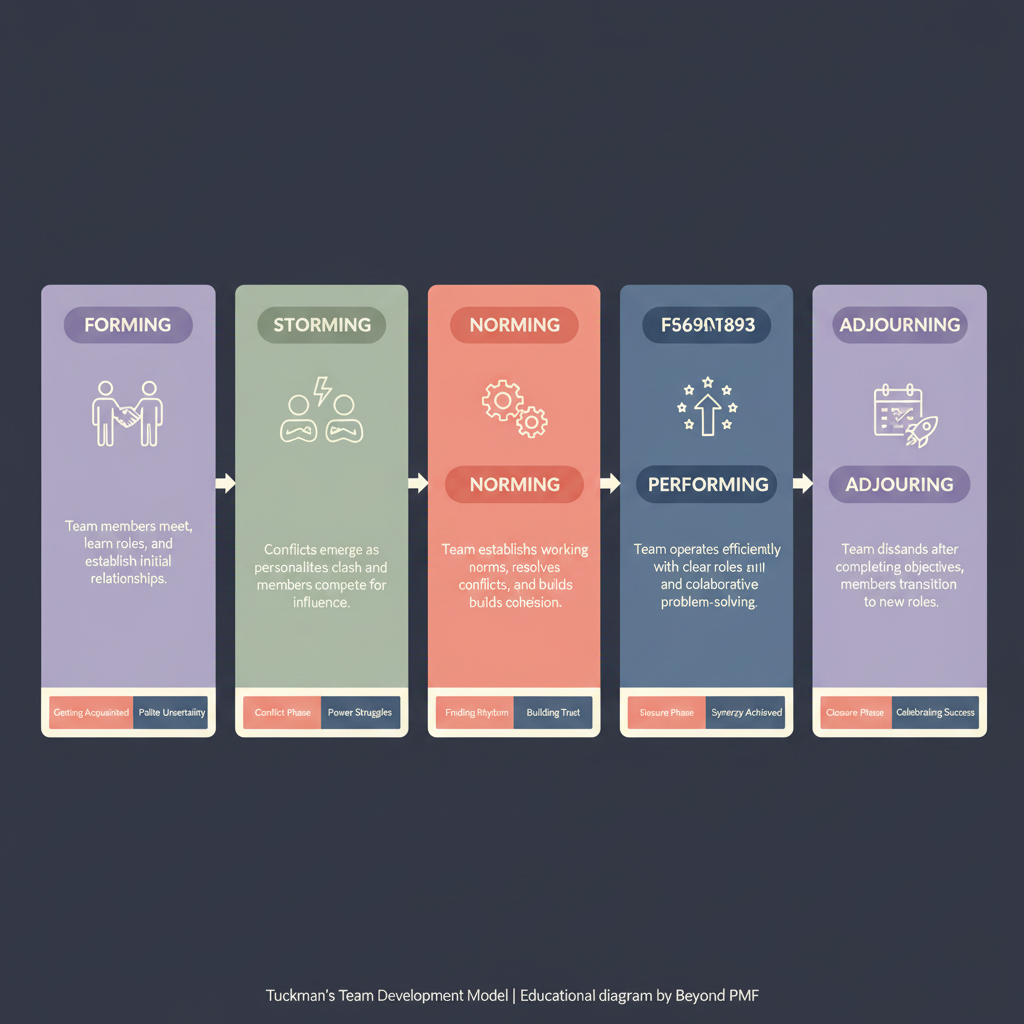
Tuckman's Team Development Model

https://ik.imagekit.io/beyondpmf/frameworks/tuckmans-team-development-model.png
Tuckman's model primarily addresses friction related to team coordination and workflow. By outlining stages of team development, it aims to improve how teams work together and coordinate their efforts to achieve a common goal.

Tuckman's Team Development Model, developed by psychologist Bruce Tuckman in 1965, is a theory that describes four distinct stages for a team's path to high performance: forming, storming, norming, and performing. Each stage represents a phase of team development and is characterized by specific behaviors and challenges. The model is widely used to help team leaders manage team dynamics effectively, facilitating smoother transitions and enhancing team productivity.

Steps / Detailed Description

Forming: Team members are introduced. They start to understand the team's goals, their roles, and the tasks ahead, often behaving independently. | Storming: Conflicts arise as team members push against boundaries. This phase is crucial for the growth of the team. | Norming: The team establishes norms and cohesive bonds, enhancing stability and cooperation. | Performing: The team reaches optimal performance as roles become flexible and functional, focusing on team goals.

Best Practices

Be patient and allow the team to progress through stages naturally | Communicate openly and set clear expectations in every stage | Adapt leadership style to meet the needs of the team at each stage

Pros

Provides a clear roadmap for team development | Helps predict challenges and behaviors in team dynamics | Facilitates better communication and understanding among team members

Cons

May oversimplify the complexity of team dynamics | Not all teams follow these stages linearly | Less applicable to modern, fast-changing team environments

When to Use

When forming a new team | During major transitions or changes within an existing team

When Not to Use

In very short-term projects where teams do not have time to develop through all stages | When team members frequently change, disrupting the development process

Related Frameworks

Lifecycle

Not tied to a specific lifecycle stage

Scope

Scope not defined

Maturity Level

Maturity level not specified

Time to Implement

2–4 Weeks
3–6 Months
1–2 Weeks
3–6 Months
1–2 Months
3–6 Months
1–2 Weeks
Less Than 1 Day
1–2 Weeks
Longer Than 6 Months
1–2 Weeks
Longer Than 6 Months
1–2 Weeks
3–6 Months
1–2 Weeks
1–2 Weeks
1–2 Weeks
1–2 Weeks
1–2 Days
1–2 Weeks
1–2 Weeks
1–2 Weeks
1–2 Weeks
1–2 Weeks
1–2 Weeks
3–6 Months
1–2 Weeks
1–2 Weeks
1–2 Weeks
3–6 Months
1–2 Weeks
1–2 Weeks
2–4 Weeks
1–2 Weeks
1–2 Days
1–2 Weeks
Longer Than 6 Months
3–6 Months
Longer Than 6 Months
1–2 Weeks
Longer Than 6 Months
3–6 Months
Less Than 1 Day
3–6 Months
1–2 Months
3–6 Months
Longer Than 6 Months
3–6 Months
Less Than 1 Day
1–2 Weeks
3–6 Months
3–6 Months
1–2 Weeks
3–6 Months
1–2 Weeks
1–2 Weeks
1–2 Days
1–2 Weeks
1–2 Months
Longer Than 6 Months
1–2 Weeks
Longer Than 6 Months
1–2 Weeks
3–6 Months
1–2 Weeks
Less Than 1 Day
1–2 Weeks
3–6 Months
1–2 Weeks
3–6 Months
1–2 Weeks
1–2 Weeks
Longer Than 6 Months
Less Than 1 Day
3–6 Months
Longer Than 6 Months
1–2 Months
1–2 Weeks
Longer Than 6 Months
1–2 Weeks
3–6 Months
1–2 Weeks
1–2 Weeks
3–6 Months
Less Than 1 Day
1–2 Weeks
1–2 Weeks
3–6 Months
3–6 Months
Less Than 1 Day
1–2 Weeks
Longer Than 6 Months
1–2 Months
1–2 Weeks
1–2 Weeks
1–2 Weeks
Longer Than 6 Months

Copyright Information

Autor:
Bruce Tuckman
1965
Publication:
Journal of Developmental Psychology