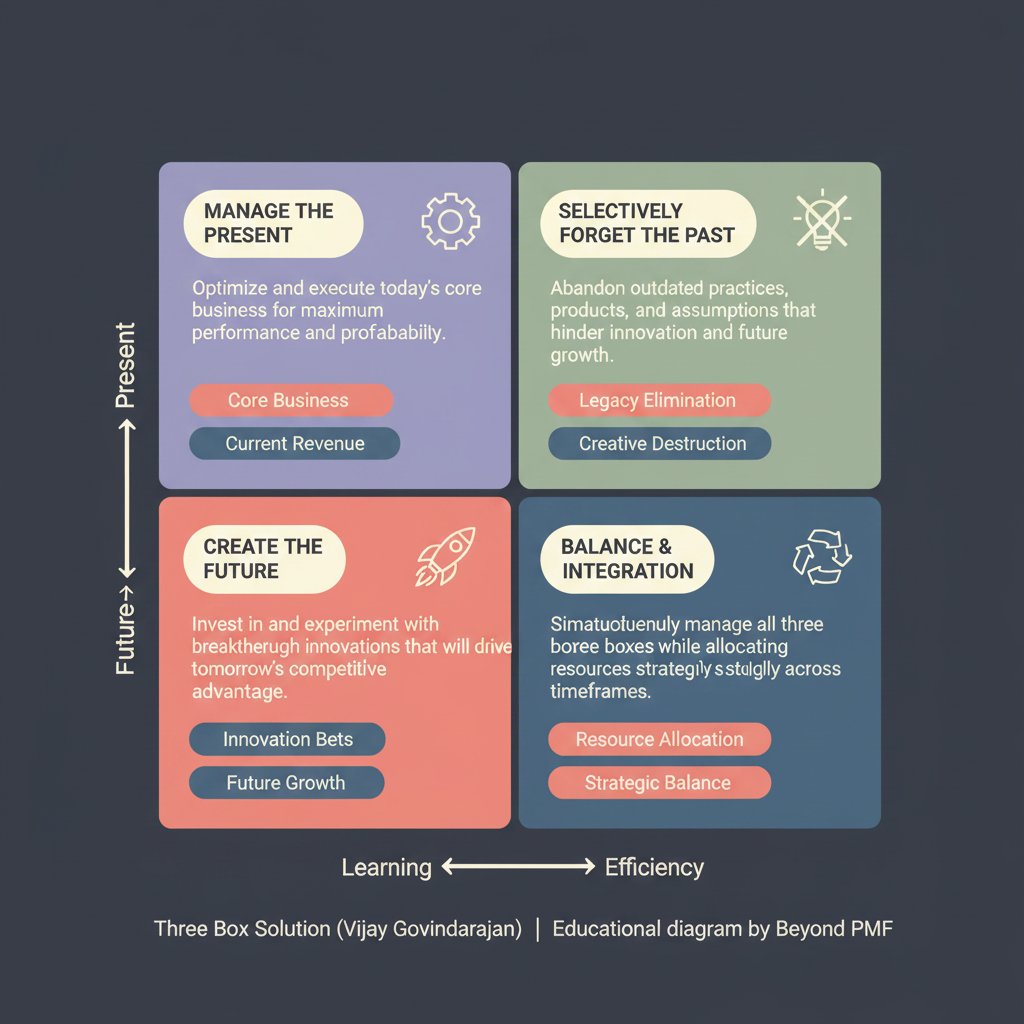
Three Box Solution (Vijay Govindarajan)

https://ik.imagekit.io/beyondpmf/frameworks/three-box-solution-vijay-govindarajan.png
The Three Box Solution directly addresses the strategic challenge of balancing current operations (Box 1) with the need to innovate for the future (Boxes 2 and 3). It provides a framework for managing conflicting priorities and resource allocation across different strategic horizons.

Developed by Vijay Govindarajan, the Three Box Solution framework assists organizations in balancing the demands of managing present business operations (Box 1), selectively forgetting past norms and practices that hinder innovation (Box 2), and creating breakthrough innovations for future growth (Box 3). This framework is particularly useful for fostering continuous innovation and adaptation in a rapidly changing business environment, helping companies to stay relevant and competitive.

Steps / Detailed Description

Box 1: Manage the present - Focus on improving core competencies and efficiency in current business operations. | Box 2: Selectively forget the past - Identify and discard outdated practices and legacy processes that are no longer beneficial. | Box 3: Create the future - Invest in developing new ideas, strategies, and business models that drive future growth and innovation.

Best Practices

Regularly review and assess the relevance of current practices and business models. | Allocate dedicated resources and teams for innovation projects separate from core business operations. | Foster a culture that supports risk-taking and views failure as a learning opportunity.

Pros

Encourages a balanced approach to managing current operations and innovating for the future. | Helps organizations to systematically identify and eliminate outdated practices. | Promotes a culture of continuous innovation and strategic thinking.

Cons

Can be challenging to implement due to conflicts between short-term and long-term goals. | Requires substantial commitment and resources to sustain efforts across all three boxes. | May lead to organizational resistance, especially from those invested in the status quo.

When to Use

When a company needs to revitalize or redefine its business model. | During periods of significant industry change or technological disruption.

When Not to Use

In highly unstable or crisis situations where immediate survival is the priority. | When the organization lacks the resources to invest in future-oriented projects.

Related Frameworks

Lifecycle

Scope

Scope not defined

Maturity Level

Maturity level not specified

Time to Implement

2–4 Weeks
3–6 Months
1–2 Weeks
3–6 Months
1–2 Months
3–6 Months
1–2 Weeks
Less Than 1 Day
1–2 Weeks
Longer Than 6 Months
1–2 Weeks
Longer Than 6 Months
1–2 Weeks
3–6 Months
1–2 Weeks
1–2 Weeks
1–2 Weeks
1–2 Weeks
1–2 Days
1–2 Weeks
1–2 Weeks
1–2 Weeks
1–2 Weeks
1–2 Weeks
1–2 Weeks
3–6 Months
1–2 Weeks
1–2 Weeks
1–2 Weeks
3–6 Months
1–2 Weeks
1–2 Weeks
2–4 Weeks
1–2 Weeks
1–2 Days
1–2 Weeks
Longer Than 6 Months
3–6 Months
Longer Than 6 Months
1–2 Weeks
Longer Than 6 Months
3–6 Months
Less Than 1 Day
3–6 Months
1–2 Months
3–6 Months
Longer Than 6 Months
3–6 Months
Less Than 1 Day
1–2 Weeks
3–6 Months
3–6 Months
1–2 Weeks
3–6 Months
1–2 Weeks
1–2 Weeks
1–2 Days
1–2 Weeks
1–2 Months
Longer Than 6 Months
1–2 Weeks
Longer Than 6 Months
1–2 Weeks
3–6 Months
1–2 Weeks
Less Than 1 Day
1–2 Weeks
3–6 Months
1–2 Weeks
3–6 Months
1–2 Weeks
1–2 Weeks
Longer Than 6 Months
Less Than 1 Day
3–6 Months
Longer Than 6 Months
1–2 Months
1–2 Weeks
Longer Than 6 Months
1–2 Weeks
3–6 Months
1–2 Weeks
1–2 Weeks
3–6 Months
Less Than 1 Day
1–2 Weeks
1–2 Weeks
3–6 Months
3–6 Months
Less Than 1 Day
1–2 Weeks
Longer Than 6 Months
1–2 Months
1–2 Weeks
1–2 Weeks
1–2 Weeks
Longer Than 6 Months

Copyright Information

Autor:
Vijay Govindarajan
Unknown
Publication:
Unknown