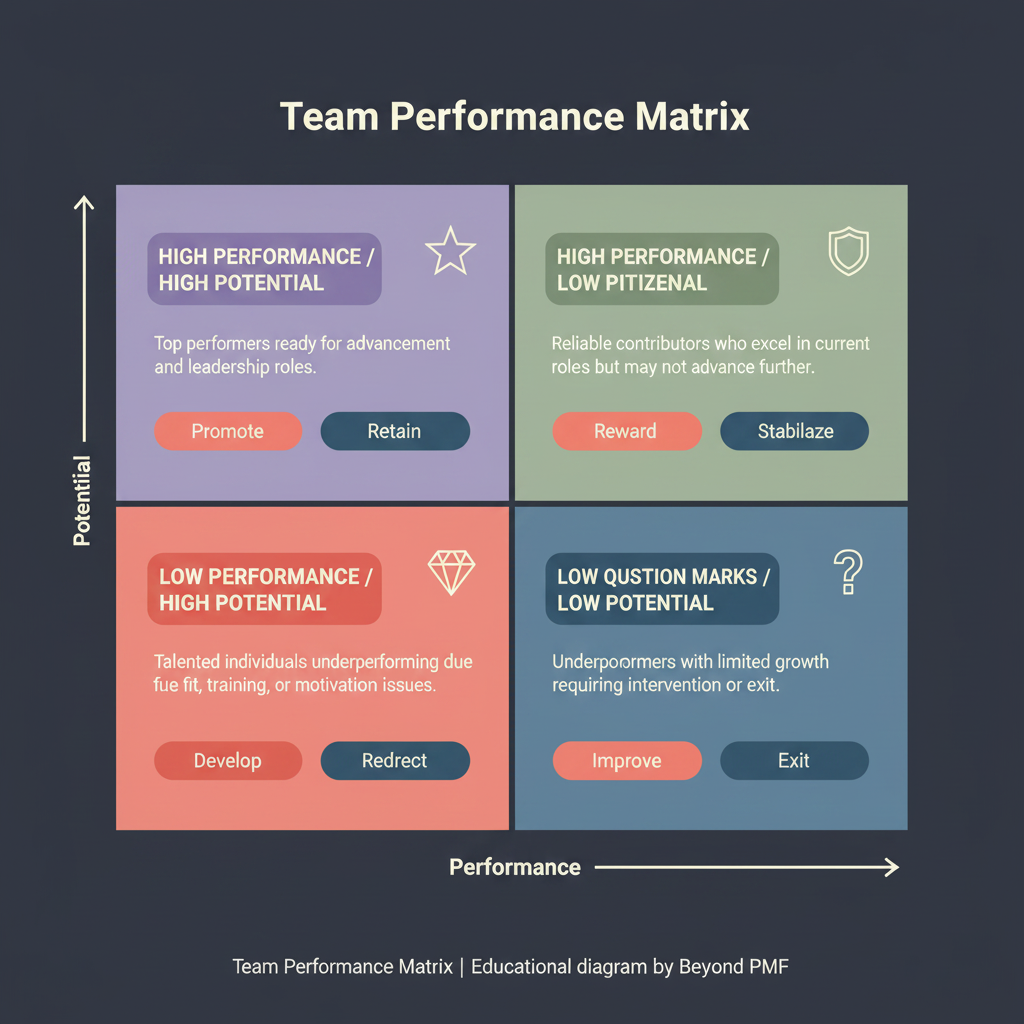
Team Performance Matrix

https://ik.imagekit.io/beyondpmf/frameworks/team-performance-matrix.png
The Team Performance Matrix likely addresses issues related to how teams function, coordinate, and execute tasks. It focuses on assessing and improving team effectiveness, which directly relates to operational efficiency and workflow.

The Team Performance Matrix is a framework designed to evaluate the performance and dynamics of teams in a structured manner. It helps managers and leaders identify strengths, weaknesses, and areas for improvement within their teams. By mapping out performance against predefined criteria, the framework facilitates targeted interventions that can lead to better team cohesion, efficiency, and overall performance. The matrix is particularly useful in complex projects or environments where teamwork is crucial for success.

Steps / Detailed Description

Define performance criteria relevant to the team's objectives. | Assess each team member against these criteria. | Plot the results on the matrix to visualize performance levels. | Identify patterns or gaps in team performance. | Develop action plans based on the matrix insights. | Implement interventions and monitor progress.

Best Practices

Ensure criteria are aligned with organizational goals | Communicate the purpose and process clearly to all team members | Regularly update the matrix to reflect changes and progress

Pros

Provides a clear visual representation of team performance | Facilitates targeted developmental interventions | Enhances understanding of team dynamics and individual contributions

Cons

Can be time-consuming to implement correctly | May lead to discomfort or resistance among team members | Requires periodic updates to remain effective

When to Use

When optimizing teams for new projects | During regular performance reviews

When Not to Use

In very small teams where informal assessments are sufficient | When there is no clear definition of performance criteria

Related Frameworks

Lifecycle

Not tied to a specific lifecycle stage

Scope

Scope not defined

Maturity Level

Maturity level not specified

Time to Implement

2–4 Weeks
3–6 Months
1–2 Weeks
3–6 Months
1–2 Months
3–6 Months
1–2 Weeks
Less Than 1 Day
1–2 Weeks
Longer Than 6 Months
1–2 Weeks
Longer Than 6 Months
1–2 Weeks
3–6 Months
1–2 Weeks
1–2 Weeks
1–2 Weeks
1–2 Weeks
1–2 Days
1–2 Weeks
1–2 Weeks
1–2 Weeks
1–2 Weeks
1–2 Weeks
1–2 Weeks
3–6 Months
1–2 Weeks
1–2 Weeks
1–2 Weeks
3–6 Months
1–2 Weeks
1–2 Weeks
2–4 Weeks
1–2 Weeks
1–2 Days
1–2 Weeks
Longer Than 6 Months
3–6 Months
Longer Than 6 Months
1–2 Weeks
Longer Than 6 Months
3–6 Months
Less Than 1 Day
3–6 Months
1–2 Months
3–6 Months
Longer Than 6 Months
3–6 Months
Less Than 1 Day
1–2 Weeks
3–6 Months
3–6 Months
1–2 Weeks
3–6 Months
1–2 Weeks
1–2 Weeks
1–2 Days
1–2 Weeks
1–2 Months
Longer Than 6 Months
1–2 Weeks
Longer Than 6 Months
1–2 Weeks
3–6 Months
1–2 Weeks
Less Than 1 Day
1–2 Weeks
3–6 Months
1–2 Weeks
3–6 Months
1–2 Weeks
1–2 Weeks
Longer Than 6 Months
Less Than 1 Day
3–6 Months
Longer Than 6 Months
1–2 Months
1–2 Weeks
Longer Than 6 Months
1–2 Weeks
3–6 Months
1–2 Weeks
1–2 Weeks
3–6 Months
Less Than 1 Day
1–2 Weeks
1–2 Weeks
3–6 Months
3–6 Months
Less Than 1 Day
1–2 Weeks
Longer Than 6 Months
1–2 Months
1–2 Weeks
1–2 Weeks
1–2 Weeks
Longer Than 6 Months

Copyright Information

Autor:
Unknown
N/A
Publication:
Unknown