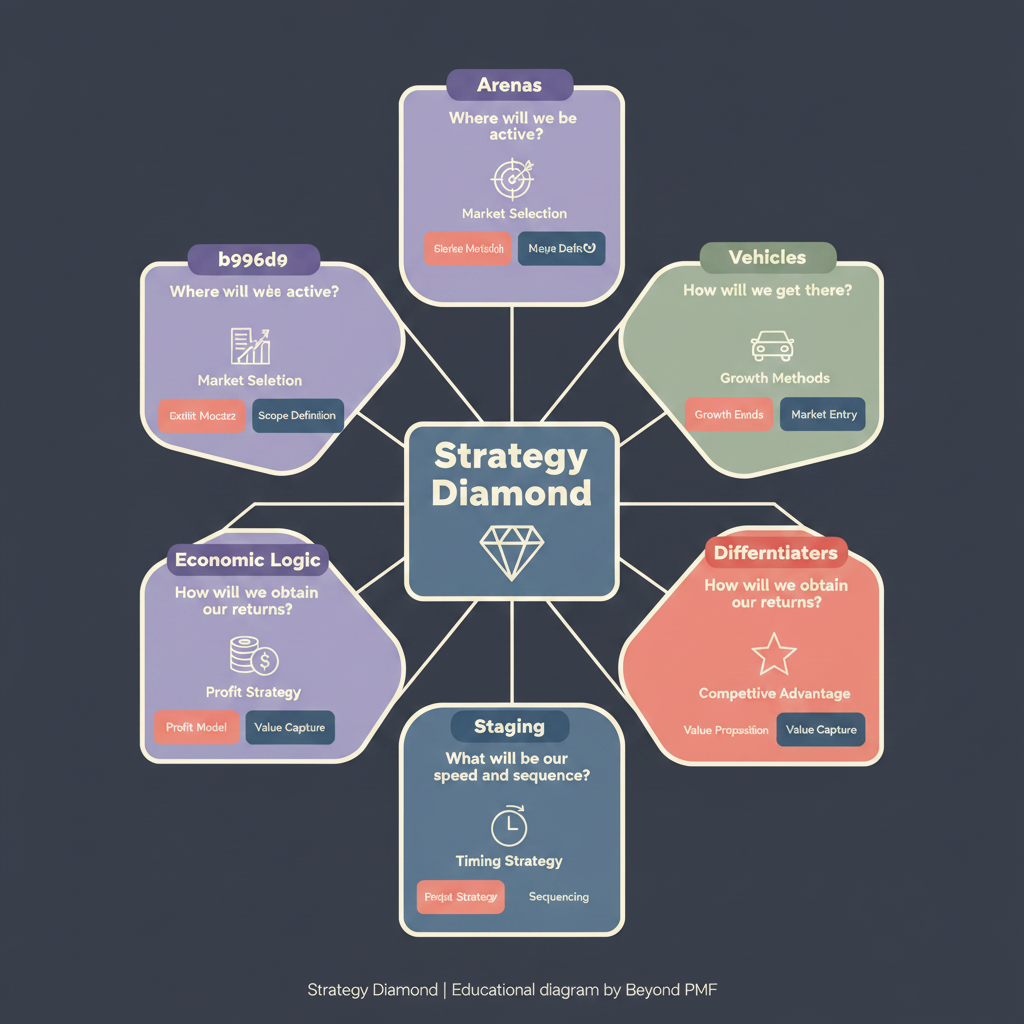
The Strategy Diamond is a comprehensive framework designed to assist organizations in developing, articulating, and executing their strategies. Developed by Donald Hambrick and James Fredrickson, it includes five key elements: Arenas, Vehicles, Differentiators, Staging, and Economic Logic. This framework is particularly useful because it covers both the content of the strategy and the process of strategy implementation, ensuring a holistic approach to strategic planning.
Identify Arenas: Determine where the organization will be active, including market segments, geographic areas, and product categories. | Choose Vehicles: Decide how the organization will get there, considering options such as organic growth, mergers, and partnerships. | Define Differentiators: Specify how the organization will win in the marketplace, focusing on aspects like pricing, innovation, and customer service. | Plan Staging: Sequence activities and allocate resources over time, deciding on priorities and milestones. | Establish Economic Logic: Outline how the strategy will return profits, considering cost structure, pricing assumptions, and scale economies.
Regularly update each component to reflect changes in the business environment | Ensure cross-departmental collaboration when filling out each part of the diamond | Use real data and market analysis to inform decisions at each step
Provides a clear and comprehensive structure for strategy development | Facilitates alignment and communication across the organization | Encourages thorough analysis of competitive advantage and market positioning
Can be overly complex for smaller organizations | Requires significant data and analysis, which can be resource-intensive | May lead to inflexibility due to its structured approach
When defining a new strategic direction | During major organizational restructuring or mergers
In highly volatile or uncertain market conditions where flexibility is crucial | For very small businesses where the complexity might outweigh the benefits