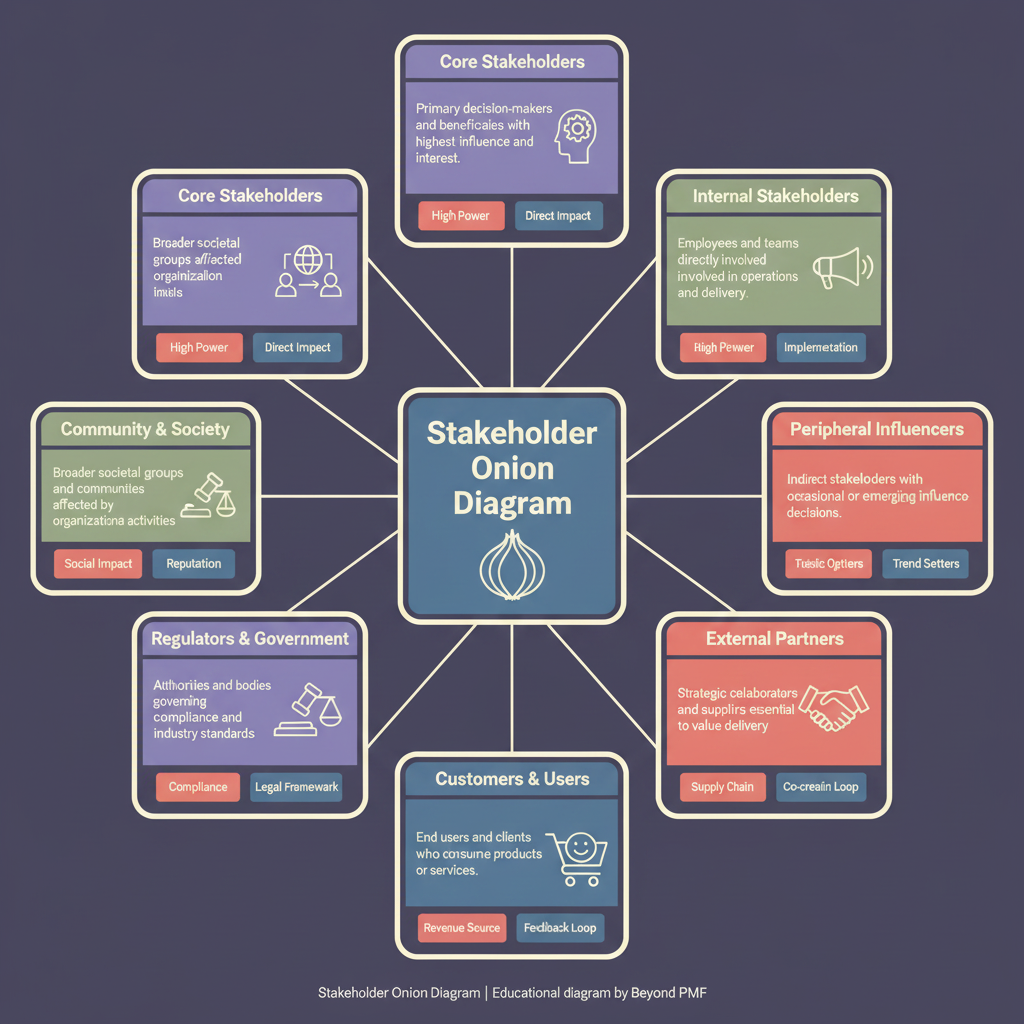
Stakeholder Onion Diagram

https://ik.imagekit.io/beyondpmf/frameworks/stakeholder-onion-diagram.png
The Stakeholder Onion Diagram primarily addresses structural friction by helping to clarify stakeholder relationships and influence within an organization. It helps define roles, understand dependencies, and manage conflicting interests related to project or organizational goals.

The Stakeholder Onion Diagram is a framework designed to help project managers and teams identify and prioritize stakeholders. This diagram organizes stakeholders into layers, similar to the layers of an onion, based on their level of involvement and impact on the project. It is used to ensure that all potential influences on a project are recognized and appropriately managed, facilitating better planning, communication, and resource allocation.

Steps / Detailed Description

Identify all potential stakeholders of the project. | Categorize stakeholders into layers based on their influence and interest. | Place the most influential stakeholders at the center and less influential ones in outer layers. | Review and adjust the diagram as the project progresses and as relationships evolve.

Best Practices

Regularly update the diagram to reflect changes in stakeholder status and relationships. | Use alongside other stakeholder analysis tools for a comprehensive view. | Engage stakeholders in the creation of the diagram to ensure accuracy and buy-in.

Pros

Helps in visualizing the importance and influence of different stakeholders. | Facilitates targeted communication strategies for different stakeholder groups. | Improves project management by clearly identifying stakeholder needs and expectations.

Cons

Can be overly simplistic, ignoring complex stakeholder relationships. | May require frequent updates as stakeholder dynamics change. | Potentially overlooks external stakeholders who might indirectly influence the project.

When to Use

At the beginning of a project to identify and prioritize stakeholders. | When revising project strategies to accommodate changing stakeholder landscapes.

When Not to Use

In projects with very limited or clear-cut stakeholder groups. | When project timelines are too short to allow for detailed stakeholder analysis.

Related Frameworks

Scope

Scope not defined

Maturity Level

Maturity level not specified

Time to Implement

2–4 Weeks
3–6 Months
1–2 Weeks
3–6 Months
1–2 Months
3–6 Months
1–2 Weeks
Less Than 1 Day
1–2 Weeks
Longer Than 6 Months
1–2 Weeks
Longer Than 6 Months
1–2 Weeks
3–6 Months
1–2 Weeks
1–2 Weeks
1–2 Weeks
1–2 Weeks
1–2 Days
1–2 Weeks
1–2 Weeks
1–2 Weeks
1–2 Weeks
1–2 Weeks
1–2 Weeks
3–6 Months
1–2 Weeks
1–2 Weeks
1–2 Weeks
3–6 Months
1–2 Weeks
1–2 Weeks
2–4 Weeks
1–2 Weeks
1–2 Days
1–2 Weeks
Longer Than 6 Months
3–6 Months
Longer Than 6 Months
1–2 Weeks
Longer Than 6 Months
3–6 Months
Less Than 1 Day
3–6 Months
1–2 Months
3–6 Months
Longer Than 6 Months
3–6 Months
Less Than 1 Day
1–2 Weeks
3–6 Months
3–6 Months
1–2 Weeks
3–6 Months
1–2 Weeks
1–2 Weeks
1–2 Days
1–2 Weeks
1–2 Months
Longer Than 6 Months
1–2 Weeks
Longer Than 6 Months
1–2 Weeks
3–6 Months
1–2 Weeks
Less Than 1 Day
1–2 Weeks
3–6 Months
1–2 Weeks
3–6 Months
1–2 Weeks
1–2 Weeks
Longer Than 6 Months
Less Than 1 Day
3–6 Months
Longer Than 6 Months
1–2 Months
1–2 Weeks
Longer Than 6 Months
1–2 Weeks
3–6 Months
1–2 Weeks
1–2 Weeks
3–6 Months
Less Than 1 Day
1–2 Weeks
1–2 Weeks
3–6 Months
3–6 Months
Less Than 1 Day
1–2 Weeks
Longer Than 6 Months
1–2 Months
1–2 Weeks
1–2 Weeks
1–2 Weeks
Longer Than 6 Months

Copyright Information

Autor:
Unknown
N/A
Publication:
Unknown