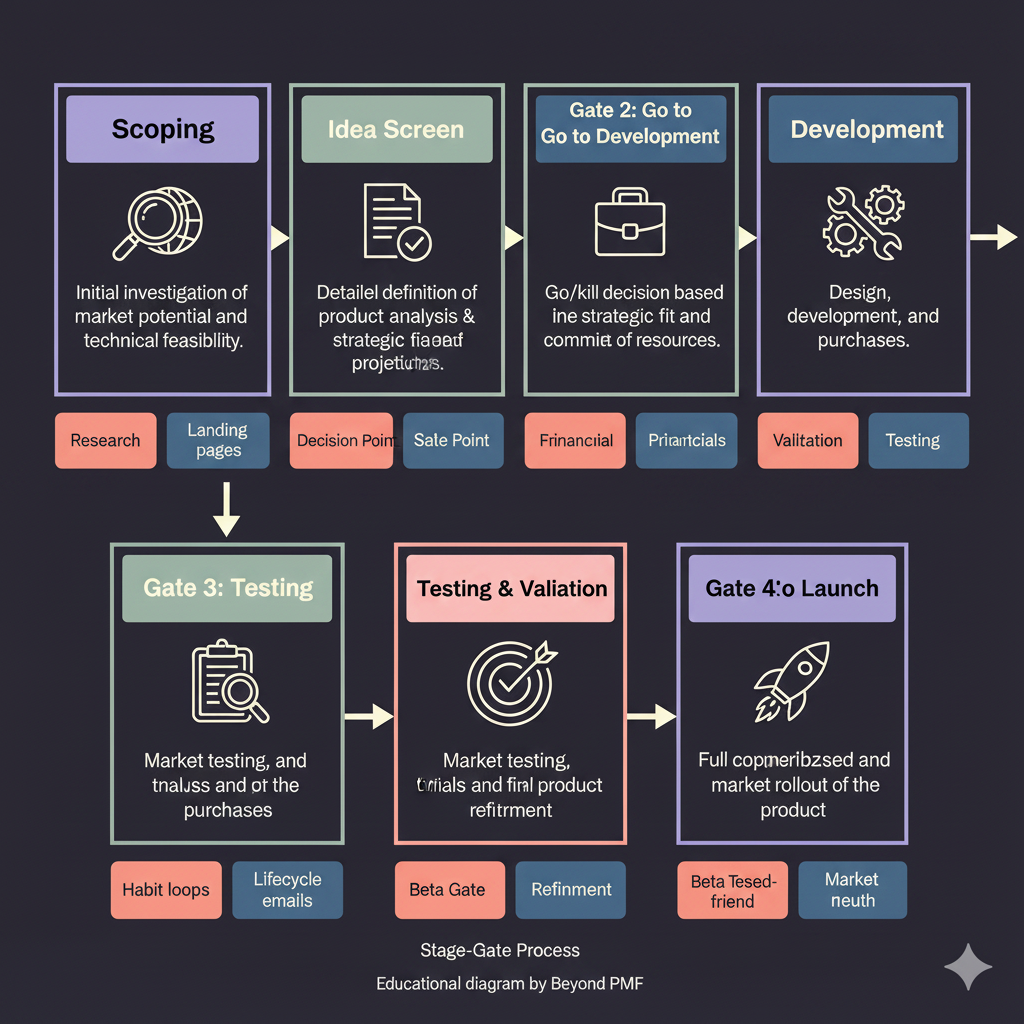
Stage-Gate Process

https://ik.imagekit.io/beyondpmf/frameworks/stage-gate-process.png
The Stage-Gate Process primarily addresses the friction associated with poor operational processes in new product development. It aims to improve workflows, coordination, and governance by providing a structured, stage-based approach to project management, thereby reducing inefficiencies and bottlenecks in the development lifecycle.

The Stage-Gate Process is a widely recognized project management framework that divides the development of new products into distinct stages separated by gates. At each gate, a decision is made to continue, modify, or halt the project based on specific criteria such as feasibility, market potential, and technical viability. This structured approach helps organizations optimize their development processes, manage risks, and improve success rates by making informed decisions at critical points.

Steps / Detailed Description

Idea Generation: Collect and select ideas for new products. | Scoping: Conduct a preliminary assessment of the idea's technical and market feasibility. | Business Case Development: Create a detailed plan including market strategy, technical requirements, and financial projections. | Development: Turn the plan into a prototype or a market-ready product. | Testing and Validation: Evaluate the product through customer and market testing. | Launch: Finalize the product and plan for full-scale marketing and production. | Post-Launch Review: Assess the product's performance and the project's overall effectiveness.

Best Practices

Ensure clear criteria at each gate | Involve cross-functional teams | Maintain flexibility to adapt stages

Pros

Improves decision-making quality | Enhances efficiency and speed to market | Reduces risk through systematic evaluation

Cons

Can be rigid and bureaucratic | May stifle creativity due to structured nature | Potentially expensive due to iterative evaluations

When to Use

Developing new products | Large projects needing structured oversight

When Not to Use

Small, fast-moving projects | Projects where innovation needs free rein

Related Frameworks

Lifecycle

Scope

Scope not defined

Maturity Level

Maturity level not specified

Time to Implement

2–4 Weeks
3–6 Months
1–2 Weeks
3–6 Months
1–2 Months
3–6 Months
1–2 Weeks
Less Than 1 Day
1–2 Weeks
Longer Than 6 Months
1–2 Weeks
Longer Than 6 Months
1–2 Weeks
3–6 Months
1–2 Weeks
1–2 Weeks
1–2 Weeks
1–2 Weeks
1–2 Days
1–2 Weeks
1–2 Weeks
1–2 Weeks
1–2 Weeks
1–2 Weeks
1–2 Weeks
3–6 Months
1–2 Weeks
1–2 Weeks
1–2 Weeks
3–6 Months
1–2 Weeks
1–2 Weeks
2–4 Weeks
1–2 Weeks
1–2 Days
1–2 Weeks
Longer Than 6 Months
3–6 Months
Longer Than 6 Months
1–2 Weeks
Longer Than 6 Months
3–6 Months
Less Than 1 Day
3–6 Months
1–2 Months
3–6 Months
Longer Than 6 Months
3–6 Months
Less Than 1 Day
1–2 Weeks
3–6 Months
3–6 Months
1–2 Weeks
3–6 Months
1–2 Weeks
1–2 Weeks
1–2 Days
1–2 Weeks
1–2 Months
Longer Than 6 Months
1–2 Weeks
Longer Than 6 Months
1–2 Weeks
3–6 Months
1–2 Weeks
Less Than 1 Day
1–2 Weeks
3–6 Months
1–2 Weeks
3–6 Months
1–2 Weeks
1–2 Weeks
Longer Than 6 Months
Less Than 1 Day
3–6 Months
Longer Than 6 Months
1–2 Months
1–2 Weeks
Longer Than 6 Months
1–2 Weeks
3–6 Months
1–2 Weeks
1–2 Weeks
3–6 Months
Less Than 1 Day
1–2 Weeks
1–2 Weeks
3–6 Months
3–6 Months
Less Than 1 Day
1–2 Weeks
Longer Than 6 Months
1–2 Months
1–2 Weeks
1–2 Weeks
1–2 Weeks
Longer Than 6 Months

Copyright Information

Autor:
Robert G. Cooper
1986
Publication:
Unknown