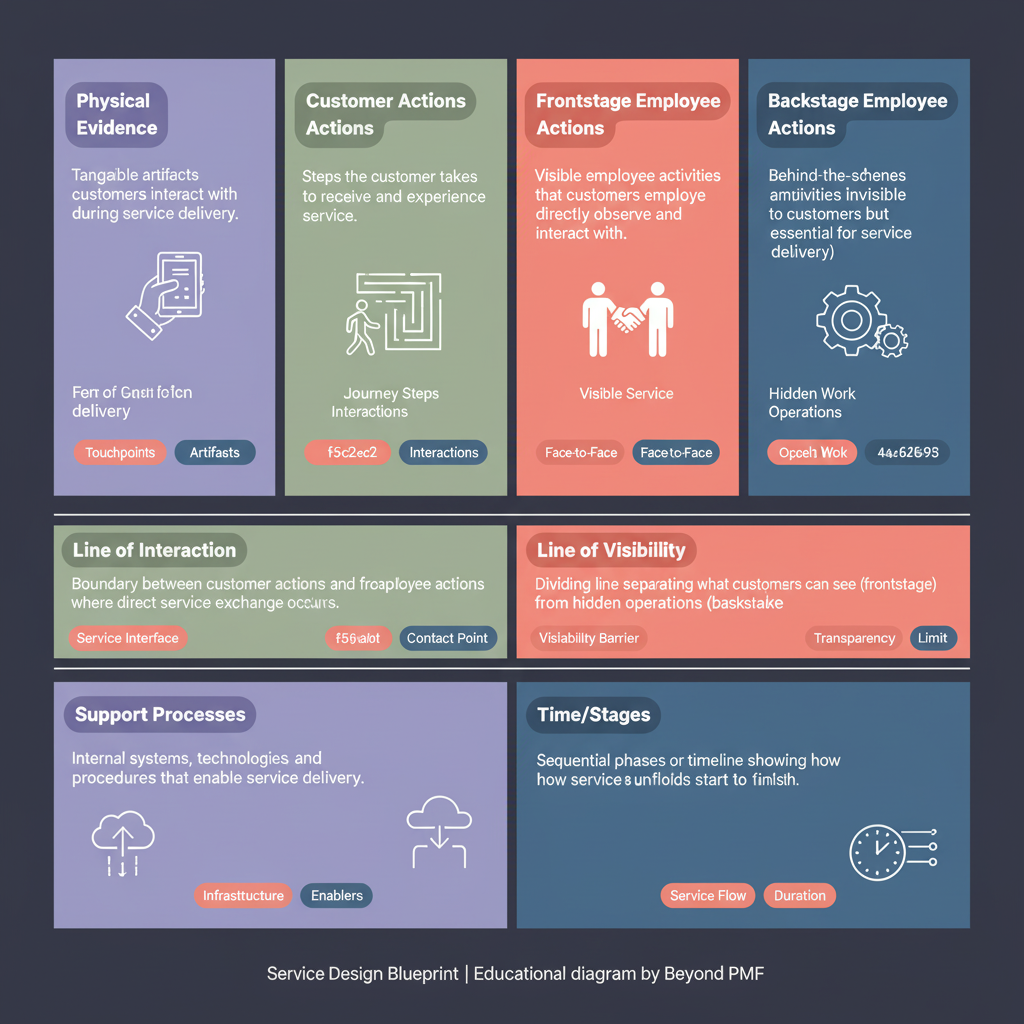
The Service Design Blueprint, often simply referred to as a service blueprint, is a strategic tool used in the planning of service processes and interactions. It helps organizations visualize the relationships and touchpoints between different components of a service, such as customers, employees, and digital systems. This framework is crucial for identifying potential improvements in service efficiency and customer satisfaction, and for ensuring a seamless integration of front-end and back-end service operations.
Identify and define the components of the service. | Map out customer interactions and touchpoints. | Link frontstage (customer-facing) and backstage (internal processes) elements. | Identify fail points and opportunities for improvement. | Iterate based on feedback and testing.
Involve a diverse team in the blueprinting process | Regularly update the blueprint to reflect changes | Use customer feedback to refine the blueprint
Enhances understanding of the service process | Facilitates better customer experiences | Identifies inefficiencies and areas for improvement
Can be time-consuming to create and maintain | Requires thorough understanding of all service aspects | May overlook external factors affecting the service
Designing or redesigning a service | Improving service delivery and efficiency
When the service structure is too simple to benefit | Under tight time constraints where detailed mapping is impractical