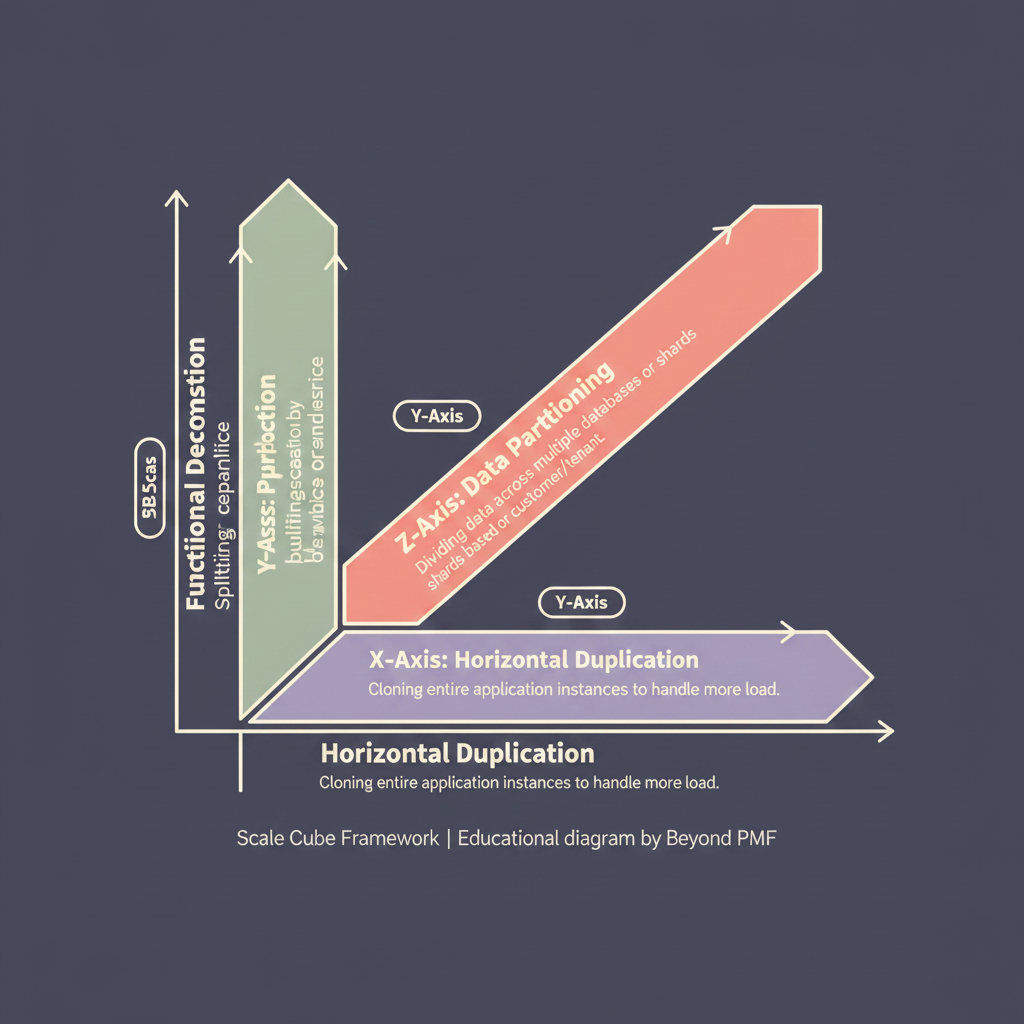
Scale Cube Framework

https://ik.imagekit.io/beyondpmf/frameworks/scale-cube-framework.png
The Scale Cube Framework focuses on breaking down application scalability into dimensions. This inherently addresses the operational friction related to processes, workflows, and coordination needed to efficiently handle increasing workloads and application demands.

The Scale Cube Framework, also known as the AKF Scale Cube, is a strategic tool used in software architecture to guide the scaling of services and applications. It breaks down scalability into three dimensions: x-axis (cloning), y-axis (decomposition by service or function), and z-axis (data partitioning). This framework helps organizations plan and implement scaling strategies that can handle increased loads without compromising on performance, thus ensuring efficient resource utilization and improved user experience.

Steps / Detailed Description

Identify the scalability needs and challenges of the application. | Apply x-axis scaling by cloning the entire application or service. | Implement y-axis scaling by decomposing the application into microservices based on functionality. | Utilize z-axis scaling through data partitioning to distribute data across different databases or servers. | Continuously monitor and optimize the scaling strategy based on performance metrics and user feedback.

Best Practices

Start with the simplest scaling dimension and progressively implement others | Maintain clear documentation and architecture diagrams | Regularly review and adjust the scaling strategy based on actual usage and performance data

Pros

Improves application performance and user experience | Enhances fault tolerance and system resilience | Facilitates efficient resource utilization

Cons

Can increase complexity in system management | May require significant changes to existing architecture | Potential for increased operational costs

When to Use

When scaling an application to handle increased user load | When transitioning from a monolithic architecture to microservices

When Not to Use

For small-scale applications with limited growth expectations | When application complexity and maintenance costs are a concern

Related Frameworks

Lifecycle

Scope

Scope not defined

Maturity Level

Maturity level not specified

Time to Implement

2–4 Weeks
3–6 Months
1–2 Weeks
3–6 Months
1–2 Months
3–6 Months
1–2 Weeks
Less Than 1 Day
1–2 Weeks
Longer Than 6 Months
1–2 Weeks
Longer Than 6 Months
1–2 Weeks
3–6 Months
1–2 Weeks
1–2 Weeks
1–2 Weeks
1–2 Weeks
1–2 Days
1–2 Weeks
1–2 Weeks
1–2 Weeks
1–2 Weeks
1–2 Weeks
1–2 Weeks
3–6 Months
1–2 Weeks
1–2 Weeks
1–2 Weeks
3–6 Months
1–2 Weeks
1–2 Weeks
2–4 Weeks
1–2 Weeks
1–2 Days
1–2 Weeks
Longer Than 6 Months
3–6 Months
Longer Than 6 Months
1–2 Weeks
Longer Than 6 Months
3–6 Months
Less Than 1 Day
3–6 Months
1–2 Months
3–6 Months
Longer Than 6 Months
3–6 Months
Less Than 1 Day
1–2 Weeks
3–6 Months
3–6 Months
1–2 Weeks
3–6 Months
1–2 Weeks
1–2 Weeks
1–2 Days
1–2 Weeks
1–2 Months
Longer Than 6 Months
1–2 Weeks
Longer Than 6 Months
1–2 Weeks
3–6 Months
1–2 Weeks
Less Than 1 Day
1–2 Weeks
3–6 Months
1–2 Weeks
3–6 Months
1–2 Weeks
1–2 Weeks
Longer Than 6 Months
Less Than 1 Day
3–6 Months
Longer Than 6 Months
1–2 Months
1–2 Weeks
Longer Than 6 Months
1–2 Weeks
3–6 Months
1–2 Weeks
1–2 Weeks
3–6 Months
Less Than 1 Day
1–2 Weeks
1–2 Weeks
3–6 Months
3–6 Months
Less Than 1 Day
1–2 Weeks
Longer Than 6 Months
1–2 Months
1–2 Weeks
1–2 Weeks
1–2 Weeks
Longer Than 6 Months

Copyright Information

Autor:
Unknown
N/A
Publication:
Generic Business Tool