Risk-Reward Matrix

https://ik.imagekit.io/beyondpmf/frameworks/risk-reward-matrix.png
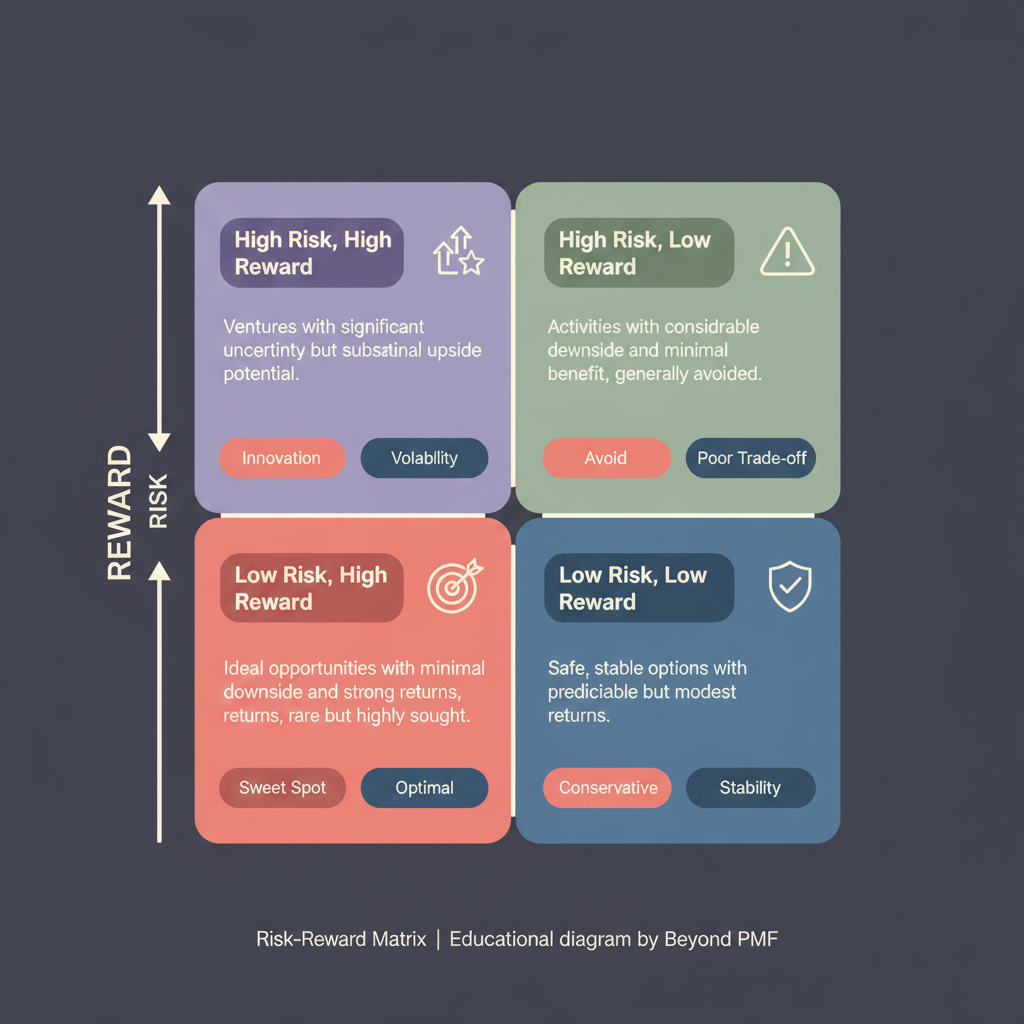
The Risk-Reward Matrix helps in evaluating different options by assessing their potential risks and rewards. This directly informs strategic decisions by providing a framework to weigh potential outcomes and align them with the overall business goals and risk appetite.

The Risk-Reward Matrix is a strategic framework used by businesses and investors to assess the potential risks and rewards associated with different decisions or investments. By plotting options on a matrix based on their potential risk and reward, decision-makers can visually compare options and prioritize those that offer the best balance between risk and potential return. This framework is particularly beneficial for making informed decisions in uncertain environments.

Steps / Detailed Description

Identify the options or opportunities to evaluate. | Assess the potential reward for each option. | Evaluate the associated risks for each option. | Plot each option on the matrix according to their risk and reward levels. | Analyze the matrix to identify which options offer the optimal balance of risk and reward.

Best Practices

Ensure comprehensive data collection for accurate risk and reward assessment | Regularly update the matrix to reflect changing circumstances | Use alongside other decision-making tools for a more holistic analysis

Pros

Provides a clear visual comparison of options | Helps in prioritizing investments or decisions based on quantifiable metrics | Facilitates strategic decision-making by highlighting risk-reward trade-offs

Cons

Can oversimplify complex decisions | Dependent on accurate assessment of risk and reward, which can be subjective | May not account for external factors affecting risk and reward

When to Use

Evaluating investment opportunities | Making strategic business decisions

When Not to Use

Situations where qualitative factors are more important than quantitative analysis | When detailed, specific risk assessment is required

Related Frameworks

Categories

Lifecycle

Scope

Scope not defined

Maturity Level

Maturity level not specified

Time to Implement

2–4 Weeks
3–6 Months
1–2 Weeks
3–6 Months
1–2 Months
3–6 Months
1–2 Weeks
Less Than 1 Day
1–2 Weeks
Longer Than 6 Months
1–2 Weeks
Longer Than 6 Months
1–2 Weeks
3–6 Months
1–2 Weeks
1–2 Weeks
1–2 Weeks
1–2 Weeks
1–2 Days
1–2 Weeks
1–2 Weeks
1–2 Weeks
1–2 Weeks
1–2 Weeks
1–2 Weeks
3–6 Months
1–2 Weeks
1–2 Weeks
1–2 Weeks
3–6 Months
1–2 Weeks
1–2 Weeks
2–4 Weeks
1–2 Weeks
1–2 Days
1–2 Weeks
Longer Than 6 Months
3–6 Months
Longer Than 6 Months
1–2 Weeks
Longer Than 6 Months
3–6 Months
Less Than 1 Day
3–6 Months
1–2 Months
3–6 Months
Longer Than 6 Months
3–6 Months
Less Than 1 Day
1–2 Weeks
3–6 Months
3–6 Months
1–2 Weeks
3–6 Months
1–2 Weeks
1–2 Weeks
1–2 Days
1–2 Weeks
1–2 Months
Longer Than 6 Months
1–2 Weeks
Longer Than 6 Months
1–2 Weeks
3–6 Months
1–2 Weeks
Less Than 1 Day
1–2 Weeks
3–6 Months
1–2 Weeks
3–6 Months
1–2 Weeks
1–2 Weeks
Longer Than 6 Months
Less Than 1 Day
3–6 Months
Longer Than 6 Months
1–2 Months
1–2 Weeks
Longer Than 6 Months
1–2 Weeks
3–6 Months
1–2 Weeks
1–2 Weeks
3–6 Months
Less Than 1 Day
1–2 Weeks
1–2 Weeks
3–6 Months
3–6 Months
Less Than 1 Day
1–2 Weeks
Longer Than 6 Months
1–2 Months
1–2 Weeks
1–2 Weeks
1–2 Weeks
Longer Than 6 Months

Copyright Information

Autor:
Public Domain
N/A
Publication:
Generic Business Tool