PESTEL Analysis

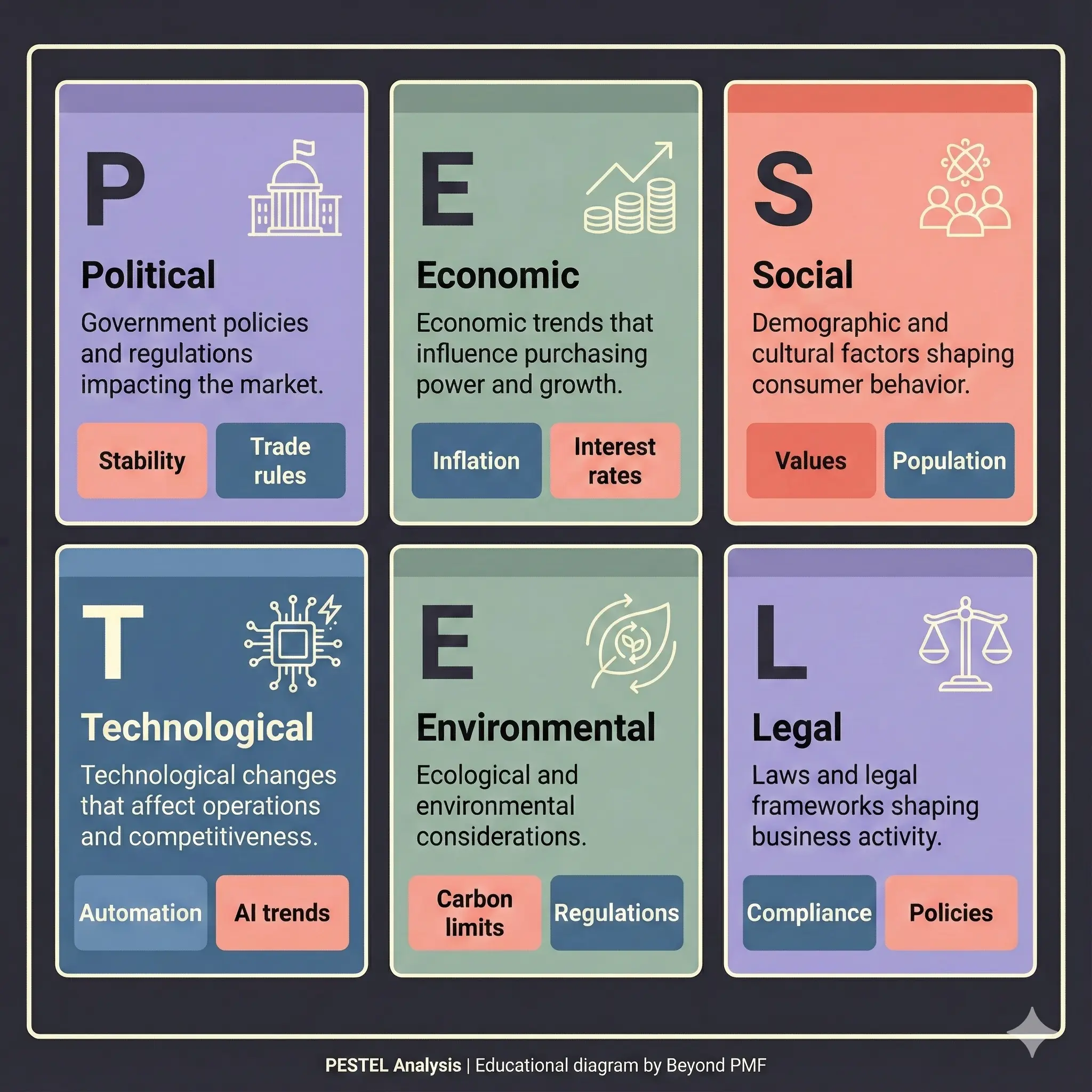
PESTEL Analysis diagram showing six external factors impacting a business: Political (stability, trade rules), Economic (inflation, interest rates), Social (values, population), Technological (automation, AI trends), Environmental (carbon limits, regulations), and Legal (compliance, policies).
PESTEL analysis primarily addresses the friction of unclear direction and lack of market alignment by helping organizations understand the external environment. This includes identifying opportunities and threats, informing strategic decisions, and ensuring the business model is suitable for the context.

PESTEL Analysis is a framework that helps organizations assess the Political, Economic, Social, Technological, Environmental, and Legal external factors that could impact their operations. This strategic tool is used to understand market growth or decline, business position, potential and direction for operations. The insights gained from a PESTEL Analysis can aid in strategic planning by identifying potential threats and opportunities in the external environment.

Steps / Detailed Description

Identify the macro-environmental factors to analyze: Political, Economic, Social, Technological, Environmental, and Legal. | Gather relevant data for each factor that could impact your organization. | Analyze the data to determine potential threats or opportunities. | Evaluate the impact of each factor on your organization's strategic decisions. | Use the insights to guide strategic planning and decision-making processes.

Best Practices

Regularly update the analysis to reflect changes in the environment. | Combine with other analysis tools for a more comprehensive strategy. | Ensure data accuracy and relevance by using credible sources.

Pros

Provides a comprehensive overview of the external environment. | Helps in identifying potential opportunities and threats. | Supports strategic planning and decision-making.

Cons

May overlook internal factors. | Can be time-consuming to gather accurate data. | Requires regular updating as external conditions change.

When to Use

When entering a new market or industry. | During the strategic planning process.

When Not to Use

When detailed internal analysis is required. | In rapidly changing industries where data may quickly become outdated.

Related Frameworks

Categories

Lifecycle

Scope

Scope not defined

Maturity Level

Maturity level not specified

Time to Implement

2–4 Weeks
3–6 Months
1–2 Weeks
3–6 Months
1–2 Months
3–6 Months
1–2 Weeks
Less Than 1 Day
1–2 Weeks
Longer Than 6 Months
1–2 Weeks
Longer Than 6 Months
1–2 Weeks
3–6 Months
1–2 Weeks
1–2 Weeks
1–2 Weeks
1–2 Weeks
1–2 Days
1–2 Weeks
1–2 Weeks
1–2 Weeks
1–2 Weeks
1–2 Weeks
1–2 Weeks
3–6 Months
1–2 Weeks
1–2 Weeks
1–2 Weeks
3–6 Months
1–2 Weeks
1–2 Weeks
2–4 Weeks
1–2 Weeks
1–2 Days
1–2 Weeks
Longer Than 6 Months
3–6 Months
Longer Than 6 Months
1–2 Weeks
Longer Than 6 Months
3–6 Months
Less Than 1 Day
3–6 Months
1–2 Months
3–6 Months
Longer Than 6 Months
3–6 Months
Less Than 1 Day
1–2 Weeks
3–6 Months
3–6 Months
1–2 Weeks
3–6 Months
1–2 Weeks
1–2 Weeks
1–2 Days
1–2 Weeks
1–2 Months
Longer Than 6 Months
1–2 Weeks
Longer Than 6 Months
1–2 Weeks
3–6 Months
1–2 Weeks
Less Than 1 Day
1–2 Weeks
3–6 Months
1–2 Weeks
3–6 Months
1–2 Weeks
1–2 Weeks
Longer Than 6 Months
Less Than 1 Day
3–6 Months
Longer Than 6 Months
1–2 Months
1–2 Weeks
Longer Than 6 Months
1–2 Weeks
3–6 Months
1–2 Weeks
1–2 Weeks
3–6 Months
Less Than 1 Day
1–2 Weeks
1–2 Weeks
3–6 Months
3–6 Months
Less Than 1 Day
1–2 Weeks
Longer Than 6 Months
1–2 Months
1–2 Weeks
1–2 Weeks
1–2 Weeks
Longer Than 6 Months

Copyright Information

Autor:
Public Domain
N/A
Publication:
Generic Business Tool