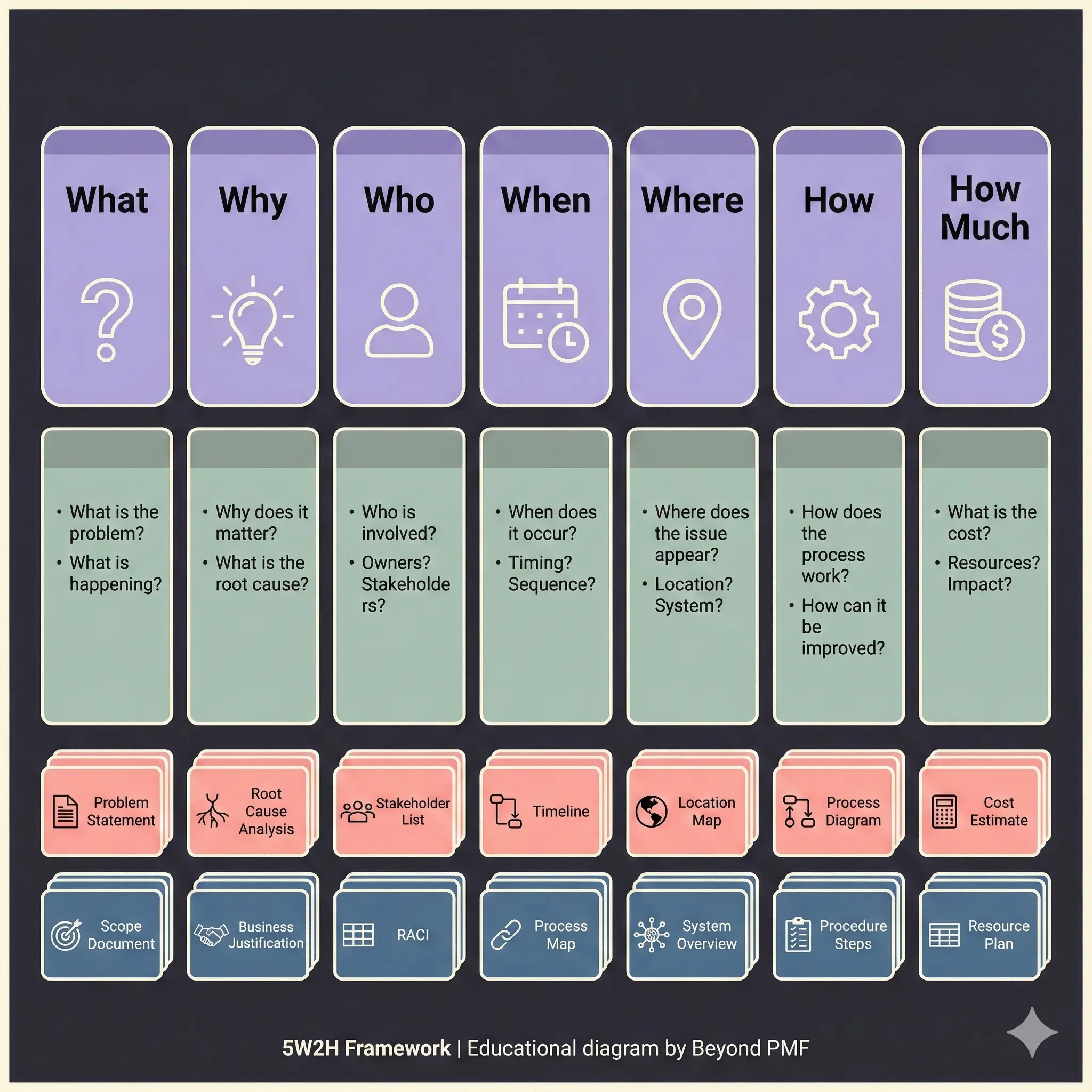
The 5W2H Framework stands for 'What, Why, Who, When, Where, How, and How Much', and is utilized primarily to explore different dimensions of a problem or a process comprehensively. This framework helps in breaking down the problem into manageable parts by questioning every aspect of the situation. It is widely used in project management, process improvement, and troubleshooting to ensure that all aspects of a problem are thoroughly understood before solutions are proposed. The framework's structured approach aids in clear communication, thorough analysis, and effective decision-making.
What: Define what the issue or process is. | Why: Understand and describe why it is important. | Who: Identify who is involved or affected. | When: Determine the time frame related to the issue. | Where: Specify where the issue occurs or is executed. | How: Describe how the process is currently handled or the issue arises. | How Much: Estimate the scale, cost, or quantity involved in the issue or process.
Clearly define each question before gathering information. | Use visual aids like flowcharts to map out responses. | Prioritize questions based on the specific context of the problem.
Provides a comprehensive analysis of a problem or process. | Facilitates clear and structured thinking. | Enhances communication among team members.
Can be time-consuming if not managed properly. | May lead to information overload if not focused. | Requires thorough understanding from all participants to be effective.
In the initial stages of project planning. | During problem-solving sessions to identify root causes.
When quick decisions are required without detailed analysis. | In situations where the problem scope is already well defined and narrow.