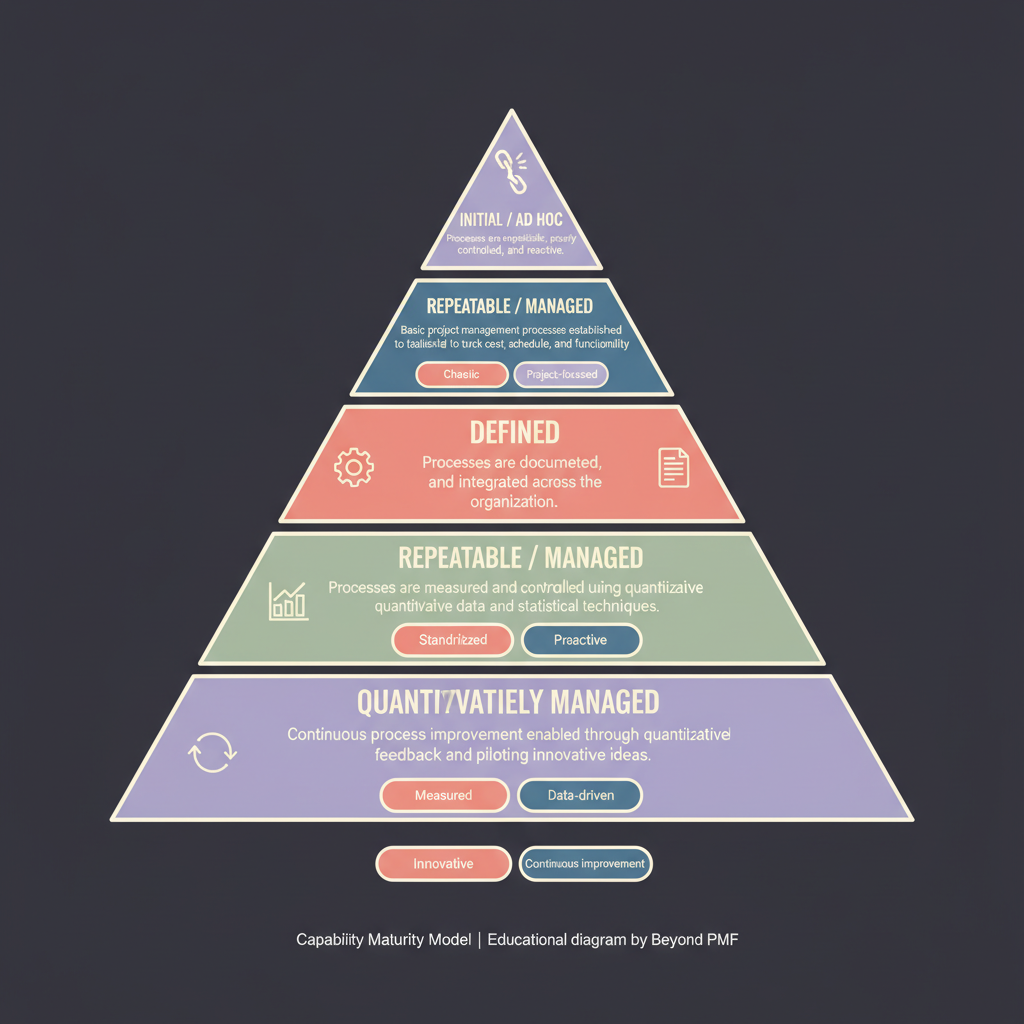
Capability Maturity Model

https://ik.imagekit.io/beyondpmf/frameworks/capability-maturity-model.png
The Capability Maturity Model (CMM) primarily addresses friction related to processes, workflows, and governance within software development. It focuses on standardizing and improving development processes to achieve consistent quality and predictability.

The Capability Maturity Model is a framework used primarily in software development to assess and improve an organization's software development processes. It helps organizations develop efficient and effective processes through a structured level of maturity, ranging from ad hoc practices to optimized processes. The model provides a clear path for continuous improvement and is beneficial in benchmarking performance, ensuring quality, and delivering consistent results.

Steps / Detailed Description

Initial Level: Processes are unpredictable, poorly controlled, and reactive. | Managed Level: Processes are characterized for projects and are often reactive. | Defined Level: Processes are characterized for the organization and are proactive. | Quantitatively Managed Level: Processes are measured and controlled. | Optimizing Level: Focus on process improvement through innovative technologies and processes.

Best Practices

Start with an assessment of current process maturity | Engage all levels of staff in training | Regularly review progress and adjust as necessary

Pros

Provides a structured approach to process improvement | Facilitates benchmarking and standardization across projects | Enhances the ability to manage and reduce risks

Cons

Can be time-consuming and costly to implement | May require significant organizational change | Focuses more on processes than on end products

When to Use

When needing to improve software development processes | When an organization seeks to benchmark its processes against an industry standard

When Not to Use

In very small or less complex projects where the model may be too cumbersome | When immediate results are required, as full benefits may take time to realize

Related Frameworks

Lifecycle

Not tied to a specific lifecycle stage

Scope

Scope not defined

Maturity Level

Maturity level not specified

Time to Implement

2–4 Weeks
3–6 Months
1–2 Weeks
3–6 Months
1–2 Months
3–6 Months
1–2 Weeks
Less Than 1 Day
1–2 Weeks
Longer Than 6 Months
1–2 Weeks
Longer Than 6 Months
1–2 Weeks
3–6 Months
1–2 Weeks
1–2 Weeks
1–2 Weeks
1–2 Weeks
1–2 Days
1–2 Weeks
1–2 Weeks
1–2 Weeks
1–2 Weeks
1–2 Weeks
1–2 Weeks
3–6 Months
1–2 Weeks
1–2 Weeks
1–2 Weeks
3–6 Months
1–2 Weeks
1–2 Weeks
2–4 Weeks
1–2 Weeks
1–2 Days
1–2 Weeks
Longer Than 6 Months
3–6 Months
Longer Than 6 Months
1–2 Weeks
Longer Than 6 Months
3–6 Months
Less Than 1 Day
3–6 Months
1–2 Months
3–6 Months
Longer Than 6 Months
3–6 Months
Less Than 1 Day
1–2 Weeks
3–6 Months
3–6 Months
1–2 Weeks
3–6 Months
1–2 Weeks
1–2 Weeks
1–2 Days
1–2 Weeks
1–2 Months
Longer Than 6 Months
1–2 Weeks
Longer Than 6 Months
1–2 Weeks
3–6 Months
1–2 Weeks
Less Than 1 Day
1–2 Weeks
3–6 Months
1–2 Weeks
3–6 Months
1–2 Weeks
1–2 Weeks
Longer Than 6 Months
Less Than 1 Day
3–6 Months
Longer Than 6 Months
1–2 Months
1–2 Weeks
Longer Than 6 Months
1–2 Weeks
3–6 Months
1–2 Weeks
1–2 Weeks
3–6 Months
Less Than 1 Day
1–2 Weeks
1–2 Weeks
3–6 Months
3–6 Months
Less Than 1 Day
1–2 Weeks
Longer Than 6 Months
1–2 Months
1–2 Weeks
1–2 Weeks
1–2 Weeks
Longer Than 6 Months

Copyright Information

Autor:
Carnegie Mellon University
1980s
Publication:
Software Engineering Institute (SEI)