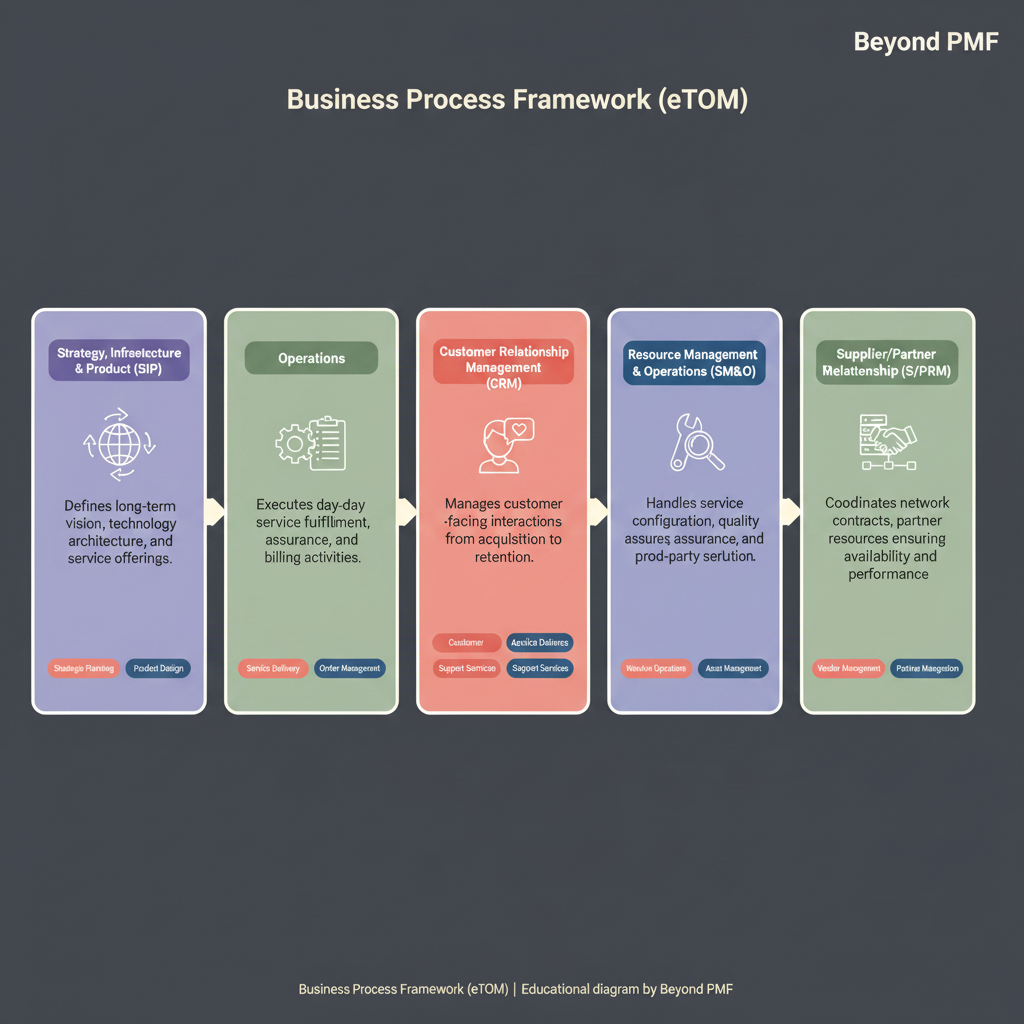
Business Process Framework (eTOM)

https://ik.imagekit.io/beyondpmf/frameworks/business-process-framework-etom.png
The eTOM framework primarily addresses friction related to standardized business processes. It aims to improve workflows, coordination, and governance within telecom service providers and the ICT industry, streamlining how work gets done.

The Business Process Framework, also known as eTOM (Enhanced Telecom Operations Map), is a critical component of the TM Forum's Frameworx suite. This framework provides a structured model for enterprise processes in the telecommunications sector, aiming to streamline operations, reduce costs, and improve service delivery. It categorizes enterprise processes into different levels of detail, which helps organizations align their operations with their business goals. The framework is widely adopted due to its flexibility, industry-specific relevance, and its role in facilitating the integration of emerging technologies.

Steps / Detailed Description

Define and scope the organizational processes. | Map existing processes to the eTOM framework categories. | Identify gaps and areas for improvement. | Implement process changes and integrate with IT systems. | Monitor and optimize processes continuously.

Best Practices

Engage stakeholders from all relevant departments early in the implementation. | Regularly update the process maps to reflect changes in the business environment. | Utilize training and resources offered by TM Forum to fully leverage the framework.

Pros

Provides a standardized process model specific to the telecom industry. | Facilitates better alignment between IT and business operations. | Supports continuous improvement and operational efficiency.

Cons

Can be complex to implement due to its comprehensive nature. | Requires significant training and change management. | May not be as flexible for non-telecom industries.

When to Use

When standardizing processes in a telecom company. | When integrating new technologies and systems within telecom operations.

When Not to Use

For small-scale or less complex organizations where the framework's scale may not be justified. | In industries other than telecommunications, where its specific focus may not align with business needs.

Related Frameworks

Lifecycle

Not tied to a specific lifecycle stage

Scope

Scope not defined

Maturity Level

Maturity level not specified

Time to Implement

2–4 Weeks
3–6 Months
1–2 Weeks
3–6 Months
1–2 Months
3–6 Months
1–2 Weeks
Less Than 1 Day
1–2 Weeks
Longer Than 6 Months
1–2 Weeks
Longer Than 6 Months
1–2 Weeks
3–6 Months
1–2 Weeks
1–2 Weeks
1–2 Weeks
1–2 Weeks
1–2 Days
1–2 Weeks
1–2 Weeks
1–2 Weeks
1–2 Weeks
1–2 Weeks
1–2 Weeks
3–6 Months
1–2 Weeks
1–2 Weeks
1–2 Weeks
3–6 Months
1–2 Weeks
1–2 Weeks
2–4 Weeks
1–2 Weeks
1–2 Days
1–2 Weeks
Longer Than 6 Months
3–6 Months
Longer Than 6 Months
1–2 Weeks
Longer Than 6 Months
3–6 Months
Less Than 1 Day
3–6 Months
1–2 Months
3–6 Months
Longer Than 6 Months
3–6 Months
Less Than 1 Day
1–2 Weeks
3–6 Months
3–6 Months
1–2 Weeks
3–6 Months
1–2 Weeks
1–2 Weeks
1–2 Days
1–2 Weeks
1–2 Months
Longer Than 6 Months
1–2 Weeks
Longer Than 6 Months
1–2 Weeks
3–6 Months
1–2 Weeks
Less Than 1 Day
1–2 Weeks
3–6 Months
1–2 Weeks
3–6 Months
1–2 Weeks
1–2 Weeks
Longer Than 6 Months
Less Than 1 Day
3–6 Months
Longer Than 6 Months
1–2 Months
1–2 Weeks
Longer Than 6 Months
1–2 Weeks
3–6 Months
1–2 Weeks
1–2 Weeks
3–6 Months
Less Than 1 Day
1–2 Weeks
1–2 Weeks
3–6 Months
3–6 Months
Less Than 1 Day
1–2 Weeks
Longer Than 6 Months
1–2 Months
1–2 Weeks
1–2 Weeks
1–2 Weeks
Longer Than 6 Months

Copyright Information

Autor:
TM Forum
2000
Publication:
TM Forum