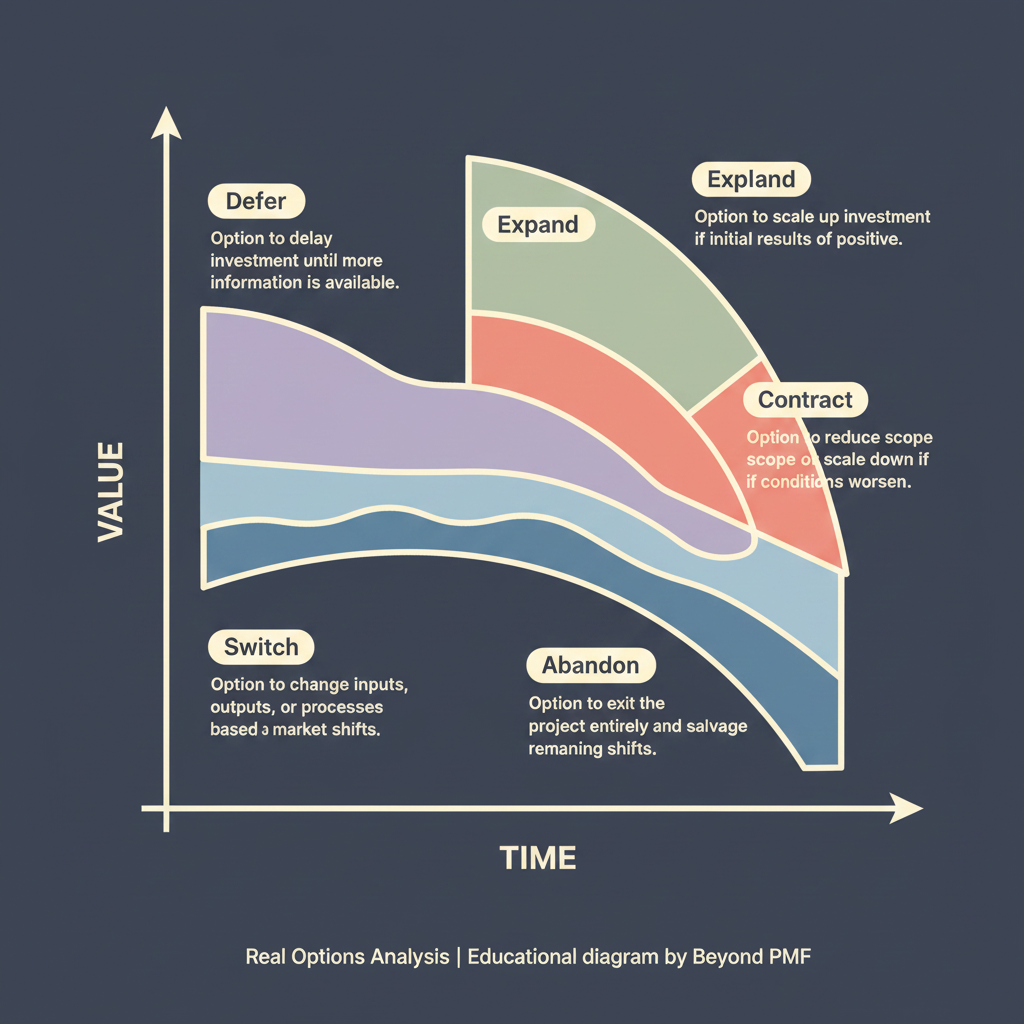
Real Options Analysis

https://ik.imagekit.io/beyondpmf/frameworks/real-options-analysis.png
Real Options Analysis helps assess the value of flexibility in investment decisions, which directly impacts strategic choices regarding resource allocation and future opportunities. It addresses the friction of making optimal strategic choices in the face of uncertainty.

Real Options Analysis (ROA) is a framework that applies financial options theory to the valuation of options in real investments, rather than financial instruments. It is used to evaluate investment opportunities where the future is uncertain, allowing businesses to make decisions that adapt to changes in the economic environment. The approach provides a way to quantify the value of managerial flexibility to alter decisions in response to unexpected market conditions, technological changes, or competitive actions.

Steps / Detailed Description

Identify the real option within the investment. | Model the project's expected cash flows without the option. | Determine the volatility factors affecting the project. | Use a suitable option pricing model to value the option. | Incorporate the option value into the overall project valuation.

Best Practices

Clearly define and understand the real options available. | Use robust volatility estimates and scenario analysis. | Regularly update the analysis to reflect changes in market conditions.

Pros

Provides a structured approach to valuing flexibility in decision-making. | Helps in making informed decisions under uncertainty. | Can lead to higher project value by incorporating strategic options.

Cons

Complex and requires advanced financial modeling skills. | Can be overly dependent on assumptions about volatility and future conditions. | May not be suitable for all types of investments due to its complexity.

When to Use

When evaluating investments with significant uncertainty and flexibility. | When strategic decisions involve multiple stages and contingent decisions.

When Not to Use

For straightforward projects with predictable outcomes. | When the cost of analysis outweighs the benefits.

Related Frameworks

Lifecycle

Not tied to a specific lifecycle stage

Scope

Scope not defined

Maturity Level

Maturity level not specified

Time to Implement

2–4 Weeks
3–6 Months
1–2 Weeks
3–6 Months
1–2 Months
3–6 Months
1–2 Weeks
Less Than 1 Day
1–2 Weeks
Longer Than 6 Months
1–2 Weeks
Longer Than 6 Months
1–2 Weeks
3–6 Months
1–2 Weeks
1–2 Weeks
1–2 Weeks
1–2 Weeks
1–2 Days
1–2 Weeks
1–2 Weeks
1–2 Weeks
1–2 Weeks
1–2 Weeks
1–2 Weeks
3–6 Months
1–2 Weeks
1–2 Weeks
1–2 Weeks
3–6 Months
1–2 Weeks
1–2 Weeks
2–4 Weeks
1–2 Weeks
1–2 Days
1–2 Weeks
Longer Than 6 Months
3–6 Months
Longer Than 6 Months
1–2 Weeks
Longer Than 6 Months
3–6 Months
Less Than 1 Day
3–6 Months
1–2 Months
3–6 Months
Longer Than 6 Months
3–6 Months
Less Than 1 Day
1–2 Weeks
3–6 Months
3–6 Months
1–2 Weeks
3–6 Months
1–2 Weeks
1–2 Weeks
1–2 Days
1–2 Weeks
1–2 Months
Longer Than 6 Months
1–2 Weeks
Longer Than 6 Months
1–2 Weeks
3–6 Months
1–2 Weeks
Less Than 1 Day
1–2 Weeks
3–6 Months
1–2 Weeks
3–6 Months
1–2 Weeks
1–2 Weeks
Longer Than 6 Months
Less Than 1 Day
3–6 Months
Longer Than 6 Months
1–2 Months
1–2 Weeks
Longer Than 6 Months
1–2 Weeks
3–6 Months
1–2 Weeks
1–2 Weeks
3–6 Months
Less Than 1 Day
1–2 Weeks
1–2 Weeks
3–6 Months
3–6 Months
Less Than 1 Day
1–2 Weeks
Longer Than 6 Months
1–2 Months
1–2 Weeks
1–2 Weeks
1–2 Weeks
Longer Than 6 Months

Copyright Information

Autor:
Unknown
N/A
Publication:
Generic Business Tool