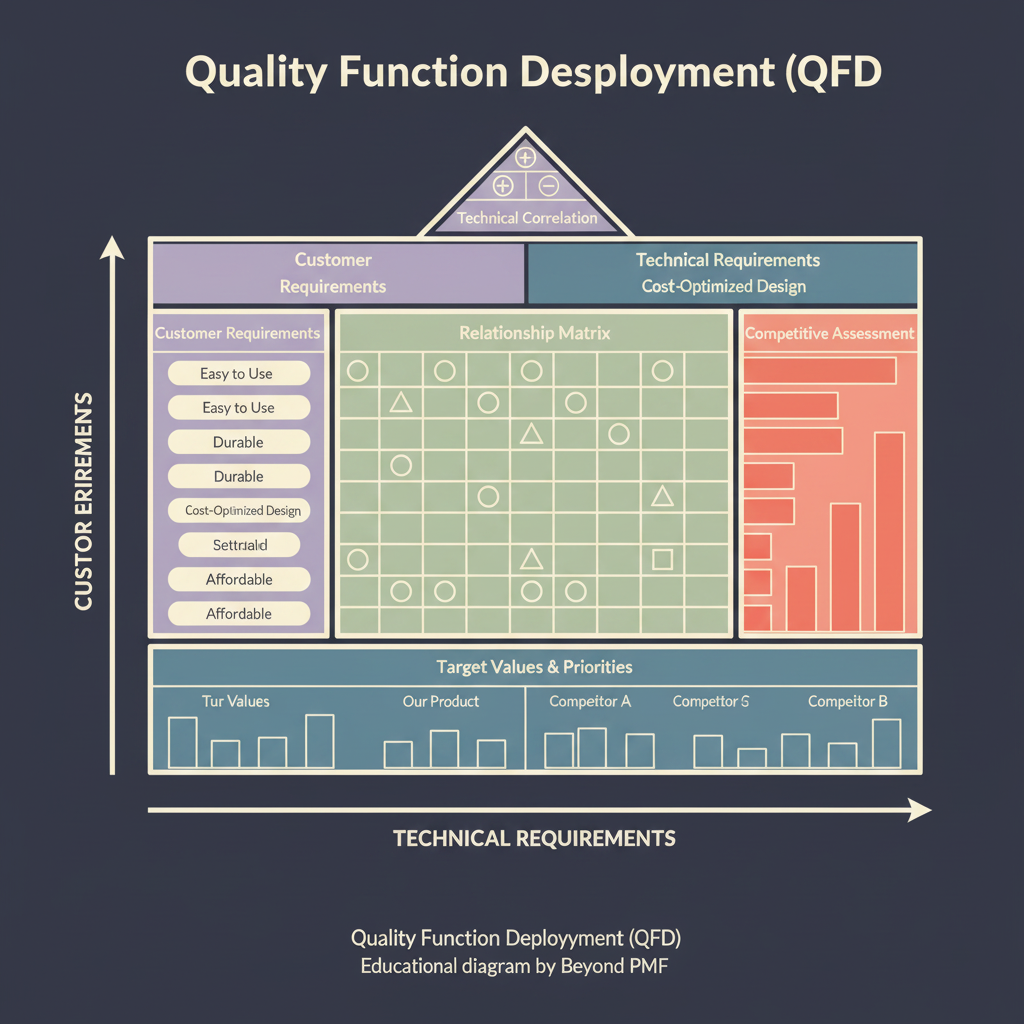
Quality Function Deployment (QFD) is a customer-driven planning process used in product development to translate customer requirements into specific engineering characteristics. It involves cross-functional teams and uses a series of matrices to prioritize and link customer needs to design, development, and manufacturing processes. The primary goal of QFD is to ensure that the final product or service aligns with customer desires, thereby enhancing customer satisfaction and competitive advantage.
Identify customer needs: Collect and prioritize customer requirements using tools like surveys and focus groups. | Develop a House of Quality: Create the first matrix to relate customer needs to how the product will meet those needs. | Product planning: Translate customer needs into part characteristics and prioritize these based on their impact on customer satisfaction. | Process planning: Develop process plans to produce the parts as specified, focusing on critical characteristics. | Quality control: Establish control plans to ensure that processes produce the desired outcomes consistently.
Start with comprehensive customer research to ensure accurate needs identification | Keep the QFD team cross-functional to include diverse perspectives | Regularly update and revise QFD matrices as more information becomes available
Enhances customer satisfaction by focusing on customer needs | Reduces development time and costs by preventing unnecessary revisions | Improves cross-functional communication and collaboration
Can be time-consuming and complex, especially for large projects | Requires thorough training and understanding of the QFD process | May lead to excessive documentation and analysis paralysis
When developing new products that need alignment with customer expectations | When modifying an existing product based on customer feedback
For very small or simple projects where the process may outweigh the benefits | When the project timeline is extremely short and does not allow for detailed planning