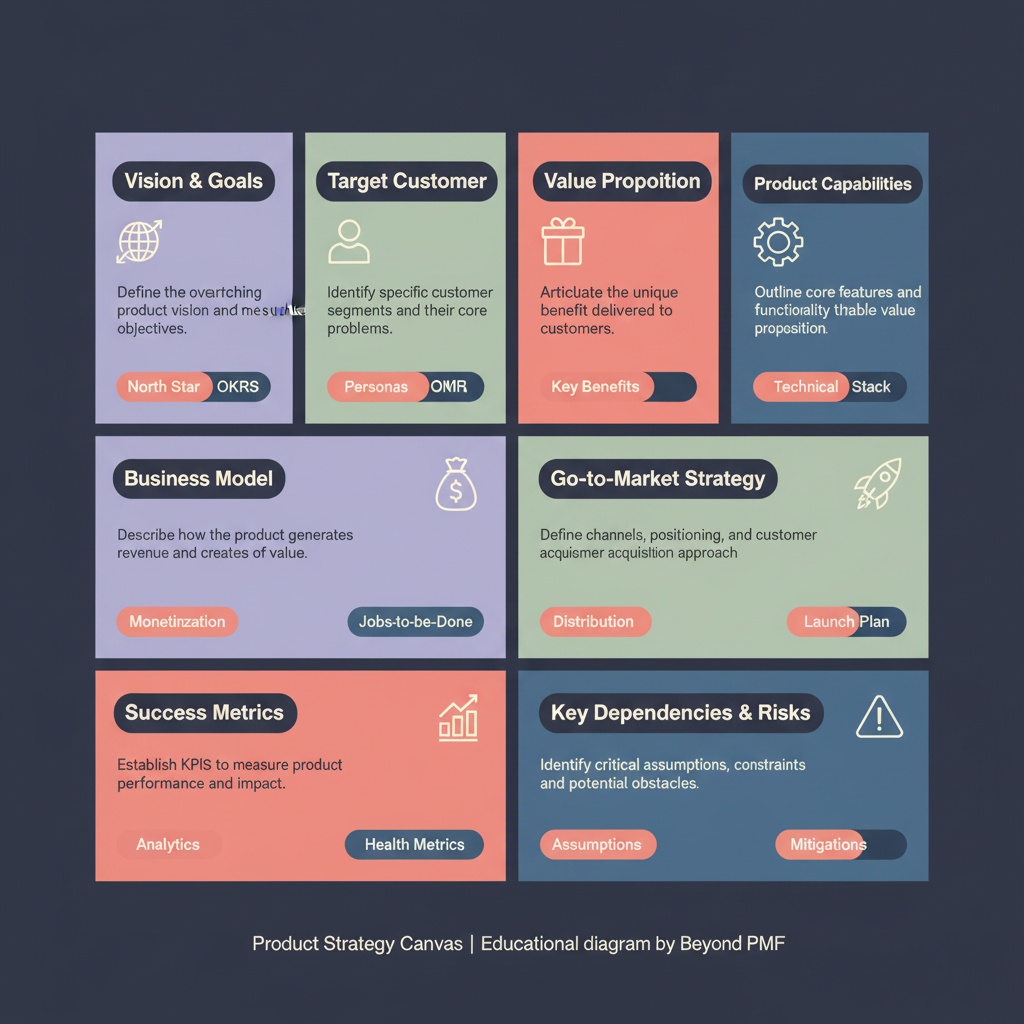
Product Strategy Canvas

The Product Strategy Canvas focuses on aligning teams around a product vision and strategic direction. This addresses the potential friction arising from unclear direction, conflicting priorities, and lack of market alignment, which are key components of strategic friction.

The Product Strategy Canvas is a framework designed to assist product teams in mapping out their product strategy in a structured and visual manner. It helps in defining the product vision, identifying target customer segments, outlining key value propositions, and aligning the product features with business goals. This framework is crucial for ensuring that all stakeholders have a clear understanding of the product's strategic direction and how it aims to meet market needs.

Steps / Detailed Description

Define the product vision and objectives. | Identify and segment target customers. | Outline key problems and needs of the target segments. | Develop value propositions that address these needs. | Map out key product features and capabilities. | Align product features with business goals and metrics. | Visualize the relationships between market needs, features, and business outcomes.

Best Practices

Regularly update the canvas to reflect changes in market conditions. | Involve cross-functional teams to gain diverse insights. | Use customer feedback to validate and refine the strategy.

Pros

Facilitates clear communication and alignment among stakeholders. | Helps in visualizing the alignment between product features and market needs. | Aids in strategic decision-making by focusing on customer-centric solutions.

Cons

Can be overly simplistic for complex products. | May require frequent updates as market conditions change. | Relies heavily on the accuracy of initial market and customer insights.

When to Use

At the beginning of the product development process. | When pivoting or redefining the product strategy.

When Not to Use

For well-established products with a fixed strategy. | When rapid, tactical decisions are needed without comprehensive strategic review.

Related Frameworks

Lifecycle

Scope

Scope not defined

Maturity Level

Maturity level not specified

Time to Implement

2–4 Weeks
3–6 Months
1–2 Weeks
3–6 Months
1–2 Months
3–6 Months
1–2 Weeks
Less Than 1 Day
1–2 Weeks
Longer Than 6 Months
1–2 Weeks
Longer Than 6 Months
1–2 Weeks
3–6 Months
1–2 Weeks
1–2 Weeks
1–2 Weeks
1–2 Weeks
1–2 Days
1–2 Weeks
1–2 Weeks
1–2 Weeks
1–2 Weeks
1–2 Weeks
1–2 Weeks
3–6 Months
1–2 Weeks
1–2 Weeks
1–2 Weeks
3–6 Months
1–2 Weeks
1–2 Weeks
2–4 Weeks
1–2 Weeks
1–2 Days
1–2 Weeks
Longer Than 6 Months
3–6 Months
Longer Than 6 Months
1–2 Weeks
Longer Than 6 Months
3–6 Months
Less Than 1 Day
3–6 Months
1–2 Months
3–6 Months
Longer Than 6 Months
3–6 Months
Less Than 1 Day
1–2 Weeks
3–6 Months
3–6 Months
1–2 Weeks
3–6 Months
1–2 Weeks
1–2 Weeks
1–2 Days
1–2 Weeks
1–2 Months
Longer Than 6 Months
1–2 Weeks
Longer Than 6 Months
1–2 Weeks
3–6 Months
1–2 Weeks
Less Than 1 Day
1–2 Weeks
3–6 Months
1–2 Weeks
3–6 Months
1–2 Weeks
1–2 Weeks
Longer Than 6 Months
Less Than 1 Day
3–6 Months
Longer Than 6 Months
1–2 Months
1–2 Weeks
Longer Than 6 Months
1–2 Weeks
3–6 Months
1–2 Weeks
1–2 Weeks
3–6 Months
Less Than 1 Day
1–2 Weeks
1–2 Weeks
3–6 Months
3–6 Months
Less Than 1 Day
1–2 Weeks
Longer Than 6 Months
1–2 Months
1–2 Weeks
1–2 Weeks
1–2 Weeks
Longer Than 6 Months

Copyright Information

Autor:
Unknown
N/A
Publication:
Unknown