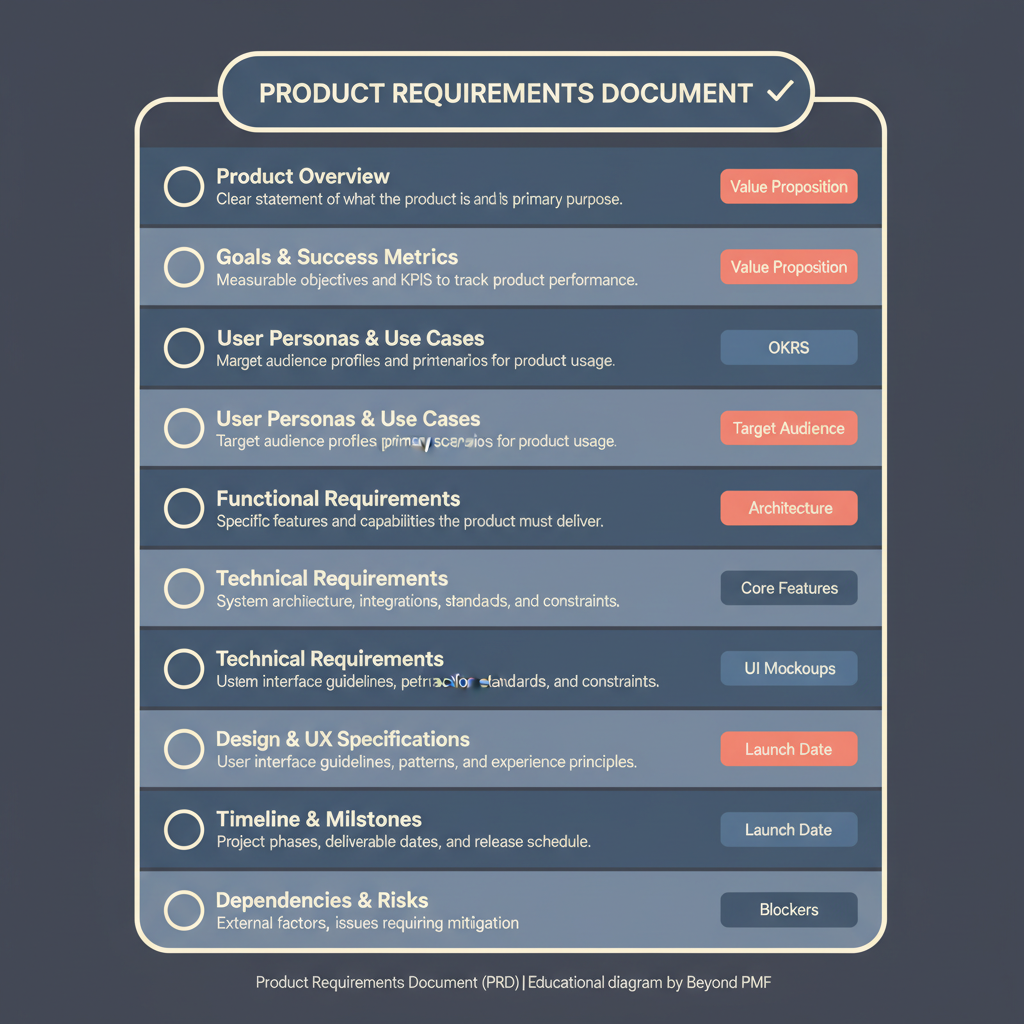
Product Requirements Document (PRD)

https://ik.imagekit.io/beyondpmf/frameworks/product-requirements-document-prd.png
A Product Requirements Document primarily addresses the friction of delivering a product that meets customer and stakeholder expectations. It ensures clarity in implementation and helps mitigate issues related to technical quality and user experience.

A Product Requirements Document (PRD) is a document that clearly defines the requirements and expected functionalities of a product before development begins. It serves as a guide for teams to understand what needs to be built and why. The PRD helps in aligning the team's efforts towards a common goal and ensures that the final product meets the stakeholders' expectations.

Steps / Detailed Description

Define the purpose and scope of the product. | Identify and engage stakeholders. | Gather and prioritize requirements. | Define user flows and user stories. | Set clear objectives and key results (OKRs). | Outline the product's functional and non-functional requirements. | Review and revise the document as needed.

Best Practices

Keep the document clear and concise. | Regularly update the PRD to reflect any changes or new insights. | Ensure all stakeholders review and agree on the PRD before development begins.

Pros

Provides clear direction and reduces ambiguity during development. | Facilitates communication and alignment among stakeholders. | Helps in setting realistic expectations and timelines.

Cons

Can be time-consuming to create and maintain. | May become quickly outdated if not regularly updated. | Rigid documentation can stifle creativity and adaptation.

When to Use

When developing a new product or feature. | When multiple teams or departments are involved in product development.

When Not to Use

For very small or quick iterative projects. | When the product requirements are already well understood and agreed upon by all parties.

Related Frameworks

Categories

Lifecycle

Scope

Scope not defined

Maturity Level

Maturity level not specified

Time to Implement

2–4 Weeks
3–6 Months
1–2 Weeks
3–6 Months
1–2 Months
3–6 Months
1–2 Weeks
Less Than 1 Day
1–2 Weeks
Longer Than 6 Months
1–2 Weeks
Longer Than 6 Months
1–2 Weeks
3–6 Months
1–2 Weeks
1–2 Weeks
1–2 Weeks
1–2 Weeks
1–2 Days
1–2 Weeks
1–2 Weeks
1–2 Weeks
1–2 Weeks
1–2 Weeks
1–2 Weeks
3–6 Months
1–2 Weeks
1–2 Weeks
1–2 Weeks
3–6 Months
1–2 Weeks
1–2 Weeks
2–4 Weeks
1–2 Weeks
1–2 Days
1–2 Weeks
Longer Than 6 Months
3–6 Months
Longer Than 6 Months
1–2 Weeks
Longer Than 6 Months
3–6 Months
Less Than 1 Day
3–6 Months
1–2 Months
3–6 Months
Longer Than 6 Months
3–6 Months
Less Than 1 Day
1–2 Weeks
3–6 Months
3–6 Months
1–2 Weeks
3–6 Months
1–2 Weeks
1–2 Weeks
1–2 Days
1–2 Weeks
1–2 Months
Longer Than 6 Months
1–2 Weeks
Longer Than 6 Months
1–2 Weeks
3–6 Months
1–2 Weeks
Less Than 1 Day
1–2 Weeks
3–6 Months
1–2 Weeks
3–6 Months
1–2 Weeks
1–2 Weeks
Longer Than 6 Months
Less Than 1 Day
3–6 Months
Longer Than 6 Months
1–2 Months
1–2 Weeks
Longer Than 6 Months
1–2 Weeks
3–6 Months
1–2 Weeks
1–2 Weeks
3–6 Months
Less Than 1 Day
1–2 Weeks
1–2 Weeks
3–6 Months
3–6 Months
Less Than 1 Day
1–2 Weeks
Longer Than 6 Months
1–2 Months
1–2 Weeks
1–2 Weeks
1–2 Weeks
Longer Than 6 Months

Copyright Information

Autor:
Unknown
N/A
Publication:
Generic Business Tool